- HPLC purity ≥99%, with a COA for each lot on request
- Certificate of analysis tied to your lot number
- Tracked EU delivery, dispatched the next working day
Dihexa
Peptidomimetic derived from angiotensin IV, studied in HGF/c-Met synapse-formation models
In stock2 formats availableCAS 1401708-83-5
€140Range €140 – €250
This listing is currently unavailable. Contact us and we will tell you when it is back or suggest an equivalent.
Ask about this listing or request its COA- FormLyophilized powder in a sealed glass vial
- Research areasSynaptogenesis, dendritic spine density, hippocampal culture models, cognitive impairment models
For laboratory research use only. Sold exclusively for in-vitro laboratory research by qualified professionals. Not for human or veterinary use, and not a medicine, food, cosmetic or dietary supplement. Terms and Conditions
Overview
Key facts
Dihexa is a compact synthetic peptidomimetic that grew out of angiotensin IV research at Washington State University.
- CAS number
- 1401708-83-5
- Purity
- ≥99% by HPLC; lot-matched COA available
- Form
- Lyophilized powder in a sealed glass vial
- Storage
- −20 °C, protected from light and moisture
- Available sizes
- 10 mg · 20 mg
For research use only. Not for human consumption.
Dihexa is a compact synthetic peptidomimetic that grew out of angiotensin IV research at Washington State University. Its full name, N-hexanoic-Tyr-Ile-(6)-aminohexanoic amide, spells out the design: a two-amino-acid core capped by a hexanoyl chain on one side and an aminohexanoic amide on the other. Those unusual, fat-loving end groups are intentional — they make the molecule resistant to metabolism and much more lipid-soluble than an ordinary short peptide.
Research on it revolves around hepatocyte growth factor and its receptor, c-Met, which leads to assays such as dendritic spine counts and synaptic markers in hippocampal cultures, electrophysiological measures of synaptic strength and rodent models of cognitive decline. Since different sources publish conflicting formula and mass values, the certificate for your lot — not a database record — is what documents the vial's contents. Preparation is the other practical hurdle: the same hexanoyl and aminohexanoic ends that confer stability make the compound poorly soluble in water, so make a concentrated DMSO stock first, check for precipitate at the working dilution and keep solvent levels within what the assay tolerates. Available in 10 mg and 20 mg vials.
What sets this listing apart
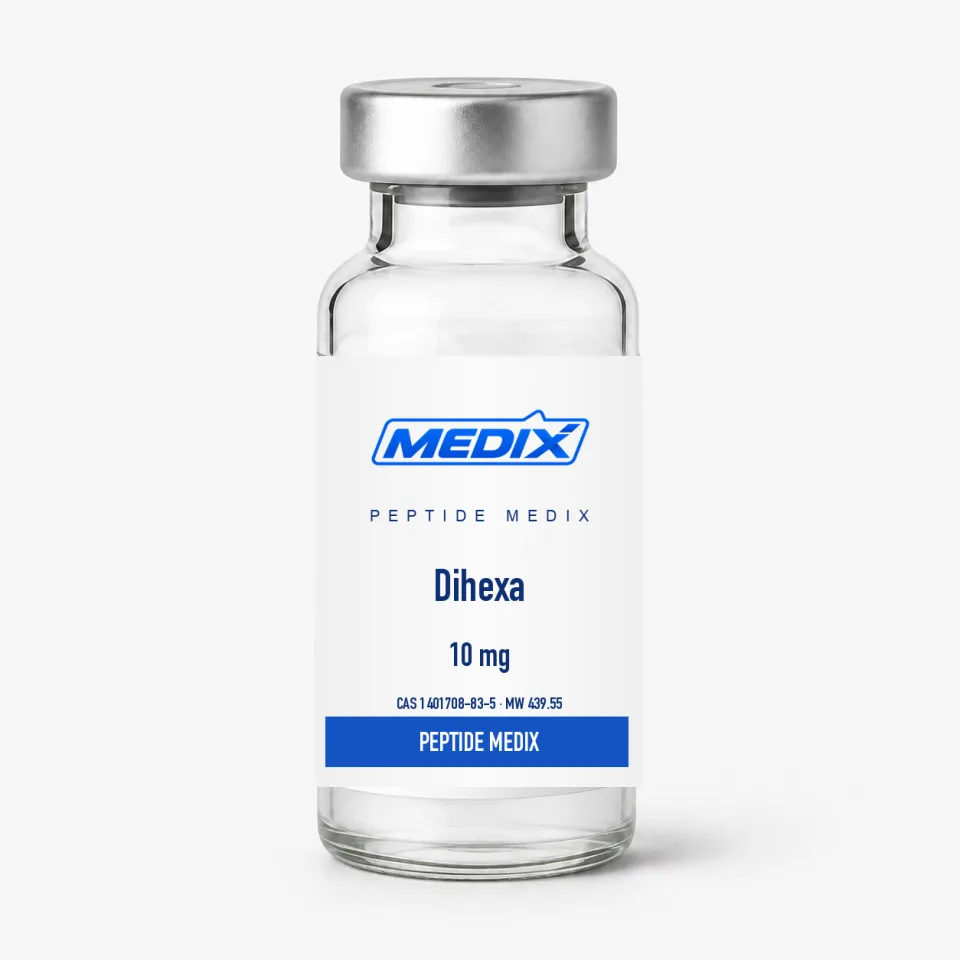
Dihexa – vial, 10/20 mg. Lyophilized powder in a sealed glass vial. Other Dihexa listings differ in format, fill or combination partners; the specification and COA always refer to the listing you order.
Same compound, other listings
Specifications
Identity
- CAS number
- 1401708-83-5
Supply & purity
- Form
- Lyophilized powder in a sealed glass vial
- Purity
- ≥99% by HPLC; lot-matched COA available
- Available sizes
- 10 mg, 20 mg
- Solubility
- Poorly water-soluble; a co-solvent such as DMSO is commonly used before dilution
Handling & storage
- Storage (lyophilized)
- −20 °C, protected from light and moisture
Additional detail
- Chemical name
- N-hexanoic-Tyr-Ile-(6)-aminohexanoic amide
- Compound class
- Angiotensin IV-derived peptidomimetic (dipeptide core with lipophilic termini)
- Primary research target
- HGF / c-Met receptor signaling
- Research areas
- Synaptogenesis, dendritic spine density, hippocampal culture models, cognitive impairment models
- Synthesis
- Solid-phase synthesis with preparative HPLC purification
- Storage (in solution)
- 2–8 °C short term; −20 °C in aliquots for longer storage
Questions about Dihexa
Is Dihexa a true peptide?
Not in the usual sense. It is a peptidomimetic: a two-residue core with a hexanoyl group and an aminohexanoic amide at its ends. Those non-amino-acid parts make it protease-resistant and very lipophilic, so it acts more like a small drug molecule than a typical research peptide.
Why is a co-solvent needed?
The lipophilic end groups that stabilise Dihexa also make it dissolve poorly in water. Most labs first dissolve it in a suitable organic solvent such as DMSO, then dilute into buffer, confirming there is no precipitate at the concentration used in the assay.
What documentation confirms purity?
We analyse each lot by HPLC for purity and by mass spectrometry for identity, and the lot's certificate is available on request. Given that published formula and mass data for Dihexa vary between sources, the COA is the definitive record of what you receive.
Which sizes are available?
10 mg and 20 mg lyophilised vials. Because most labs work from a co-solvent stock, the larger vial makes it easier to run a long series from one lot and one stock preparation.
Related