- HPLC purity ≥99%, with a COA for each lot on request
- Certificate of analysis tied to your lot number
- Tracked EU delivery, dispatched the next working day
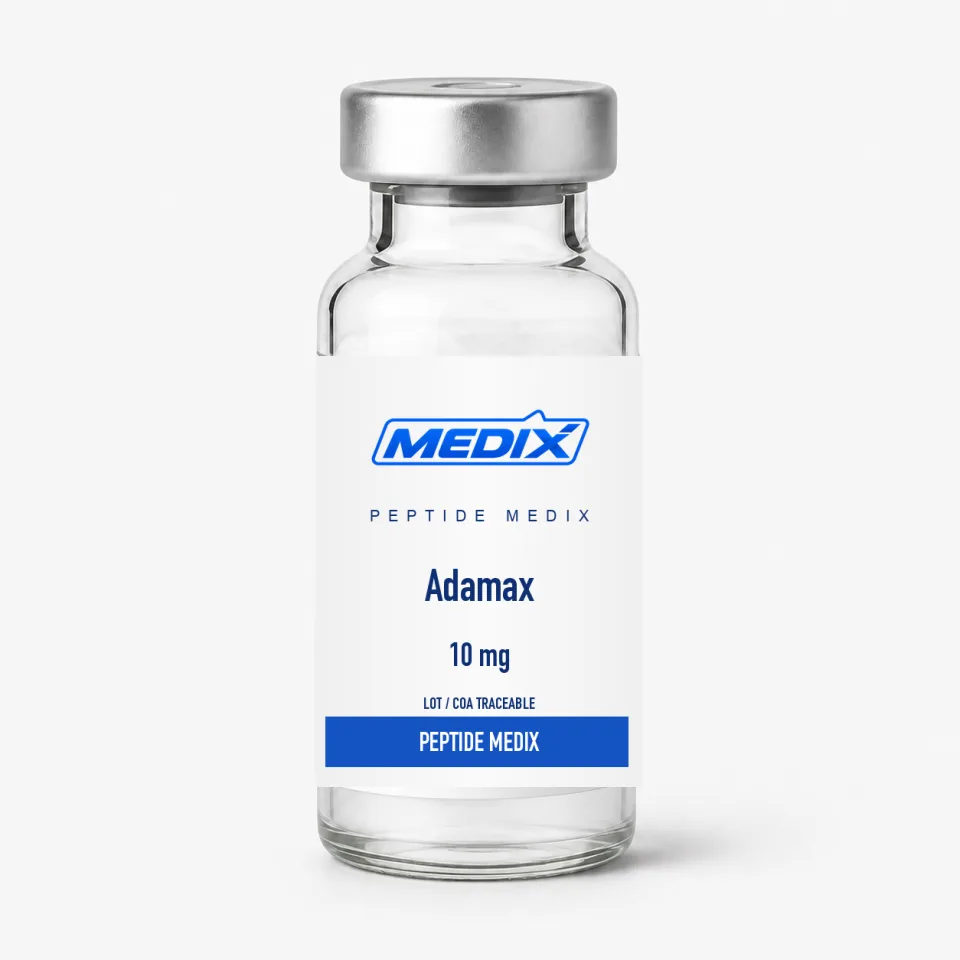
Adamax
Semax-family analogue with an adamantane group, for neurotrophic signalling studies
In stock1 format available
€93
This listing is currently unavailable. Contact us and we will tell you when it is back or suggest an equivalent.
Ask about this listing or request its COA- FormLyophilized powder in a sealed glass vial
- Research areasNeurotrophic signaling assays, BDNF/TrkB-associated markers, comparative analog panels
For laboratory research use only. Sold exclusively for in-vitro laboratory research by qualified professionals. Not for human or veterinary use, and not a medicine, food, cosmetic or dietary supplement. Terms and Conditions
Overview
Key facts
Adamax is a synthetic research compound that supplier documentation places in the Semax family as a structural analogue bearing an adamantane modification.
- Purity
- ≥99% by HPLC; lot-matched COA available
- Form
- Lyophilized powder in a sealed glass vial
- Storage
- −20 °C, protected from light and moisture
- Available size
- 10 mg
For research use only. Not for human consumption.
Adamax is a synthetic research compound that supplier documentation places in the Semax family as a structural analogue bearing an adamantane modification. Adamantane — a stiff, very lipophilic cage hydrocarbon — is used throughout medicinal chemistry to boost metabolic stability and membrane partitioning, and grafting it onto a short neuropeptide backbone mirrors the approach taken with P-21, another adamantylated compound in our cognitive range.
Next to the peptides it is catalogued with, Adamax has very little literature of its own. Much of what is said about it is inferred from the Semax/ACTH(4-10) family and from the general effects of adamantane conjugation on small molecules. Labs that use it therefore tend to run comparative characterisation work — verifying identity analytically, measuring solubility and stability, and testing it alongside better-described analogues in the same assay panel — instead of taking any profile for granted.
Specifications
Supply & purity
- Form
- Lyophilized powder in a sealed glass vial
- Purity
- ≥99% by HPLC; lot-matched COA available
- Solubility
- Reduced aqueous solubility expected from the adamantane group; a co-solvent step is commonly used
Handling & storage
- Storage (lyophilized)
- −20 °C, protected from light and moisture
Additional detail
- Available size
- 10 mg
- Compound class
- Adamantane-modified synthetic peptide analog
- Family
- Described within the Semax / ACTH(4-10) analog research family
- Research areas
- Neurotrophic signaling assays, BDNF/TrkB-associated markers, comparative analog panels
- Synthesis
- Solid-phase peptide synthesis with preparative HPLC purification
- Storage (in solution)
- 2–8 °C short term; aliquot and freeze for longer storage
- Shipping
- Ships from our EU warehouse; stable at ambient temperature in transit
Questions about Adamax
What is Adamax?
A synthetic research compound presented as an adamantane-bearing analogue of the Semax peptide family. Because independent structural data are scarce, the lot's certificate of analysis — with HPLC purity and mass-spectrometry identity — is the most dependable account of what your vial contains.
What is the purpose of the adamantane group?
Adamantane is a rigid and strongly lipophilic cage hydrocarbon that medicinal chemists attach to slow metabolic clearance and increase partitioning into lipids. In peptide analogues it plays a role similar to acetylation or amidation: it helps a short, easily degraded sequence last longer.
Does it come with a certificate of analysis?
Yes. Every lot is checked by reversed-phase HPLC for purity and by mass spectrometry for identity, and the COA for your lot can be requested. With so little published characterisation, review that document before starting any assay.
What is the best way to dissolve Adamax?
The adamantane moiety lowers water solubility compared with typical research peptides. Most labs first prepare a concentrated stock in a suitable organic co-solvent, dilute it into buffer just before use, and inspect for precipitation at the final working concentration.
Related