- Each component ≥99% by HPLC, documented per lot
- Certificate of analysis tied to your lot number
- Tracked EU delivery, dispatched the next working day
GHK-Cu + Epitalon
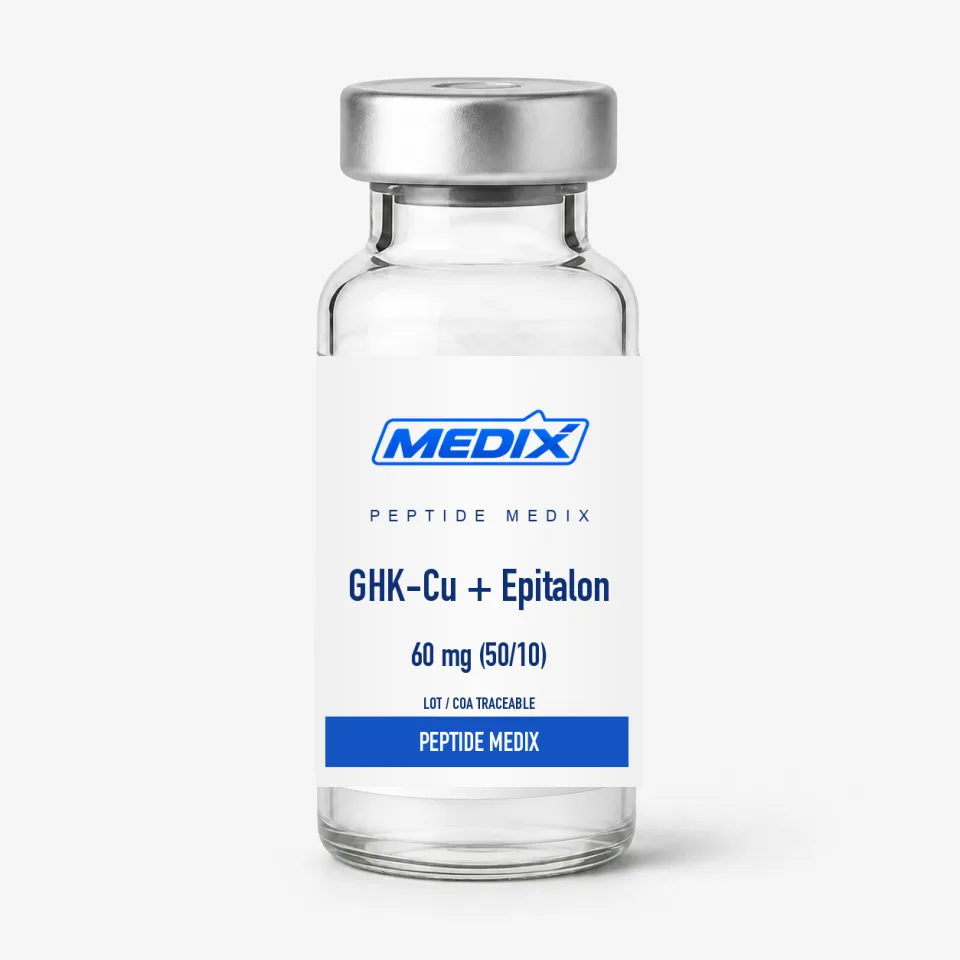
Blend vial with 50 mg GHK-Cu and 10 mg epitalon
In stock1 format available
€119
This listing is currently unavailable. Contact us and we will tell you when it is back or suggest an equivalent.
Ask about this listing or request its COA- FormCo-lyophilized powder, sealed glass vial
- Research areasExtracellular matrix remodeling, skin and hair-follicle models, telomerase and senescence research
For laboratory research use only. Sold exclusively for in-vitro laboratory research by qualified professionals. Not for human or veterinary use, and not a medicine, food, cosmetic or dietary supplement. Terms and Conditions
Overview
Key facts
Two well-studied research peptides share this lyophilised vial: 50 mg of the copper-binding tripeptide GHK-Cu and 10 mg of the bioregulator tetrapeptide epitalon (Ala-Glu-Asp-Gly).
- Purity
- ≥99% per component by HPLC; lot-matched COA
- Form
- Co-lyophilized powder, sealed glass vial
- Storage
- −20 °C, protected from light and moisture
- Available size
- 60 mg · (50/10)
For research use only. Not for human consumption.
Two well-studied research peptides share this lyophilised vial: 50 mg of the copper-binding tripeptide GHK-Cu and 10 mg of the bioregulator tetrapeptide epitalon (Ala-Glu-Asp-Gly). Labs that run skin-remodelling and cellular-ageing experiments in parallel often choose a co-formulated vial, since it saves one reconstitution and keeps the ratio between the compounds constant throughout a study.
GHK-Cu is glycyl-L-histidyl-L-lysine complexed with copper(II), a tripeptide first isolated from human plasma in the 1970s. It is investigated for reported effects on collagen and glycosaminoglycan gene expression, closure in wound models and regulation of antioxidant enzymes, and it delivers copper in a form fibroblast cultures can absorb. Epitalon is a synthetic analogue of the pineal extract epithalamin, studied in telomerase, chromatin and circadian research.
Researchers combine them because they address different layers of one broad question — remodelling of the extracellular matrix on one hand, nuclear and telomere-related processes on the other. The content of both components is verified and documented on the lot's Certificate of Analysis.
What sets this listing apart
GHK-Cu + Epitalon combines GHK-Cu (Copper Peptide) and Epitalon (Epithalon) in one listing (60 mg). Components that are also sold on their own are linked below, each with its own specification and COA.
Same compound, other listings
Specifications
Supply & purity
- Form
- Co-lyophilized powder, sealed glass vial
- Purity
- ≥99% per component by HPLC; lot-matched COA
Handling & storage
- Storage (lyophilized)
- −20 °C, protected from light and moisture
Additional detail
- Vial content
- 60 mg total — GHK-Cu 50 mg + epitalon 10 mg
- Component ratio
- 5:1 by mass (GHK-Cu : epitalon)
- GHK-Cu CAS number
- 89030-95-5
- GHK-Cu molecular formula
- C14H24N6O4·Cu
- GHK-Cu molecular weight
- 403.93 g/mol
- GHK-Cu sequence
- Gly-His-Lys, copper(II) complex
- Epitalon CAS number
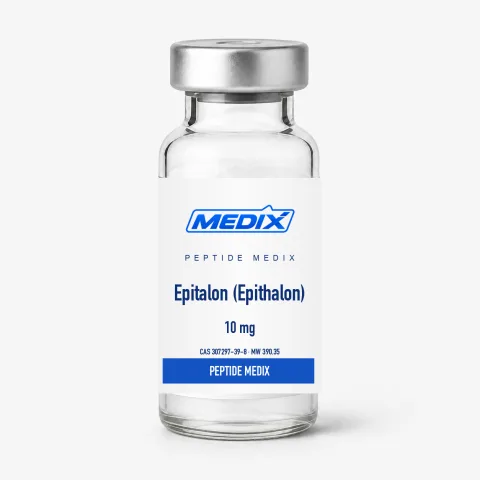
- 307297-39-8
- Epitalon molecular formula
- C14H22N4O9
- Epitalon sequence
- H-Ala-Glu-Asp-Gly-OH (390.35 g/mol)
- Research areas
- Extracellular matrix remodeling, skin and hair-follicle models, telomerase and senescence research
Questions about GHK-Cu + Epitalon
What does the blend contain?
Each vial holds 60 mg of co-lyophilised peptide: 50 mg GHK-Cu (the copper-binding tripeptide) and 10 mg epitalon (the Ala-Glu-Asp-Gly tetrapeptide). The lot Certificate of Analysis verifies each one separately.
Why is the powder blue?
Copper(II) bound by the GHK tripeptide produces the colour. Any GHK-Cu preparation should give a blue to blue-violet cake; if the colour disappears, the copper complex may have been reduced or degraded.
Can I vary the two components separately?
Not with this vial. Once co-lyophilised, the 5:1 mass ratio is fixed, so diluting changes both concentrations in step. If you need to adjust one compound on its own, use individual GHK-Cu and epitalon vials.
Is the blend tested by an independent lab?
Yes. HPLC confirms the purity of each component and mass spectrometry its identity; the lot's Certificate of Analysis, showing the content of both peptides, can be viewed before purchase.
What must not be combined with this blend?
Keep strong reducing agents and thiol reagents — dithiothreitol or glutathione, for instance — away from it, as they can reduce copper(II) and destabilise the complex. Strongly alkaline buffers should also be avoided, since they can cause copper species to precipitate.
Related