- HPLC-assayed purity of ≥99%
- Certificate of analysis tied to your lot number
- Tracked EU delivery, dispatched the next working day
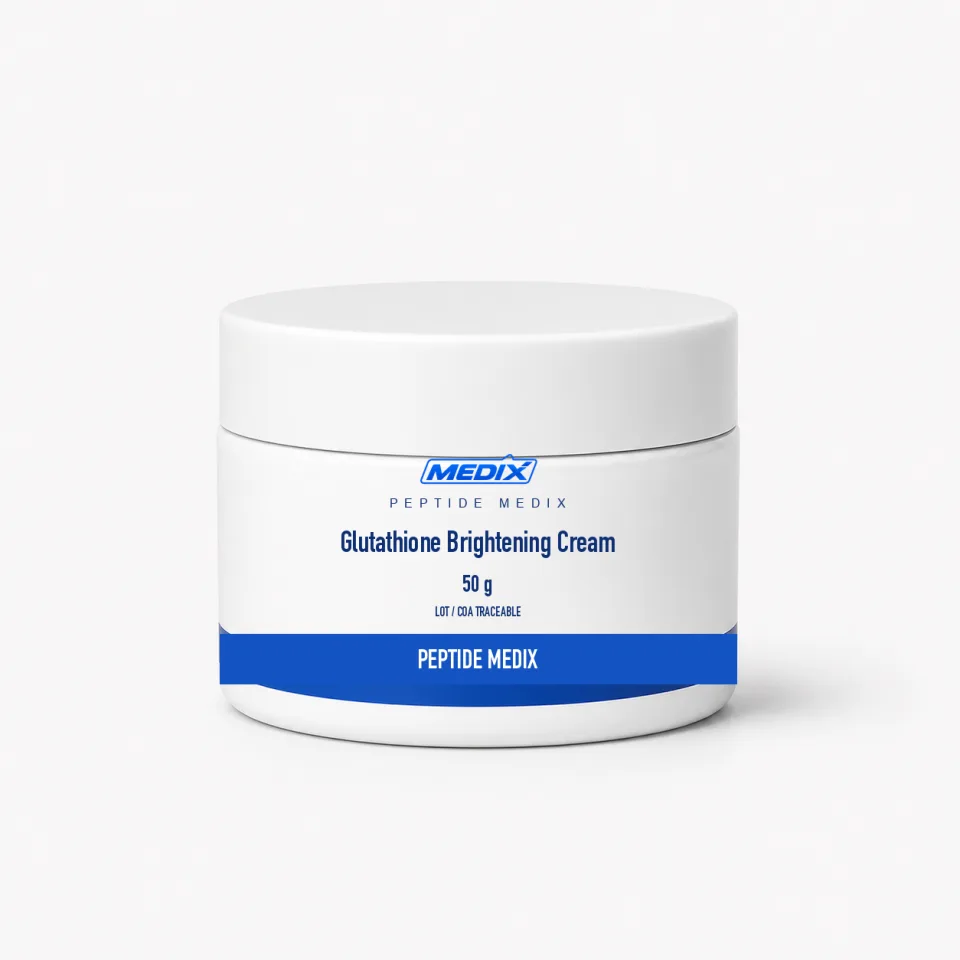
Glutathione Brightening Cream
50 g emollient cream containing reduced L-glutathione, for topical research
In stock1 format available
€46
This listing is currently unavailable. Contact us and we will tell you when it is back or suggest an equivalent.
Ask about this listing or request its COA- FormOpaque emollient cream in a screw-top jar
- Research areasTopical antioxidant delivery, melanogenesis and tyrosinase models, vehicle and occlusion effects, thiol stability in formulation
For laboratory research use only. Sold exclusively for in-vitro laboratory research by qualified professionals. Not for human or veterinary use, and not a medicine, food, cosmetic or dietary supplement. Terms and Conditions
Overview
Key facts
Reduced L-glutathione — gamma-L-glutamyl-L-cysteinyl-glycine, the tripeptide with the unusual gamma link (CAS 70-18-8) — is dispersed here in an emollient cream and packed in a 50 g jar.
- CAS number
- 70-18-8
- Molecular formula
- C10H17N3O6S
- Molecular weight
- 307.32 g/mol
- Form
- Opaque emollient cream in a screw-top jar
- Storage
- Cool and dark, ideally 2–8 °C; keep the jar tightly closed
- Available size
- 50 g
For research use only. Not for human consumption.
Reduced L-glutathione — gamma-L-glutamyl-L-cysteinyl-glycine, the tripeptide with the unusual gamma link (CAS 70-18-8) — is dispersed here in an emollient cream and packed in a 50 g jar. The glutathione is the same ≥99% HPLC-pure input we use for our lyophilised vials; only the vehicle is different, and in topical research the vehicle is seldom a trivial detail.
Inside cells, glutathione is the principal thiol antioxidant, and nearly every property studied depends on the free sulfhydryl of its cysteine. Pigmentation research reports that it may disrupt melanin formation in several proposed ways: by acting on tyrosinase directly, by trapping reactive intermediates of the melanin pathway, and by tilting production from eumelanin towards pheomelanin. This mix of mechanisms is why both topical and systemic glutathione products keep appearing in the depigmentation literature.
What sets this listing apart
Glutathione Brightening Cream – cream/serum, 50 g. Opaque emollient cream in a screw-top jar. Other L-Glutathione listings differ in format, fill or combination partners; the specification and COA always refer to the listing you order.
Same compound, other listings
Specifications
Identity
- Peptide class
- Non-ribosomal gamma-linked tripeptide
Supply & purity
- Form
- Opaque emollient cream in a screw-top jar
- Available sizes
- 50 g
Additional detail
- Active
- Reduced L-glutathione (GSH), gamma-L-glutamyl-L-cysteinyl-glycine
- Peptide purity input
- ≥99% by HPLC; lot-matched COA available
- Active loading
- Stated on the jar label for your lot
- CAS number (active)
- 70-18-8
- Molecular formula (active)
- C10H17N3O6S
- Molecular weight (active)
- 307.32 g/mol
- Reactive group
- Free cysteinyl thiol (−SH), oxidises to the GSSG disulfide dimer
- Vehicle
- Oil-in-water emollient cream base, no added fragrance
- Research areas
- Topical antioxidant delivery, melanogenesis and tyrosinase models, vehicle and occlusion effects, thiol stability in formulation
- Compatibility note
- Avoid contact with oxidising agents and metal ions such as copper or iron, which accelerate thiol oxidation
- Storage
- Cool and dark, ideally 2–8 °C; keep the jar tightly closed
Questions about Glutathione Brightening Cream
Is this the same glutathione as in your vials?
Yes — identical reduced L-glutathione (same CAS number, formula and molecular mass) from ≥99% HPLC-pure raw material. Only the format differs: here it sits in an emollient cream instead of arriving as lyophilised powder for you to dissolve.
Why test a cream rather than a simple solution?
Often the vehicle is exactly what is being studied. A cream leaves an occlusive film that alters stratum corneum hydration, contact time and the partitioning of a hydrophilic molecule. Studies of permeation, occlusion or vehicle effects need a formulated test article, not a solution in a beaker.
Does glutathione stay stable in a cream?
Exposed to air, its free thiol oxidises into the GSSG disulfide dimer, and metals like copper and iron speed this up considerably. Cold, dark storage with the lid tight slows the process, yet studies should measure the reduced fraction when the cream is used instead of relying on the labelled content.
Which documents are provided?
The certificate of analysis for the glutathione lot used — HPLC purity ≥99% and identity confirmation. The jar label states how much active the finished cream contains. Please quote the lot number when you ask for the COA.
Can it be used together with GHK-Cu products?
Only if the experiment is designed for it. GHK-Cu is a copper complex and glutathione a potent thiol reductant, so their chemistries interact: copper speeds thiol oxidation, and thiols can disrupt copper binding. Unless that interaction is what you are studying, test them separately.
Related