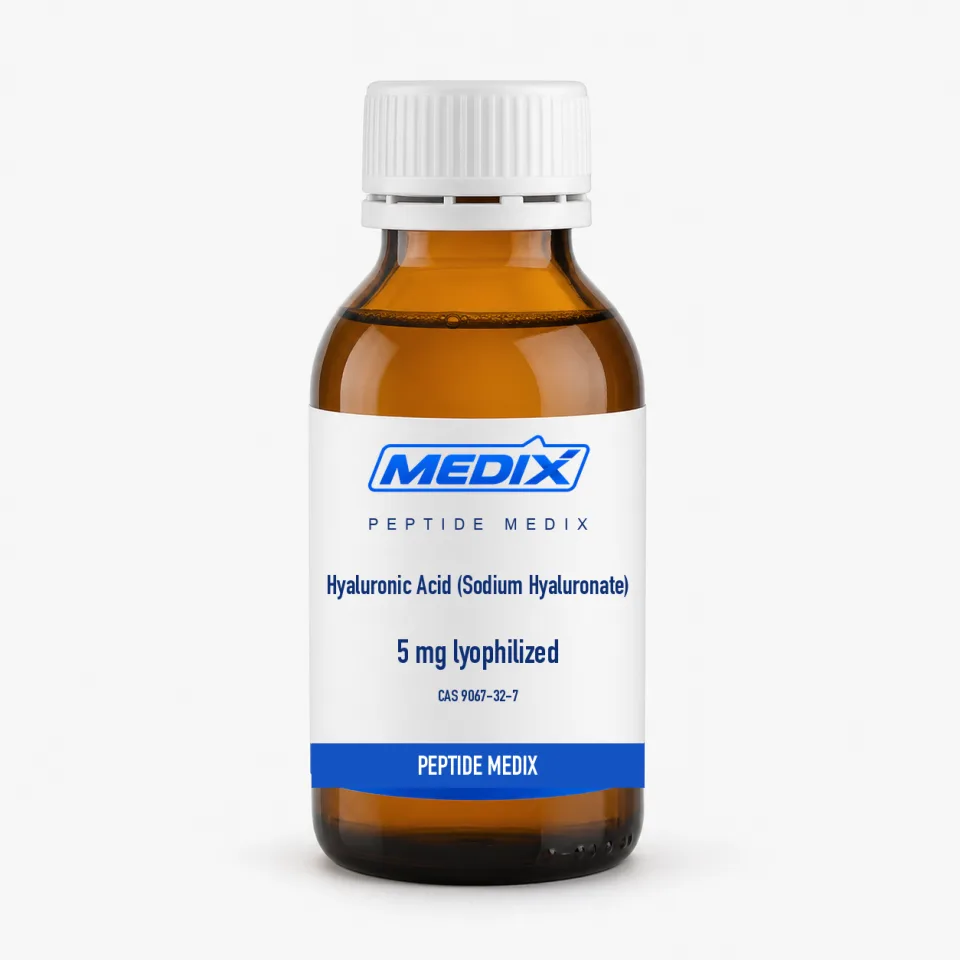
- HPLC-assayed purity of ≥99%
- Certificate of analysis tied to your lot number
- Tracked EU delivery, dispatched the next working day
Hyaluronic Acid (Sodium Hyaluronate)
Sodium hyaluronate (glycosaminoglycan) for skin, matrix and rheology research
In stock2 formats availableCAS 9067-32-7 (sodium hyaluronate)
€46Range €46 – €68
This listing is currently unavailable. Contact us and we will tell you when it is back or suggest an equivalent.
Ask about this listing or request its COA- FormLyophilized sodium hyaluronate powder, or pre-mixed 1% aqueous solution
- Mol. weightPolydisperse — a chain-length distribution rather than a single mass; see the lot COA
- Research areasSkin hydration and dermal matrix models, hydrogel scaffolds, synovial viscosity, wound-model studies
For laboratory research use only. Sold exclusively for in-vitro laboratory research by qualified professionals. Not for human or veterinary use, and not a medicine, food, cosmetic or dietary supplement. Terms and Conditions
Overview
Key facts
Despite its place in our cosmetic range, hyaluronic acid is not a peptide.
- CAS number
- 9067-32-7 (sodium hyaluronate)
- Molecular weight
- Polydisperse — a chain-length distribution rather than a single mass; see the lot COA
- Form
- Lyophilized sodium hyaluronate powder, or pre-mixed 1% aqueous solution
- Available sizes
- 5 mg lyophilized · 2 mL · 1 solution
For research use only. Not for human consumption.
Despite its place in our cosmetic range, hyaluronic acid is not a peptide. It is an unbranched glycosaminoglycan whose repeating unit is a disaccharide of D-glucuronic acid and N-acetyl-D-glucosamine, linked alternately by beta-1,3 and beta-1,4 bonds. This plain, non-sulfated chain is chemically identical wherever it is made — dermis, synovial fluid, the vitreous of the eye; the source changes only the chain length, and it is chain length that governs most of its physical and biological behaviour. Lab-grade material is usually the sodium salt, sodium hyaluronate, which dries, weighs and redissolves much more easily than the free acid.
With a carboxylate on every disaccharide, the polymer holds an enormous amount of water for its mass and gives viscoelastic solutions even at low concentration. Researchers exploit this directly — as a thickener, a hydrogel ingredient or a matrix mimic — and also study hyaluronan as a signalling molecule, because fragments of different sizes engage the CD44, RHAMM and LYVE-1 receptors and hyaluronidases in different ways.
Specifications
Identity
- CAS number
- 9067-32-7 (sodium hyaluronate)
- Molecular weight
- Polydisperse — a chain-length distribution rather than a single mass; see the lot COA
Supply & purity
- Form
- Lyophilized sodium hyaluronate powder, or pre-mixed 1% aqueous solution
- Available sizes
- 5 mg lyophilized; 2 mL of 1% solution
- Solubility
- Water and aqueous buffers; dissolves slowly, hydrate without vigorous shear
Additional detail
- Chemical class
- Non-sulfated linear glycosaminoglycan (polysaccharide)
- Repeating unit
- D-glucuronic acid + N-acetyl-D-glucosamine, beta-1,3 and beta-1,4 linked
- Solution behaviour
- Highly hydrophilic; forms viscoelastic, shear-thinning solutions at low concentration
- Known receptors
- CD44, RHAMM (HMMR), LYVE-1
- Degrading enzymes
- Hyaluronidases (HYAL1, HYAL2, PH-20) and reactive oxygen species
- Research areas
- Skin hydration and dermal matrix models, hydrogel scaffolds, synovial viscosity, wound-model studies
- Storage (powder)
- 2–8 °C or cooler, sealed and protected from moisture
- Storage (solution)
- 2–8 °C, protected from light; do not freeze-thaw repeatedly
Questions about Hyaluronic Acid (Sodium Hyaluronate)
Is it hyaluronic acid or sodium hyaluronate?
We supply sodium hyaluronate — the sodium salt of hyaluronic acid. It is the usual laboratory form because it dries into a stable powder and dissolves more readily than the free acid. At physiological pH the two are chemically the same once in solution.
What is its molecular weight?
Hyaluronan is polydisperse, so it is characterised by a distribution of chain lengths rather than a single value. The certificate of analysis for your lot is the authoritative record; cite that range in publications, since reported effects frequently depend on chain size.
Can I obtain a certificate of analysis?
Yes. Each lot is tested and comes with a COA covering identity and purity. Ask for it when ordering or later by lot number, and store it with your lab records so the grade used can be reported with your results.
Which format suits my lab?
Choose the 5 mg lyophilised powder if you want to set buffer, ionic strength and final concentration yourself. Choose the 2 mL 1% solution for formulation, viscosity or topical-model work, where a consistent ready-made stock takes one preparation variable out of the picture.
How can I dissolve it without clumps?
Sprinkle the powder over the surface of the water phase and let it hydrate before stirring, instead of tipping it into a liquid that is already being mixed. Gentle agitation over a longer time yields a clear solution; high shear or sonication is quicker but breaks the polymer chains.
Related