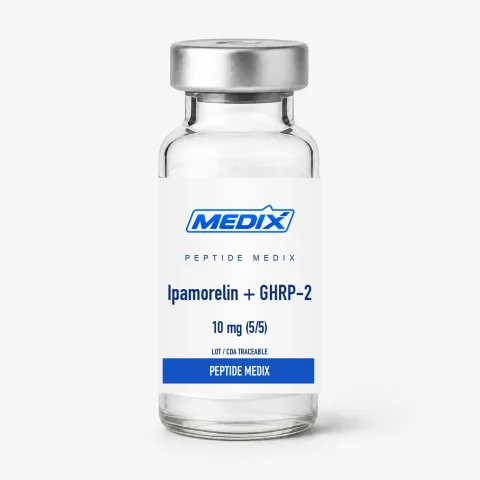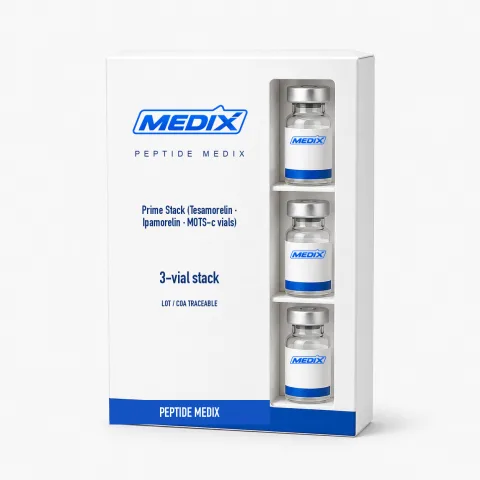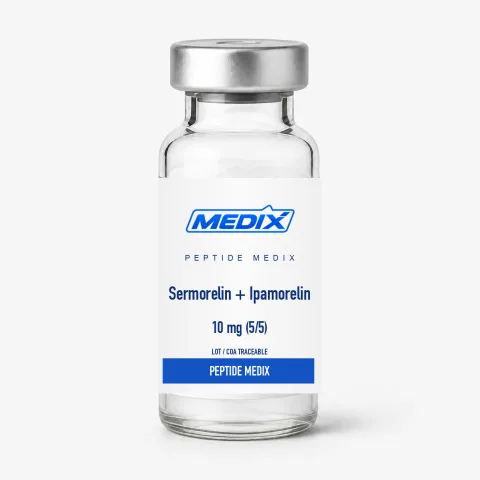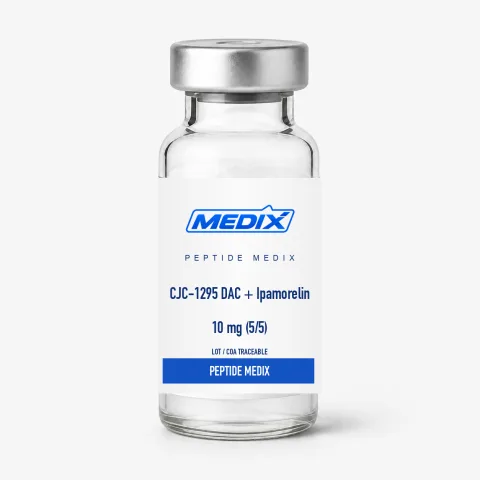
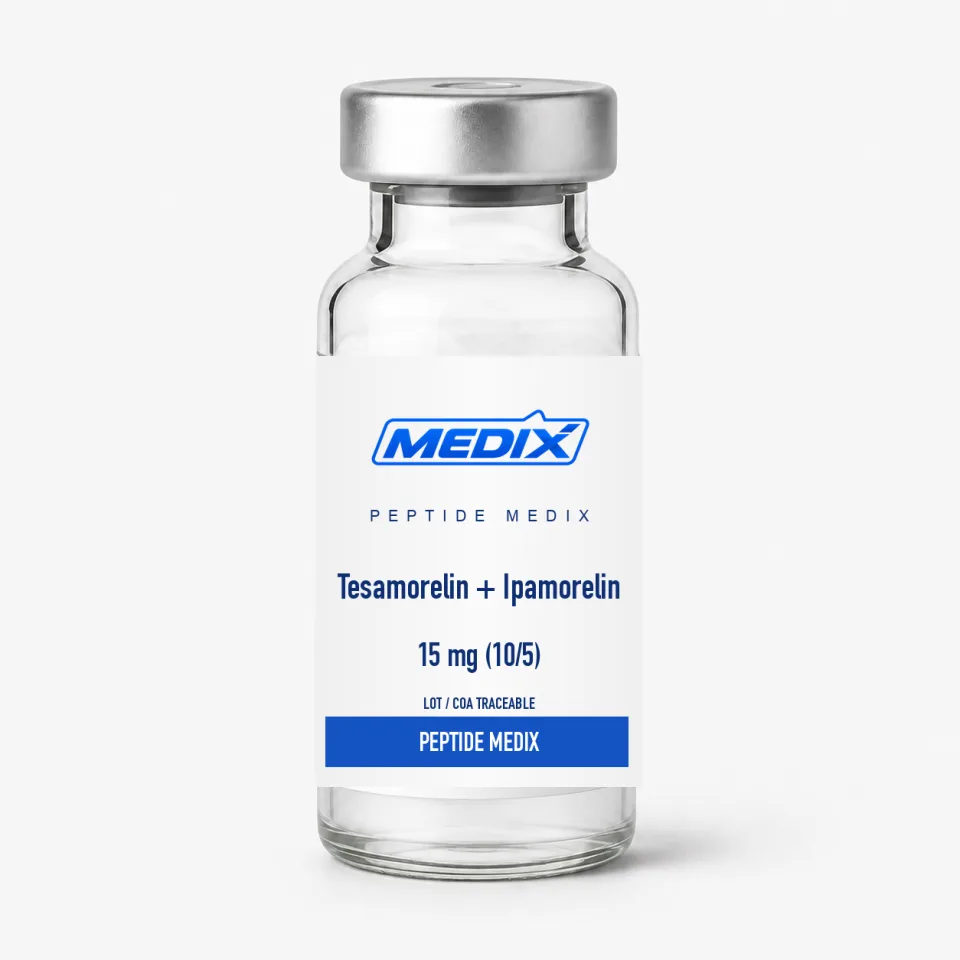
- Each component assayed to ≥99% (HPLC); per-lot COA on request
- Certificate of analysis tied to your lot number
- Tracked EU delivery, dispatched the next working day
Tesamorelin + Ipamorelin
Stabilised 44-residue GHRH analogue combined with a selective GHS-receptor agonist
In stock2 formats availableCAS Tesamorelin: 218949-48-5 · Ipamorelin: 170851-70-4
€140Range €140 – €250
This listing is currently unavailable. Contact us and we will tell you when it is back or suggest an equivalent.
Ask about this listing or request its COA- FormCo-lyophilized powder, sealed glass vial
- Mol. weightTesamorelin: 5135.86 g/mol · Ipamorelin: 711.85 g/mol
- Research areasVisceral adipose tissue models, GH/IGF-1 axis, body composition, lipid metabolism
For laboratory research use only. Sold exclusively for in-vitro laboratory research by qualified professionals. Not for human or veterinary use, and not a medicine, food, cosmetic or dietary supplement. Terms and Conditions
Overview
Key facts
Two peptides are dried together in this vial.
- CAS number
- Tesamorelin: 218949-48-5 · Ipamorelin: 170851-70-4
- Molecular formula
- Tesamorelin: C221H366N72O67S · Ipamorelin: C38H49N9O5
- Molecular weight
- Tesamorelin: 5135.86 g/mol · Ipamorelin: 711.85 g/mol
- Purity
- ≥99% by HPLC per component; lot-matched COA available
- Form
- Co-lyophilized powder, sealed glass vial
- Storage
- Lyophilized: −20 °C, protected from light and moisture. Reconstituted: 2–8 °C, use within the study window.
- Available sizes
- 15 mg · (10/5) · 30 mg · (20/10)
For research use only. Not for human consumption.
Two peptides are dried together in this vial. One is Tesamorelin, a synthetic GHRH that retains every one of the natural hormone's 44 amino acids; the other is Ipamorelin, a five-amino-acid peptide that stimulates the ghrelin receptor (GHS-R1a). Most secretagogue research uses much shorter GHRH fragments; Tesamorelin instead preserves the full GHRH(1-44) chain and caps its first tyrosine with a trans-3-hexenoyl group, which shields it from DPP-4 and makes it considerably more durable than unaltered GHRH.
Ipamorelin brings in the second pathway. Its sequence, Aib-His-D-2-Nal-D-Phe-Lys-NH2, is made largely of non-natural building blocks, and it activates the ghrelin receptor instead of the GHRH receptor — so one pituitary somatotroph is stimulated through two independent receptors. Their molecular weights are far apart (5135.86 against 711.85 g/mol), so the 2:1 split by weight actually delivers about 3.6 ipamorelin molecules for every tesamorelin molecule (roughly 1:3.6 in moles); studies expressing results in moles need to make that conversion explicitly. Two fills are offered, 15 mg (10 mg/5 mg) and 30 mg (20 mg/10 mg), freeze-dried as a single cake; reconstitute with bacteriostatic water and keep unopened vials at −20 °C.
What sets this listing apart
Tesamorelin + Ipamorelin combines Tesamorelin and Ipamorelin in one listing (15/30 mg). Components that are also sold on their own are linked below, each with its own specification and COA.
Same compound, other listings
Specifications
Identity
- CAS number
- Tesamorelin: 218949-48-5 · Ipamorelin: 170851-70-4
- Molecular formula
- Tesamorelin: C221H366N72O67S · Ipamorelin: C38H49N9O5
- Molecular weight
- Tesamorelin: 5135.86 g/mol · Ipamorelin: 711.85 g/mol
- Peptide class
- Stabilised full-length GHRH analogue with a growth hormone secretagogue receptor agonist
Supply & purity
- Form
- Co-lyophilized powder, sealed glass vial
- Purity
- ≥99% by HPLC per component; lot-matched COA available
- Available sizes
- 15 mg (10 mg/5 mg), 30 mg (20 mg/10 mg)
- Solubility
- Bacteriostatic water
Additional detail
- Blend ratio
- 2:1 Tesamorelin to Ipamorelin
- Tesamorelin structure
- trans-3-hexenoyl-modified human GHRH(1-44) analogue, 44 residues, C-terminal amide
- Ipamorelin sequence
- Aib-His-D-2-Nal-D-Phe-Lys-NH2
- Research areas
- Visceral adipose tissue models, GH/IGF-1 axis, body composition, lipid metabolism
- Storage
- Lyophilized: −20 °C, protected from light and moisture. Reconstituted: 2–8 °C, use within the study window.
Questions about Tesamorelin + Ipamorelin
What separates tesamorelin from CJC-1295 and sermorelin?
Sermorelin and CJC-1295 (No DAC) are GHRH fragments of 29 residues. Tesamorelin keeps all 44 residues and carries an N-terminal trans-3-hexenoyl group that blocks DPP-4, giving it markedly better stability and a longer working window than either fragment.
Why a 2:1 ratio rather than 1:1?
A tesamorelin molecule is around seven times heavier than an ipamorelin molecule, so a 1:1 split by weight would leave the two badly unbalanced in moles. Fills of 10 mg + 5 mg and 20 mg + 10 mg mirror the balance usually chosen in research; the certificate lists the exact mass of each peptide.
Are both peptides tested separately?
Yes — before the two are combined and freeze-dried, an outside laboratory tests each one: HPLC for purity and mass spectrometry for identity. The certificate, matched to the lot number printed on your vial, is available whenever you ask.
What are the storage conditions?
Keep the unopened freeze-dried vial at −20 °C, shielded from light and humidity, for long-term stability. Once dissolved, store it in the fridge (2–8 °C), use it up during the study, and don't freeze and thaw it repeatedly or leave it out at room temperature or in direct light for long.
Is the blend intended for use in humans?
No. It is supplied solely for in-vitro and laboratory animal research, and we give no dosing guidance.