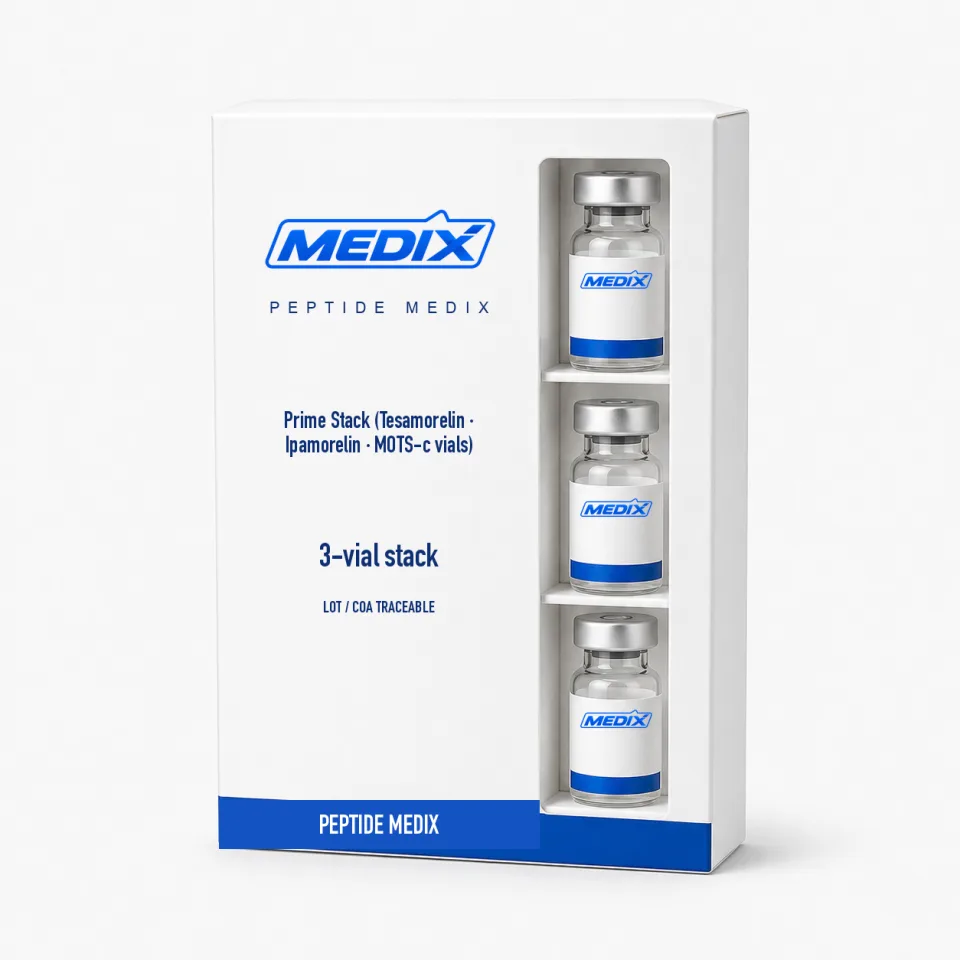
- Every vial assayed to ≥99% (HPLC) with its own lot COA
- Certificate of analysis tied to your lot number
- Tracked EU delivery, dispatched the next working day
Prime Stack (Tesamorelin · Ipamorelin · MOTS-c vials)
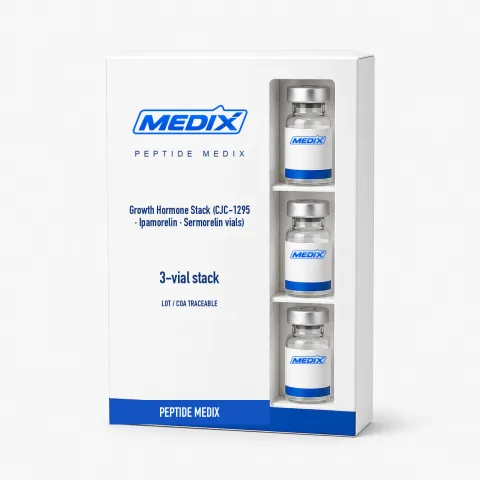
Kit of three vials — tesamorelin, ipamorelin and MOTS-c — for GH-axis and mitochondrial studies
In stock1 format available
€144
This listing is currently unavailable. Contact us and we will tell you when it is back or suggest an equivalent.
Ask about this listing or request its COA- FormLyophilized powder in each vial, individually capped
- Research areasGHRH receptor signalling, GHS-R1a pharmacology, AMPK and mitochondrial metabolism
For laboratory research use only. Sold exclusively for in-vitro laboratory research by qualified professionals. Not for human or veterinary use, and not a medicine, food, cosmetic or dietary supplement. Terms and Conditions
Overview
Key facts
This stack links growth-hormone-axis research with mitochondrial biology: tesamorelin, ipamorelin and MOTS-c, each in its own sealed lyophilised vial.
- Purity
- ≥99% by HPLC per vial; separate lot-matched COA for each
- Form
- Lyophilized powder in each vial, individually capped
- Storage
- −20 °C, protected from light and moisture
- Available size
- 3-vial stack
For research use only. Not for human consumption.
This stack links growth-hormone-axis research with mitochondrial biology: tesamorelin, ipamorelin and MOTS-c, each in its own sealed lyophilised vial. Two of them act on the pituitary, via different receptors; the third works at the mitochondrion and has nothing to do with the somatotropic axis.
Tesamorelin is a stabilised GHRH analogue — the complete GHRH(1-44) sequence with a trans-3-hexenoyl group on its N-terminus that fends off dipeptidyl peptidase-4. Ipamorelin, a pentapeptide agonist of the ghrelin receptor GHS-R1a, was described as selective when first characterised, shifting cortisol and prolactin only slightly in the animal models examined. MOTS-c is a different sort of molecule altogether: 16 residues encoded in the mitochondrial 12S rRNA gene, investigated for its links to AMPK signalling and metabolic balance.
With the three kept apart, a study can run the GHRH-receptor, ghrelin-receptor and mitochondrial arms independently, or combine them in any ratio the design needs. Each vial is HPLC-assayed to ≥99% purity and comes with its own lot certificate. Research material for laboratory use only.
What sets this listing apart
Prime Stack combines Tesamorelin, Ipamorelin and MOTS-c in one listing. Components that are also sold on their own are linked below, each with its own specification and COA.
Same compound, other listings
Specifications
Supply & purity
- Form
- Lyophilized powder in each vial, individually capped
- Purity
- ≥99% by HPLC per vial; separate lot-matched COA for each
Handling & storage
- Storage (lyophilized)
- −20 °C, protected from light and moisture
- Storage (reconstituted)
- 2–8 °C, protected from light
Additional detail
- Product type
- Multi-vial research kit — three separately sealed vials
- Kit contents
- One tesamorelin vial, one ipamorelin vial, one MOTS-c vial
- Tesamorelin
- CAS 218949-48-5 · C221H366N72O67S · 5135.86 g/mol
- Ipamorelin
- CAS 170851-70-4 · C38H49N9O5 · 711.85 g/mol
- MOTS-c
- CAS 1627580-64-6 · C101H152N28O22S2 · 2174.55 g/mol
- Tesamorelin class
- GHRH(1-44) analogue with N-terminal trans-3-hexenoyl group
- Ipamorelin sequence
- Aib-His-D-2-Nal-D-Phe-Lys-NH2
- Research areas
- GHRH receptor signalling, GHS-R1a pharmacology, AMPK and mitochondrial metabolism
- Reconstitution
- Each vial prepared separately at protocol-defined concentration
Questions about Prime Stack (Tesamorelin · Ipamorelin · MOTS-c vials)
Tesamorelin versus sermorelin — what's the difference?
Sermorelin is the shortened GHRH(1-29) fragment; tesamorelin is the entire 44-residue sequence with an N-terminal trans-3-hexenoyl group that resists DPP-4. Both act on the GHRH receptor, but tesamorelin is the more stable of the two.
What is MOTS-c doing alongside two GH-axis peptides?
It covers a separate level of biology. Tesamorelin and ipamorelin act at pituitary receptors, while MOTS-c is a mitochondria-encoded peptide researched for AMPK and cellular energy metabolism — so the kit lets one panel address endocrine and mitochondrial arms independently.
Is there an individual COA for every vial?
Yes. The three vials come from separate production lots, each released with its own certificate of HPLC identity and purity for that peptide. You can request the current certificates before ordering.
Which of the three is most delicate to handle?
Tesamorelin. At about 5,136 g/mol it is the biggest molecule in the kit and the most prone to shear damage, so add bacteriostatic water slowly along the glass and swirl — never shake or vortex.
Can the vials be opened at different stages of a study?
Yes. Unopened lyophilised vials kept sealed at −20 °C, away from light and moisture, remain stable for well over a year, so you can bring components in phase by phase instead of preparing everything at once.