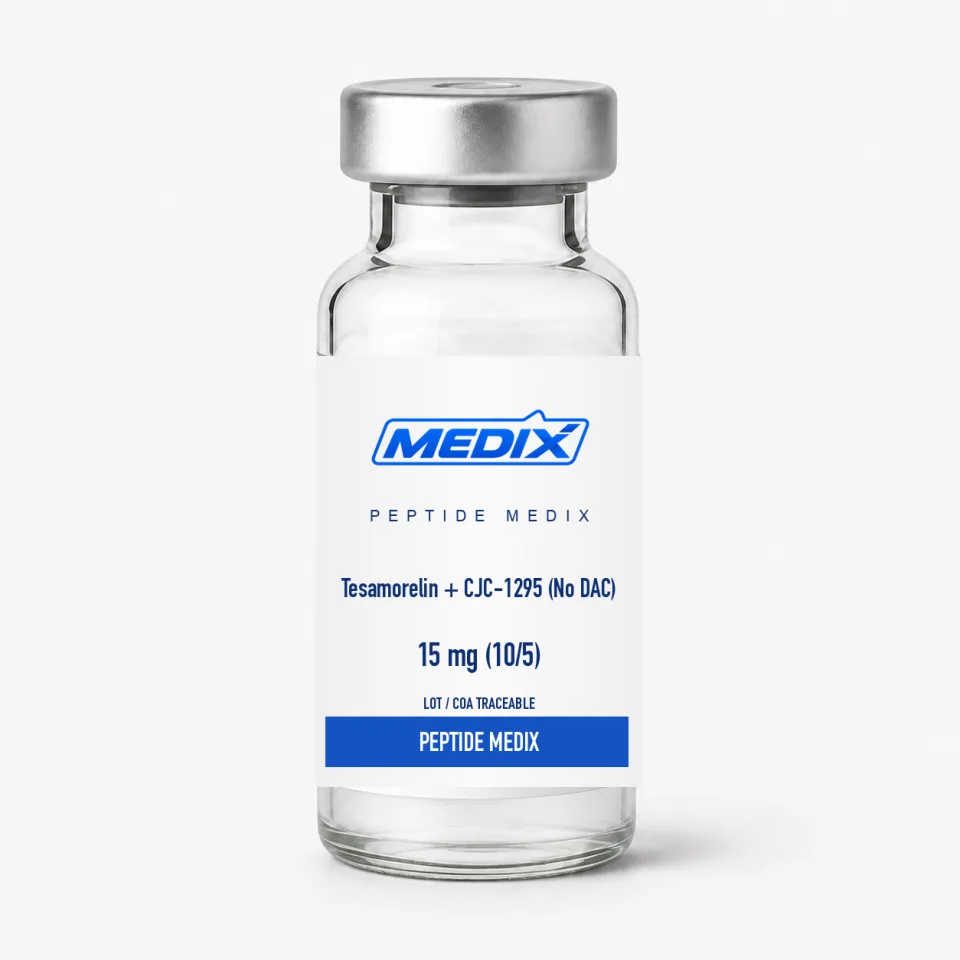
- Each component assayed to ≥99% (HPLC); per-lot COA on request
- Certificate of analysis tied to your lot number
- Tracked EU delivery, dispatched the next working day
Tesamorelin + CJC-1295 (No DAC)
Two GHRH analogues in one vial — tesamorelin (10 mg) plus Mod GRF 1-29 (5 mg)
In stock1 format available
€153
This listing is currently unavailable. Contact us and we will tell you when it is back or suggest an equivalent.
Ask about this listing or request its COA- FormCo-lyophilized powder, sealed glass vial with crimped stopper
- Research areasSomatotropic axis signalling, GHRH receptor structure–activity relationships, peptide stability and DPP-4 resistance, visceral adipose metabolism models
For laboratory research use only. Sold exclusively for in-vitro laboratory research by qualified professionals. Not for human or veterinary use, and not a medicine, food, cosmetic or dietary supplement. Terms and Conditions
Overview
Key facts
This vial holds a pair of GHRH analogues freeze-dried together — tesamorelin at 10 mg and CJC-1295 (no DAC) at 5 mg, making 15 mg of peptide in total.
- Purity
- ≥99% by HPLC per component; lot-matched COA available
- Form
- Co-lyophilized powder, sealed glass vial with crimped stopper
- Storage
- −20 °C, sealed and protected from light and moisture
- Available size
- 15 mg · (10/5)
For research use only. Not for human consumption.
This vial holds a pair of GHRH analogues freeze-dried together — tesamorelin at 10 mg and CJC-1295 (no DAC) at 5 mg, making 15 mg of peptide in total. Both bind one and the same receptor, the GHRH receptor on the somatotroph cells of the pituitary, but they are built on very different designs — which is precisely why researchers like to compare them.
Tesamorelin keeps the whole GHRH(1–44) chain and carries a trans-3-hexenoyl cap on the first tyrosine. That cap prevents DPP-4 — the enzyme that rapidly disables native GHRH — from cutting the peptide, and it adds a fatty anchor that alters where the molecule goes. CJC-1295 without DAC, correctly named Modified GRF (1-29), takes the opposite route: it keeps only the first 29 residues, which are enough for full receptor activity, and swaps in four substitutions (D-Ala2, Gln8, Ala15, Leu27) to resist enzymes and oxidation. With no drug affinity complex it cannot latch onto serum albumin, so it lingers in plasma only briefly.
Our other blends usually join a GHRH analogue with a secretagogue that acts at the ghrelin receptor. Here, unusually, both ingredients share a single receptor — so the vial is a tool for comparison work (modelling receptor occupancy, structure–activity studies, formulation research), not a pairing that engages two receptors to complement each other. Each ingredient meets a ≥99% HPLC purity specification, and the lot has its own certificate.
What sets this listing apart
Tesamorelin + CJC-1295 combines Tesamorelin and CJC-1295 in one listing (15 mg). Components that are also sold on their own are linked below, each with its own specification and COA.
Same compound, other listings
- Tesamorelin
- CJC-1295 (No DAC / Mod GRF 1-29)
- Tesamorelin (Egrifta-type) — Prescription Reference
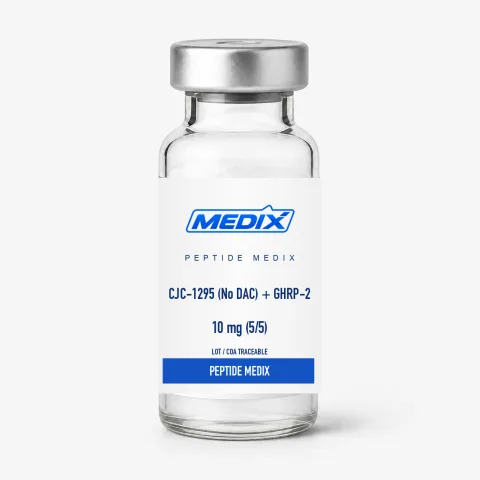
- CJC-1295 (No DAC) + GHRP-2
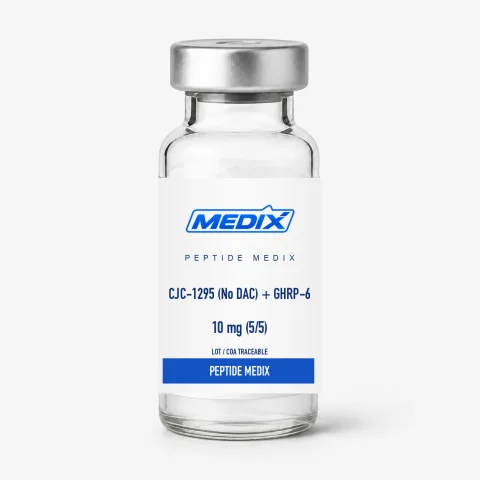
- CJC-1295 (No DAC) + GHRP-6
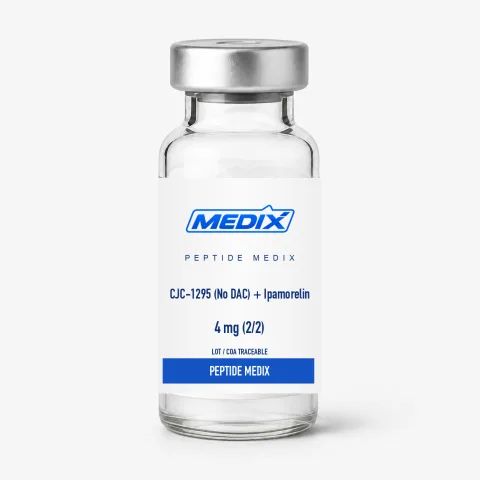
- CJC-1295 (No DAC) + Ipamorelin
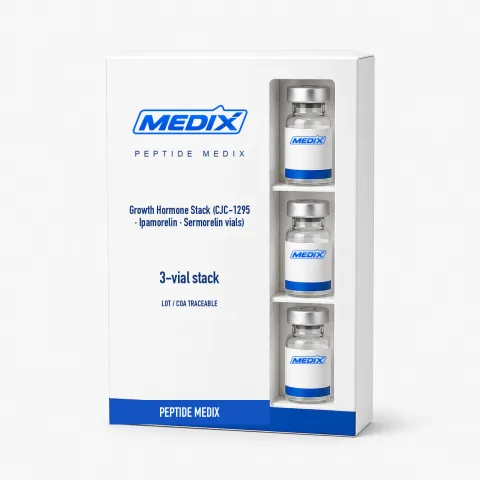
- Growth Hormone Stack (CJC-1295 · Ipamorelin · Sermorelin vials)
- GH Peptide Starter Kit (CJC-1295 + Ipamorelin 10 mg · Bac Water · Syringes · Pads)
Specifications
Identity
- Peptide class
- GHRH analogues (GHRH-R agonists)
Supply & purity
- Form
- Co-lyophilized powder, sealed glass vial with crimped stopper
- Purity
- ≥99% by HPLC per component; lot-matched COA available
- Available sizes
- 15 mg total (10 mg tesamorelin / 5 mg CJC-1295 no DAC)
- Solubility
- Bacteriostatic water or sterile water; both components dissolve readily
Handling & storage
- Storage (lyophilized)
- −20 °C, sealed and protected from light and moisture
- Storage (reconstituted)
- 2–8 °C, protected from light, used within the study window
Additional detail
- Blend ratio
- 2:1 by mass, tesamorelin to CJC-1295 no DAC
- Component 1
- Tesamorelin — CAS 218949-48-5, C221H366N72O67S, 5135.86 g/mol, 44 residues, N-terminally acylated with a C-terminal amide
- Component 2
- CJC-1295 no DAC (Modified GRF 1-29) — CAS 863288-34-0, C152H252N44O42, 3367.93 g/mol, 29 residues with a C-terminal amide
- Shared target
- Growth hormone-releasing hormone receptor (GHRH-R), a class B GPCR on pituitary somatotrophs
- Tesamorelin modification
- trans-3-hexenoyl group on the N-terminal tyrosine, conferring DPP-4 resistance
- CJC-1295 modifications
- D-Ala2, Gln8, Ala15 and Leu27 substitutions on the GRF 1-29 backbone; no drug affinity complex
- Research areas
- Somatotropic axis signalling, GHRH receptor structure–activity relationships, peptide stability and DPP-4 resistance, visceral adipose metabolism models
Questions about Tesamorelin + CJC-1295 (No DAC)
Why combine two GHRH analogues instead of one plus a GHRP?
Our blends typically pair GHRH analogues with ghrelin-receptor secretagogues so that two receptors are stimulated. This one is designed differently: both ingredients act on one receptor, which makes it suitable for comparison and formulation studies. Don't expect the additive effect a two-receptor combination aims for.
What is in the 15 mg vial?
10 mg tesamorelin plus 5 mg CJC-1295 without DAC, co-lyophilised — 15 mg of peptide at a fixed 2:1 mass ratio. Since they share one vial, every aliquot you draw after reconstitution contains both in that same proportion.
CJC-1295 with or without DAC — what's the difference?
DAC — the drug affinity complex — is a maleimide that forms a covalent bond with serum albumin, keeping the peptide in circulation far longer. Without it, the molecule acts only briefly, like other short-lived GHRH analogues. Apart from this, both share the same Modified GRF (1-29) backbone.
Which purity documents are provided?
Each component is HPLC-tested to ≥99% before blending, and the lot certificate covering both peptides is available on request, giving individual purities together with the blend's stated composition and ratio.
How do I reconstitute the blend?
Add bacteriostatic or sterile water slowly along the vial wall and swirl — don't shake — until the cake has fully dissolved; both peptides go into solution easily. Record the diluent volume so you can calculate each component's concentration from the 2:1 ratio.
Can I run single-agent controls from this vial?
No. Once freeze-dried together, the two peptides can't be pulled apart in the lab. For single-agent controls, buy tesamorelin and CJC-1295 (no DAC) in their own vials — we stock them individually for exactly this purpose.