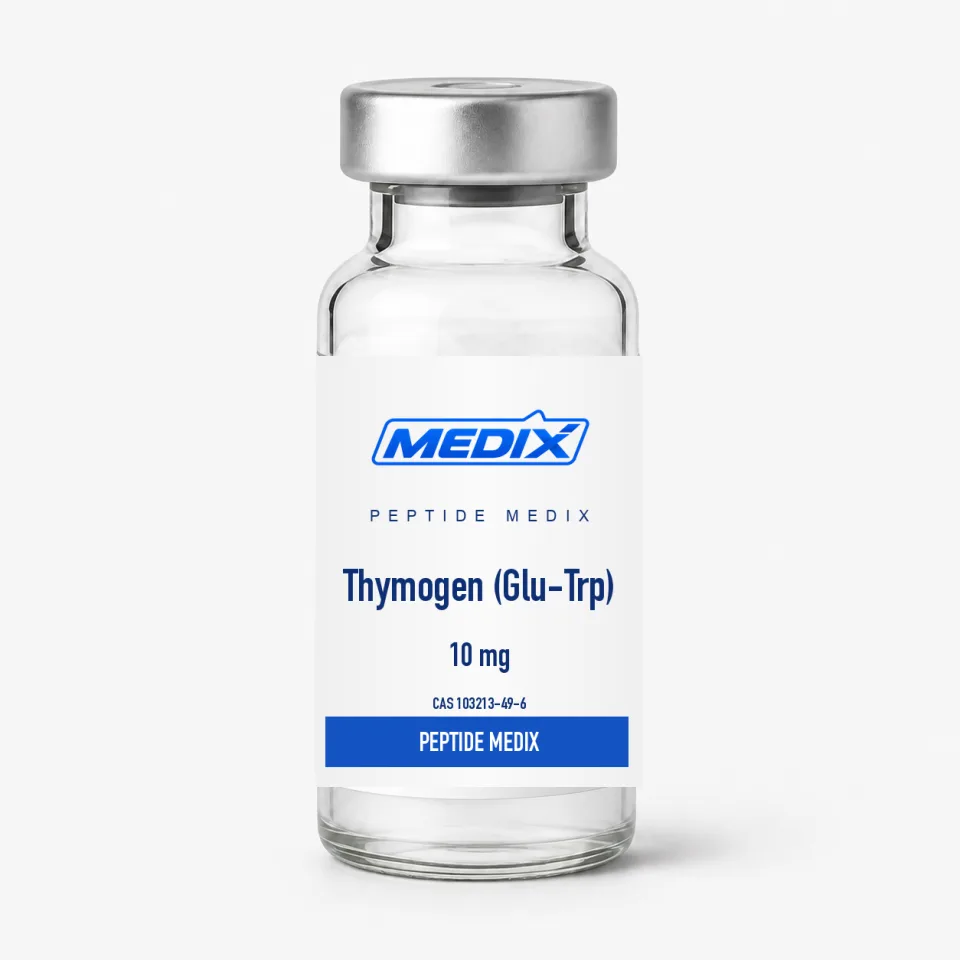
- HPLC purity ≥99%, with a COA for each lot on request
- Certificate of analysis tied to your lot number
- Tracked EU delivery, dispatched the next working day
Thymogen (Glu-Trp)
Synthetic Glu-Trp dipeptide researched in thymic immune-regulation models
In stock2 formats availableCAS 103213-49-6
€55Range €55 – €93
This listing is currently unavailable. Contact us and we will tell you when it is back or suggest an equivalent.
Ask about this listing or request its COA- FormLyophilized powder, sealed glass vial with flip-off seal
- Mol. weight333.34 g/mol
- Research areasLymphocyte differentiation, thymic immune signalling, cytokine expression models
For laboratory research use only. Sold exclusively for in-vitro laboratory research by qualified professionals. Not for human or veterinary use, and not a medicine, food, cosmetic or dietary supplement. Terms and Conditions
Overview
Key facts
Thymogen — L-glutamyl-L-tryptophan — is among the very shortest peptides in our immune range: two residues, Glu-Trp, C16H19N3O5, 333.34 g/mol, CAS 103213-49-6.
- CAS number
- 103213-49-6
- Molecular formula
- C16H19N3O5
- Molecular weight
- 333.34 g/mol
- Amino acid sequence
- H-Glu-Trp-OH (L-glutamyl-L-tryptophan)
- Purity
- ≥99% by HPLC; lot-matched COA available
- Form
- Lyophilized powder, sealed glass vial with flip-off seal
- Storage
- −20 °C, sealed and protected from light and moisture
- Available sizes
- 10 mg · 20 mg
For research use only. Not for human consumption.
Thymogen — L-glutamyl-L-tryptophan — is among the very shortest peptides in our immune range: two residues, Glu-Trp, C16H19N3O5, 333.34 g/mol, CAS 103213-49-6. It came out of Soviet research at the Military Medical Academy in Leningrad, where scientists breaking thymic extracts into fractions looked for the smallest active sequence instead of the whole polypeptide mixture and singled out this pair.
That origin puts Thymogen in the same family tree as Thymalin and the wider group of peptide bioregulators associated with Vladimir Khavinson and Vyacheslav Morozov — short synthetic sequences meant to reproduce, in a defined and repeatable chemical form, the activity credited to a tissue extract. Thymalin is a peptide complex isolated from calf thymus; Thymogen, by contrast, is one synthetic molecule of precisely known structure, which makes it the cleaner reagent for controlled experiments.
Specifications
Identity
- CAS number
- 103213-49-6
- Molecular formula
- C16H19N3O5
- Molecular weight
- 333.34 g/mol
- Amino acid sequence
- H-Glu-Trp-OH (L-glutamyl-L-tryptophan)
- Chain length
- 2 amino acids (dipeptide)
- Peptide class
- Synthetic thymic peptide bioregulator
Supply & purity
- Form
- Lyophilized powder, sealed glass vial with flip-off seal
- Purity
- ≥99% by HPLC; lot-matched COA available
- Available sizes
- 10 mg, 20 mg
- Solubility
- Readily soluble in water and bacteriostatic water
Handling & storage
- Storage (lyophilized)
- −20 °C, sealed and protected from light and moisture
- Storage (reconstituted)
- 2–8 °C, protected from light; use within the study window
Additional detail
- Also known as
- Thymogen, Glu-Trp, EW dipeptide
- Research areas
- Lymphocyte differentiation, thymic immune signalling, cytokine expression models
Questions about Thymogen (Glu-Trp)
What is Thymogen?
The synthetic dipeptide Glu-Trp (L-glutamyl-L-tryptophan), which grew out of Soviet efforts to find the shortest active sequence in fractionated thymus extracts. Its structure is fully defined — two amino acids, CAS 103213-49-6, 333.34 g/mol.
In what way does it differ from Thymalin?
Thymalin is extracted from calf thymus as a peptide mixture whose make-up varies between batches. Thymogen is one synthetic molecule with a known structure, so every lot's identity and purity can be checked analytically.
How is purity established, and do I get a COA?
Reversed-phase HPLC shows ≥99% purity and identity is matched to the expected 333.34 g/mol. The certificate bearing your vial's lot number can be requested before or after you buy.
10 mg or 20 mg — which should I order?
10 mg suffices for assay development and brief pilots; 20 mg means fewer vials to open over longer or multi-arm studies. As the dipeptide is cheap to make, labs usually decide by study length, not price per milligram.
Why protect Thymogen from light?
Its tryptophan absorbs UV strongly and photo-oxidises easily. That absorbance is useful for measuring the peptide around 280 nm, but it also means solutions in clear containers under lab lights can degrade — so amber or foil-wrapped storage is routine.
What are the storage and reconstitution steps?
Store the sealed vial dry at −20 °C. Dissolve it — easily — in bacteriostatic or sterile water with a gentle swirl rather than shaking, then keep the solution in the fridge (2–8 °C) away from light and use it within your planned study period.
Related