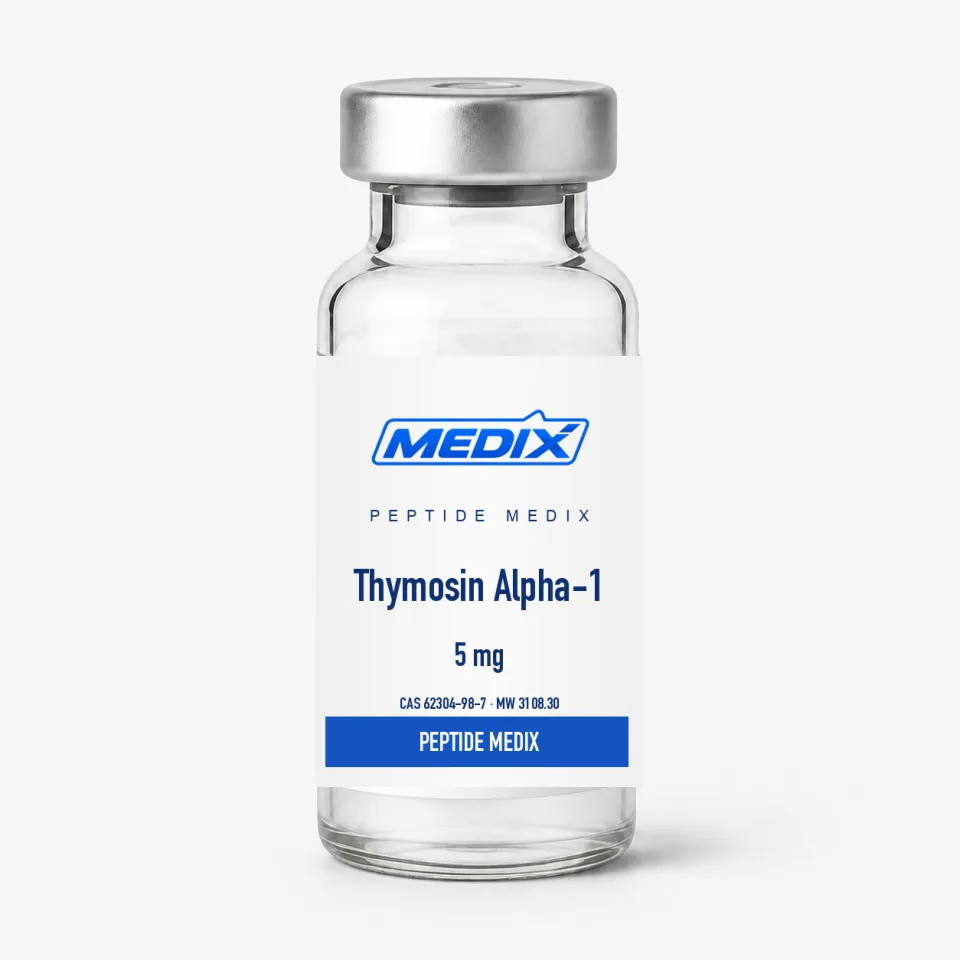
- HPLC purity ≥99%, with a COA for each lot on request
- Certificate of analysis tied to your lot number
- Tracked EU delivery, dispatched the next working day
Thymosin Alpha-1
Acetylated 28-amino-acid thymic peptide derived from prothymosin alpha
In stock3 formats availableCAS 62304-98-7
€72Range €72 – €221
This listing is currently unavailable. Contact us and we will tell you when it is back or suggest an equivalent.
Ask about this listing or request its COA- FormLyophilized powder, sealed glass vial with crimped stopper
- Mol. weight3108.30 g/mol
- Research areasT cell maturation, Toll-like receptor signalling, antiviral and vaccine adjuvant models
For laboratory research use only. Sold exclusively for in-vitro laboratory research by qualified professionals. Not for human or veterinary use, and not a medicine, food, cosmetic or dietary supplement. Terms and Conditions
Overview
Key facts
Thymosin Alpha-1 consists of 28 amino acids with an acetyl group at the N-terminus and matches the opening 28 residues of prothymosin alpha.
- CAS number
- 62304-98-7
- Molecular formula
- C129H215N33O55
- Molecular weight
- 3108.30 g/mol
- Amino acid sequence
- Ac-Ser-Asp-Ala-Ala-Val-Asp-Thr-Ser-Ser-Glu-Ile-Thr-Thr-Lys-Asp-Leu-Lys…
- Purity
- ≥99% by HPLC; lot-matched COA available
- Form
- Lyophilized powder, sealed glass vial with crimped stopper
- Storage
- −20 °C, sealed and protected from light and moisture
- Available sizes
- 5 mg · 10 mg · 20 mg
For research use only. Not for human consumption.
Thymosin Alpha-1 consists of 28 amino acids with an acetyl group at the N-terminus and matches the opening 28 residues of prothymosin alpha. Researchers isolated it from calf thymus in the 1970s while hunting for the active components of thymosin fraction 5, and it is still the best-characterised individual molecule to come out of that effort.
We make it by solid-phase synthesis, purify it to ≥99% by reversed-phase HPLC, and ship it as lyophilised powder in sealed vials of 5 mg, 10 mg and 20 mg, each lot with its own certificate of analysis. It is used chiefly to study T-cell maturation, Toll-like receptor signalling and immune modulation. For laboratory research only.
What sets this listing apart
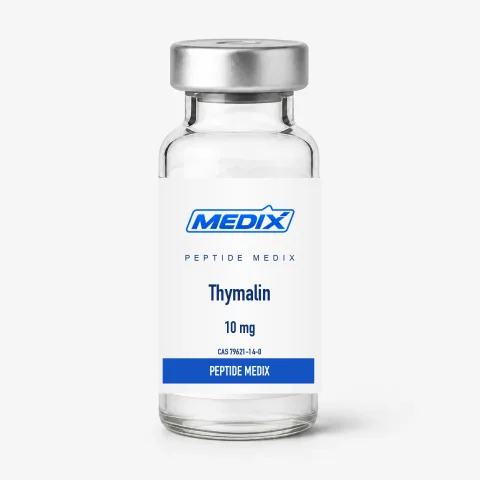
Thymosin Alpha-1 – vial, 5/10/20 mg. Lyophilized powder, sealed glass vial with crimped stopper. Other Thymosin Alpha-1 listings differ in format, fill or combination partners; the specification and COA always refer to the listing you order.
Same compound, other listings
Specifications
Identity
- CAS number
- 62304-98-7
- Molecular formula
- C129H215N33O55
- Molecular weight
- 3108.30 g/mol
- Amino acid sequence
- Ac-Ser-Asp-Ala-Ala-Val-Asp-Thr-Ser-Ser-Glu-Ile-Thr-Thr-Lys-Asp-Leu-Lys-Glu-Lys-Lys-Glu-Val-Val-Glu-Glu-Ala-Glu-Asn
- Chain length
- 28 amino acids, N-terminally acetylated
- Peptide class
- Thymic immunomodulatory peptide
Supply & purity
- Form
- Lyophilized powder, sealed glass vial with crimped stopper
- Purity
- ≥99% by HPLC; lot-matched COA available
- Available sizes
- 5 mg, 10 mg, 20 mg
Handling & storage
- Storage (lyophilized)
- −20 °C, sealed and protected from light and moisture
- Storage (reconstituted)
- 2–8 °C, protected from light, used within the study window
Additional detail
- Parent protein
- Prothymosin alpha (residues 1–28)
- Research areas
- T cell maturation, Toll-like receptor signalling, antiviral and vaccine adjuvant models
Questions about Thymosin Alpha-1
What is Thymosin Alpha-1?
A synthetic peptide of 28 amino acids with an acetylated N-terminus, identical to the first 28 residues of prothymosin alpha. First found in calf thymus extract, it is supplied here as lyophilised powder for immune-signalling research.
How does it differ from Thymalin and Thymulin?
Thymosin Alpha-1 is one defined molecule with a known sequence and mass. Thymalin is a blend of thymic polypeptides, and Thymulin is a separate nine-residue peptide whose activity is described as zinc-dependent. All stem from thymus research but are chemically different.
What purity is guaranteed, and is a COA included?
Each lot is purified and checked by reversed-phase HPLC to ≥99%, and mass spectrometry confirms the expected 3108.30 g/mol. The certificate matching your vial's lot number can be requested at any time.
How should the solution be kept after reconstitution?
Refrigerate it at 2–8 °C in the dark and use it during the planned study period rather than keeping it indefinitely. Split it into aliquots right after dissolving so each tube is thawed only once instead of cycling the entire stock.
Related