- HPLC-assayed purity of ≥99%
- Certificate of analysis tied to your lot number
- Tracked EU delivery, dispatched the next working day
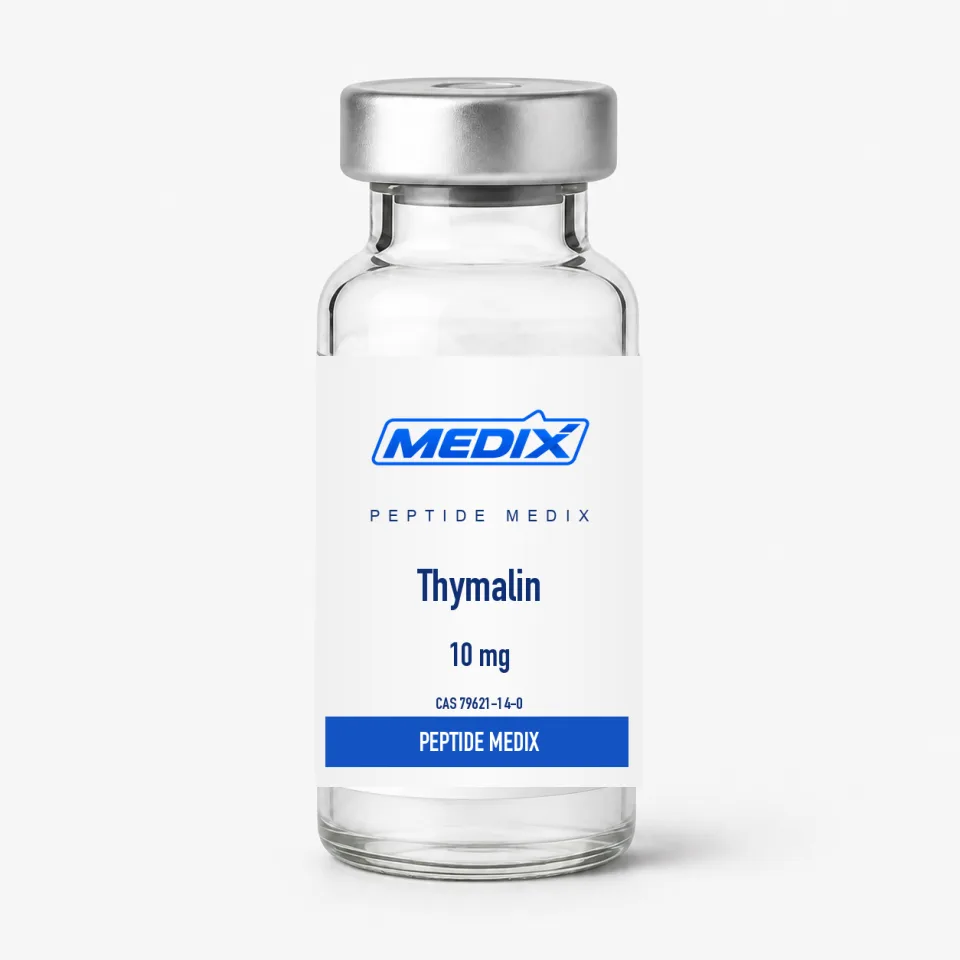
Thymalin
Standardised polypeptide complex from thymus in lyophilised research vials
In stock2 formats availableCAS 79621-14-0
€46Range €46 – €72
This listing is currently unavailable. Contact us and we will tell you when it is back or suggest an equivalent.
Ask about this listing or request its COA- FormLyophilized polypeptide complex, sealed glass vial with crimped stopper
- Mol. weightNot a single defined mass — a polypeptide fraction, not one compound
- Research areasImmune parameters in ageing models, thymic bioregulator studies
For laboratory research use only. Sold exclusively for in-vitro laboratory research by qualified professionals. Not for human or veterinary use, and not a medicine, food, cosmetic or dietary supplement. Terms and Conditions
Overview
Key facts
Thymalin is a mixture, not one compound: a standardised set of low-molecular-weight polypeptides obtained from thymus tissue.
- CAS number
- 79621-14-0
- Molecular weight
- Not a single defined mass — a polypeptide fraction, not one compound
- Amino acid sequence
- Not applicable; the complex contains multiple peptide species
- Form
- Lyophilized polypeptide complex, sealed glass vial with crimped stopper
- Storage
- −20 °C, sealed and protected from light and moisture
- Available sizes
- 10 mg · 20 mg
For research use only. Not for human consumption.
Thymalin is a mixture, not one compound: a standardised set of low-molecular-weight polypeptides obtained from thymus tissue. It originated in the Russian peptide bioregulator programme linked to Vladimir Khavinson and has been studied there since the 1970s. For anyone specifying reagents this matters — there is no single sequence, formula or exact mass to cite, and its certificate of analysis assesses the complex against a specification instead of stating purity for one molecule.
Under the bioregulator concept, short peptide fractions from a tissue are thought to signal back to that same tissue; Thymalin represents the thymus, just as Epitalon represents the pineal gland and Vilon and Prostamax other tissues. That programme's publications cover immune measures in ageing animals as well as long-running observational cohorts in humans.
What sets this listing apart
Thymalin – vial, 10/20 mg. Lyophilized polypeptide complex, sealed glass vial with crimped stopper. Other Thymalin listings differ in format, fill or combination partners; the specification and COA always refer to the listing you order.
Same compound, other listings
Specifications
Identity
- CAS number
- 79621-14-0
- Molecular weight
- Not a single defined mass — a polypeptide fraction, not one compound
- Amino acid sequence
- Not applicable; the complex contains multiple peptide species
- Peptide class
- Tissue-derived peptide bioregulator (thymic)
Supply & purity
- Form
- Lyophilized polypeptide complex, sealed glass vial with crimped stopper
- Available sizes
- 10 mg, 20 mg
Handling & storage
- Storage (lyophilized)
- −20 °C, sealed and protected from light and moisture
- Storage (reconstituted)
- 2–8 °C, protected from light, used within the study window
Additional detail
- Composition
- Standardised mixture of low-molecular-weight thymic polypeptides
- Source tissue
- Thymus
- Documentation
- Lot-matched COA reporting the complex against its specification
- Research areas
- Immune parameters in ageing models, thymic bioregulator studies
Questions about Thymalin
What exactly is Thymalin?
Not one synthetic molecule but a standardised complex of small polypeptides taken from thymus tissue. It is part of the bioregulator family developed in Russian labs, and we supply it as lyophilised research powder.
Why no formula or sequence?
The material is a fraction containing many peptide species. With no single mass for mass spectrometry to confirm and no single sequence to state, it is defined by its source, manufacturing process and analytical profile.
Thymalin versus Thymosin Alpha-1 — what's the difference?
Thymosin Alpha-1 is one defined 28-residue peptide whose sequence, formula and mass can be checked analytically; Thymalin is a mixture. Both trace back to research on thymic extracts, yet they cannot stand in for each other in a study.
Which document accompanies a lot?
A certificate carrying the vial's lot number that assesses the complex against its manufacturing specification. Since a fraction's purity can't be expressed as one area-percent value, the document reports conformity rather than a single chromatographic peak.
How convincing is the evidence published so far?
It rests mostly on rodent experiments and observational human cohorts from the programme that developed it, much of it in Russian-language journals. Independent replication elsewhere is scarce — something to weigh when interpreting findings.
Related