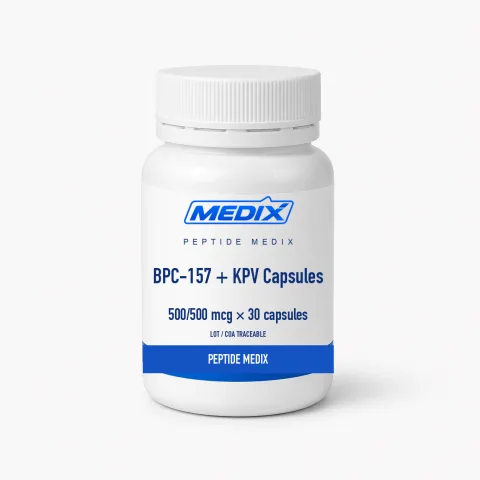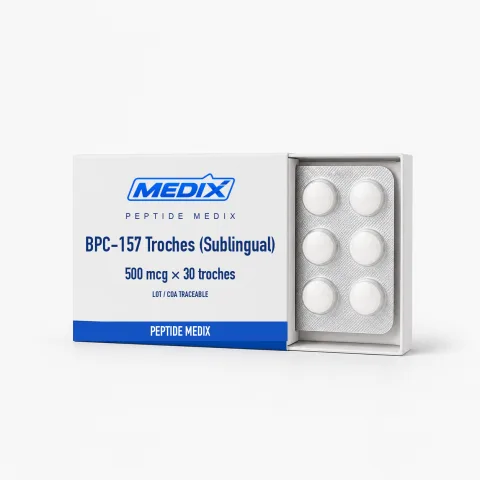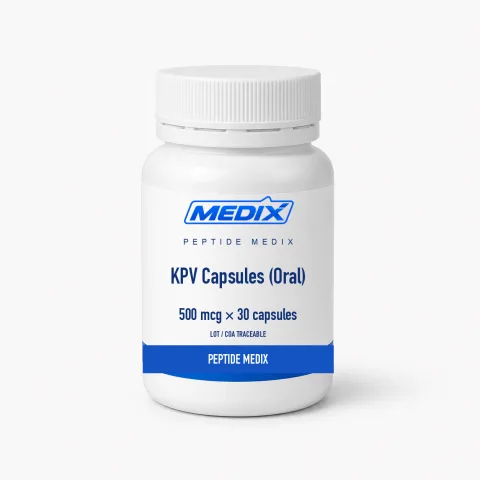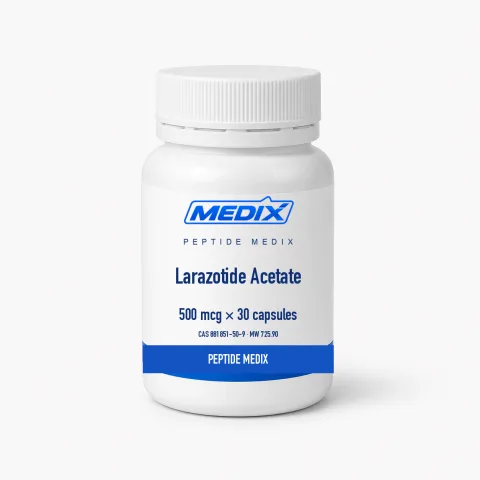
- HPLC-assayed purity of ≥99%
- Certificate of analysis tied to your lot number
- Tracked EU delivery, dispatched the next working day
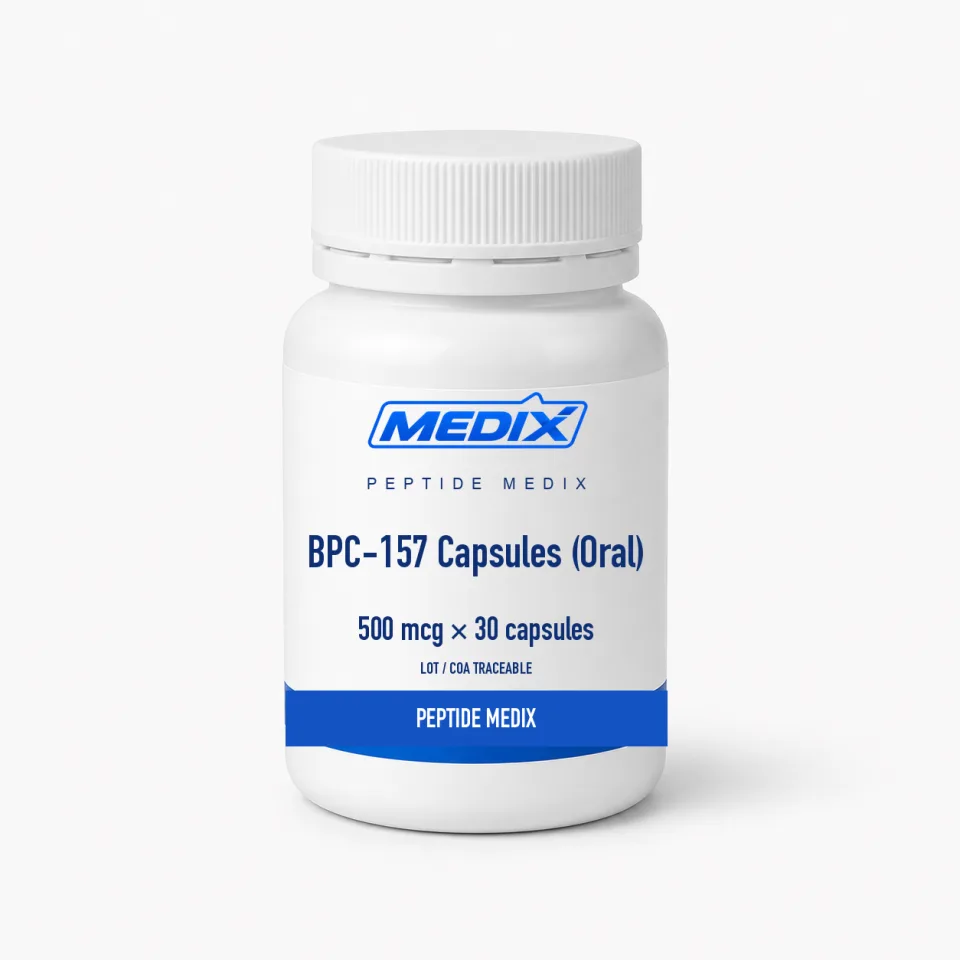
BPC-157 Capsules (Oral)
BPC-157 research capsules for oral-route studies — 500 mcg each, 30 or 60 per bottle
In stock2 formats availableCAS 137525-51-0
€68Range €68 – €119
This listing is currently unavailable. Contact us and we will tell you when it is back or suggest an equivalent.
Ask about this listing or request its COA- FormOral capsule, sealed bottle with tamper-evident closure
- Mol. weight1419.55 g/mol
- Research areasGastrointestinal mucosal integrity, barrier function, oral bioavailability studies
For laboratory research use only. Sold exclusively for in-vitro laboratory research by qualified professionals. Not for human or veterinary use, and not a medicine, food, cosmetic or dietary supplement. Terms and Conditions
Overview
Key facts
An oral presentation makes sense given BPC-157's origin.
- CAS number
- 137525-51-0
- Molecular formula
- C62H98N16O22
- Molecular weight
- 1419.55 g/mol
- Amino acid sequence
- Gly-Glu-Pro-Pro-Pro-Gly-Lys-Pro-Ala-Asp-Asp-Ala-Gly-Leu-Val
- Purity
- ≥99% by HPLC; lot-matched COA available
- Form
- Oral capsule, sealed bottle with tamper-evident closure
- Storage
- Cool, dry conditions away from direct light; refrigeration extends shelf stability
- Available sizes
- 500 mcg · 30 capsules · 500 mcg · 60 capsules
For research use only. Not for human consumption.
An oral presentation makes sense given BPC-157's origin. The parent protein, body protection compound, was isolated from human gastric juice, and stability data indicate that the fragment withstands acidic aqueous conditions far better than most peptides of similar size. For that reason, gastrointestinal models in the literature use oral and intragastric routes as well as injection.
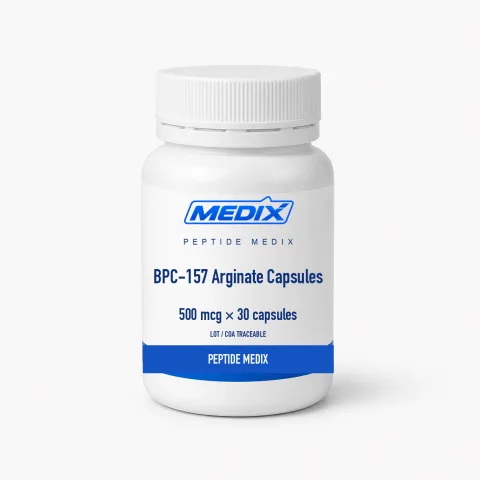
Every capsule contains 500 micrograms of the pentadecapeptide — CAS 137525-51-0, C62H98N16O22, 1419.55 g/mol, sequence Gly-Glu-Pro-Pro-Pro-Gly-Lys-Pro-Ala-Asp-Asp-Ala-Gly-Leu-Val — mixed with an inert filler to a uniform fill weight, in bottles of thirty or sixty. With the unit content fixed, there is no reconstitution step, which removes the biggest source of variation between preparations in a long series; the price is that the investigator cannot choose the concentration, which is what the lyophilised vial is for. Related listings vary the same parameter in other ways: the arginate capsule uses the arginine salt of the peptide instead of the more common acetate, and the troche targets sublingual rather than gastrointestinal exposure. Keep bottles closed, dry and dark, with the desiccant inside.
What sets this listing apart
BPC-157 Capsules (Oral) – capsules, 500 mcg. Oral capsule, sealed bottle with tamper-evident closure. Other BPC-157 listings differ in format, fill or combination partners; the specification and COA always refer to the listing you order.
Same compound, other listings
Specifications
Identity
- CAS number
- 137525-51-0
- Molecular formula
- C62H98N16O22
- Molecular weight
- 1419.55 g/mol
- Amino acid sequence
- Gly-Glu-Pro-Pro-Pro-Gly-Lys-Pro-Ala-Asp-Asp-Ala-Gly-Leu-Val
Supply & purity
- Form
- Oral capsule, sealed bottle with tamper-evident closure
Additional detail
- Peptide per capsule
- 500 mcg BPC-157
- Available counts
- 30 capsules, 60 capsules
- Peptide purity
- ≥99% by HPLC; lot-matched COA available
- Active peptide
- BPC-157, a 15-amino-acid pentadecapeptide
- Research areas
- Gastrointestinal mucosal integrity, barrier function, oral bioavailability studies
- Storage
- Cool, dry conditions away from direct light; refrigeration extends shelf stability
- Preparation required
- None — fixed unit content, no reconstitution step
Questions about BPC-157 Capsules (Oral)
What does one capsule contain?
500 micrograms of BPC-157, the 15-amino-acid pentadecapeptide, combined with an inert filler for a uniform fill weight. Bottles of 30 or 60 capsules come with a tamper-evident seal and a desiccant.
Is it the same peptide as in your vials?
Yes — identical solid-phase synthesised material, purified by reversed-phase HPLC to ≥99% and documented with a certificate of analysis for each lot. Only the presentation changes: a fixed 500 microgram unit instead of a bulk lyophilised cake.
How should I store the bottle?
Closed, dry and away from direct light and heat, with the desiccant left inside. Refrigeration is optional but prolongs stability. Peptide powders attract moisture, so do not keep opening the bottle in humid surroundings or tip capsules into unsealed containers.
Can I obtain a certificate of analysis?
Yes. The certificate that matches the lot number on the bottle label can be requested; it reports HPLC purity and mass confirmation for the peptide used in that fill. Noting the lot number when a study starts keeps the unit content traceable later on.
Related