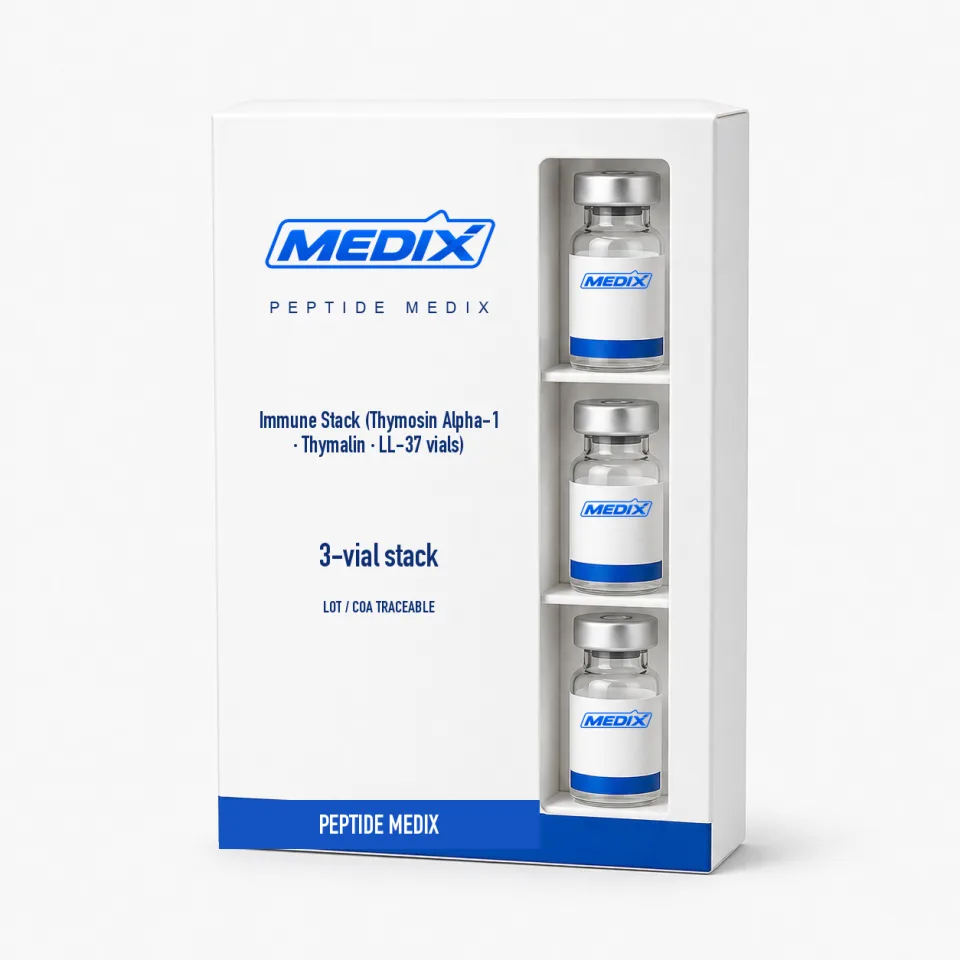
- Every vial assayed to ≥99% (HPLC) with its own lot COA
- Certificate of analysis tied to your lot number
- Tracked EU delivery, dispatched the next working day
Immune Stack (Thymosin Alpha-1 · Thymalin · LL-37 vials)
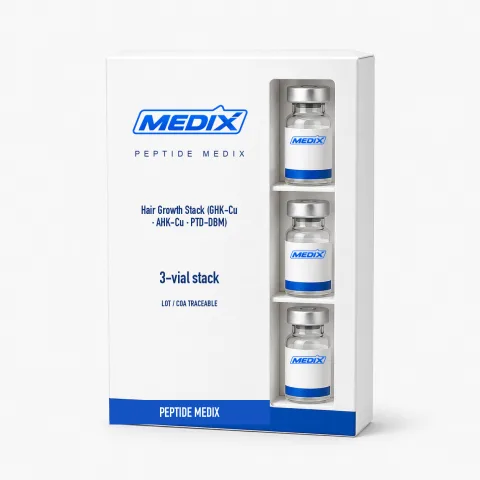
Immunology research kit in three vials: Thymosin Alpha-1, Thymalin and LL-37
In stock1 format available
Ask about this listing or request its COA- FormLyophilized powder in each vial, individually capped
- Research areasT-cell maturation markers, thymic peptide biology, innate immune and membrane studies
For laboratory research use only. Sold exclusively for in-vitro laboratory research by qualified professionals. Not for human or veterinary use, and not a medicine, food, cosmetic or dietary supplement. Terms and Conditions
Overview
Key facts
Three peptides used in immunology research — Thymosin Alpha-1, Thymalin and LL-37 — make up this stack, each in its own sealed lyophilised vial.
- Purity
- ≥99% by HPLC per vial; separate lot-matched COA for each
- Form
- Lyophilized powder in each vial, individually capped
- Storage
- −20 °C, protected from light and moisture
- Available size
- 3-vial stack
For research use only. Not for human consumption.
Three peptides used in immunology research — Thymosin Alpha-1, Thymalin and LL-37 — make up this stack, each in its own sealed lyophilised vial. Together they cover thymus biology and innate antimicrobial defence: related fields, but ones investigated with quite different assays.
Of the three, Thymosin Alpha-1 is the best characterised: an acetylated 28-amino-acid peptide first purified from thymosin fraction 5, an extract of thymus. Thymalin is another kind of product altogether — a low-molecular-weight polypeptide complex obtained from calf thymus, developed within the Russian bioregulator tradition instead of as one defined sequence. LL-37 falls into a third category: the sole human cathelicidin, a cationic 37-residue antimicrobial peptide cut from its precursor hCAP18, supported by an extensive Western literature on membrane interactions and innate immune signalling.
Every vial is HPLC-assayed and released with its own lot certificate of analysis. Keeping the three separate matters: LL-37 is highly cationic and membrane-active, and it must be handled differently from the two thymic preparations. The kit is offered only to laboratories, as research material.
What sets this listing apart
Immune Stack combines Thymosin Alpha-1, Thymalin and LL-37 (Cathelicidin) in one listing. Components that are also sold on their own are linked below, each with its own specification and COA.
Same compound, other listings
Specifications
Supply & purity
- Form
- Lyophilized powder in each vial, individually capped
- Purity
- ≥99% by HPLC per vial; separate lot-matched COA for each
Handling & storage
- Storage (lyophilized)
- −20 °C, protected from light and moisture
- Storage (reconstituted)
- 2–8 °C, protected from light
Additional detail
- Product type
- Multi-vial research kit — three separately sealed vials
- Kit contents
- One Thymosin Alpha-1 vial, one Thymalin vial, one LL-37 vial
- Thymosin Alpha-1
- CAS 62304-98-7 · C129H215N33O55 · 3108.30 g/mol
- Thymalin
- CAS 79621-14-0 · thymic polypeptide complex, not a single sequence
- LL-37
- CAS 154947-66-7 · 4493.33 g/mol · 37 residues
- Thymosin Alpha-1 class
- N-terminally acetylated 28-residue thymic peptide
- LL-37 class
- Human cathelicidin, cationic antimicrobial peptide from hCAP18
- Research areas
- T-cell maturation markers, thymic peptide biology, innate immune and membrane studies
- Reconstitution
- Each vial prepared separately; LL-37 requires low-binding labware
Questions about Immune Stack (Thymosin Alpha-1 · Thymalin · LL-37 vials)
Is Thymalin one peptide?
No — it is a complex of low-molecular-weight polypeptides extracted from calf thymus, not a single synthetic sequence, so we list no one formula or molecular weight for it. Its certificate describes the fraction as a whole rather than a single molecule.
Why does LL-37 call for special labware?
Its strong positive charge makes it stick to ordinary glass and polypropylene, which can lower the concentration in your assay without you noticing. Low-binding tubes and tips are the standard precaution, as is working from aliquots instead of puncturing one vial again and again.
Does every vial come with its own COA?
Yes — each is a separate production lot with its own certificate of analysis. Since Thymalin is a complex, not a defined sequence, its document gives a fraction profile, whereas the other two report single-peptide purity.
What separates Thymosin Alpha-1 from Thymalin?
Thymosin Alpha-1 is a single, chemically synthesised 28-residue peptide with a known sequence and mass. Thymalin is a polypeptide fraction extracted from thymus tissue. Both belong to thymus research, but as materials they are completely different.
Can I use just one of the three?
Certainly. The vials are independent, so you can open one and leave the others sealed at −20 °C. Kept cold and dry, unopened lyophilised peptide stays stable for well over a year; the retest date on each lot's COA is the governing date.
Related