- Each component assayed to ≥99% (HPLC), documented per lot
- Certificate of analysis tied to your lot number
- Tracked EU delivery, dispatched the next working day
BPC-157 + TB-500 + KPV
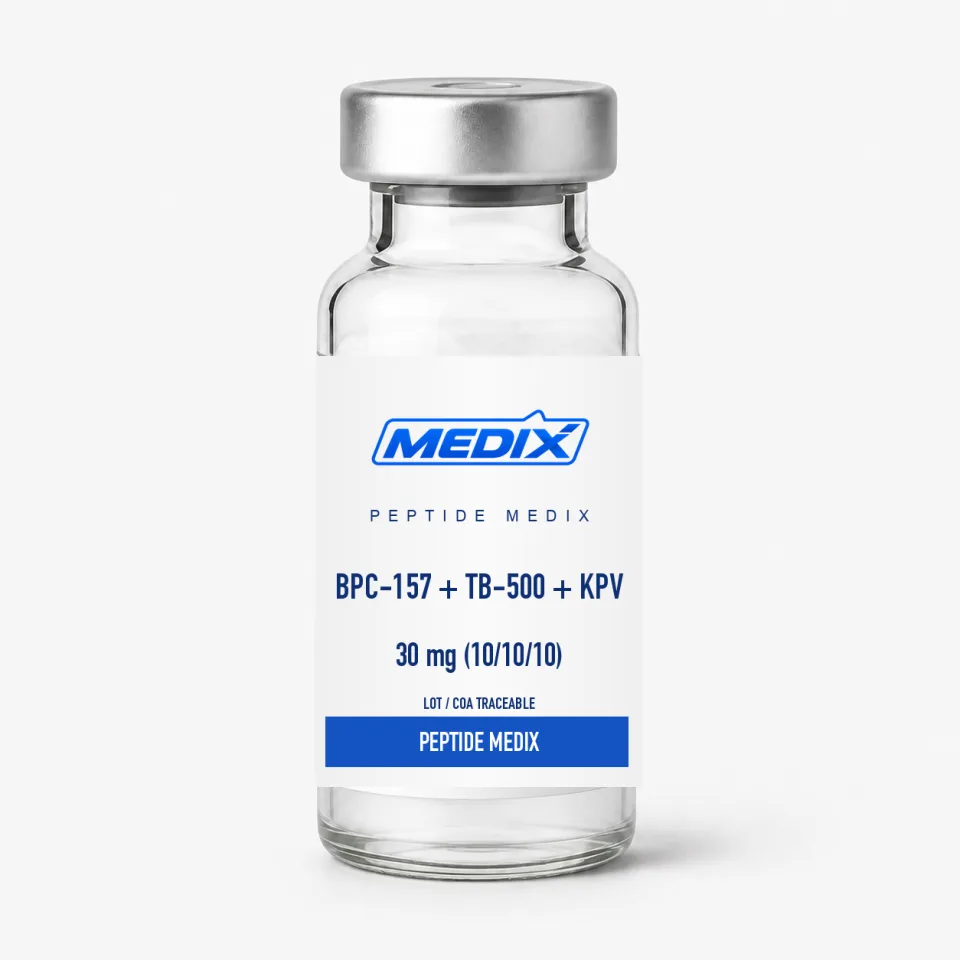
30 mg research vial combining BPC-157, TB-500 and KPV — 10 mg of each
In stock1 format available
€165
This listing is currently unavailable. Contact us and we will tell you when it is back or suggest an equivalent.
Ask about this listing or request its COA- FormLyophilized powder, sealed glass vial
- Research areasGastrointestinal mucosa, inflammatory signalling, connective-tissue repair models
For laboratory research use only. Sold exclusively for in-vitro laboratory research by qualified professionals. Not for human or veterinary use, and not a medicine, food, cosmetic or dietary supplement. Terms and Conditions
Overview
Key facts
Three peptides are combined by equal weight in this 30 mg lyophilised vial: 10 mg each of BPC-157, TB-500 and KPV.
- Purity
- ≥99% by HPLC per component; lot-matched COA
- Form
- Lyophilized powder, sealed glass vial
- Storage
- −20 °C, protected from light and moisture
- Available size
- 30 mg · (10/10/10)
For research use only. Not for human consumption.
Three peptides are combined by equal weight in this 30 mg lyophilised vial: 10 mg each of BPC-157, TB-500 and KPV. In contrast to the copper-dominated GLOW and KLOW formulas, the balanced 10/10/10 composition keeps all three components on a similar footing — useful for designs in which no one peptide should dominate.
Gut and inflammation research is where this trio is most often used, since BPC-157's focus on the mucosa and KPV's link to NF-κB signalling meet there. Peptide Medix EU delivers the vial as white lyophilised powder in which each component is HPLC-assayed to ≥99% purity, released with a certificate of analysis for the lot, and sold for laboratory research only.
What sets this listing apart
BPC-157 + TB-500 + KPV combines BPC-157, TB-500 and KPV in one listing (30 mg). Components that are also sold on their own are linked below, each with its own specification and COA.
Same compound, other listings
Specifications
Supply & purity
- Form
- Lyophilized powder, sealed glass vial
- Purity
- ≥99% by HPLC per component; lot-matched COA
- Solubility
- Bacteriostatic water or sterile water
Handling & storage
- Storage (lyophilized)
- −20 °C, protected from light and moisture
- Storage (reconstituted)
- 2–8 °C, used within the study window
Additional detail
- Product type
- Three-peptide research blend, single vial
- Components
- BPC-157, TB-500 (thymosin beta-4 fragment), KPV
- Total peptide content
- 30 mg per vial (10 mg each)
- BPC-157
- CAS 137525-51-0 · C62H98N16O22 · 1419.55 g/mol
- TB-500
- CAS 885340-08-9 · C38H68N10O14 · 889.02 g/mol
- KPV
- CAS 67727-97-3 · C16H30N4O4 · 342.43 g/mol
- Appearance
- White to off-white powder; clear colourless solution when reconstituted
- Research areas
- Gastrointestinal mucosa, inflammatory signalling, connective-tissue repair models
Questions about BPC-157 + TB-500 + KPV
How is it different from a BPC-157/TB-500 blend?
KPV is what sets it apart. Two-peptide “Wolverine” blends address the repair and cell-migration literature; the extra tripeptide from alpha-MSH adds an inflammation-signalling element that labs studying mucosal or colitis models often want in the same vial.
What ratio does the vial contain?
Equal amounts by mass: 10 mg BPC-157, 10 mg TB-500 and 10 mg KPV, 30 mg overall. Since the molecular weights differ a great deal, the molar ratio is not 1:1:1 — per milligram, KPV supplies by far the most molecules.
Are the three components tested one by one?
Yes. The lot's certificate of analysis lists HPLC identity and purity separately for BPC-157, TB-500 and KPV instead of one combined value. You can ask for the current lot COA before ordering.
Should the solution have a colour after reconstitution?
No. This blend contains no copper complex, unlike GHK-Cu formulas, so a correctly reconstituted vial yields a clear, colourless liquid. Any colour, haze or visible particles mean the vial should be set aside and not used.
May it be given to humans or animals?
No. It is a research chemical for in-vitro and laboratory work by qualified researchers only — not a medicine, supplement or veterinary product. It has not been assessed for administration to any living organism, and Peptide Medix EU provides no dosing or usage instructions.
Related