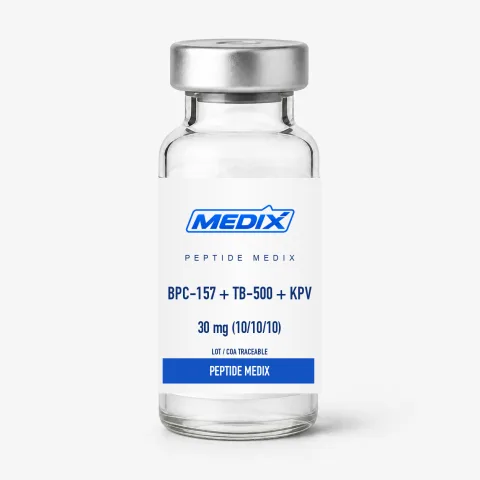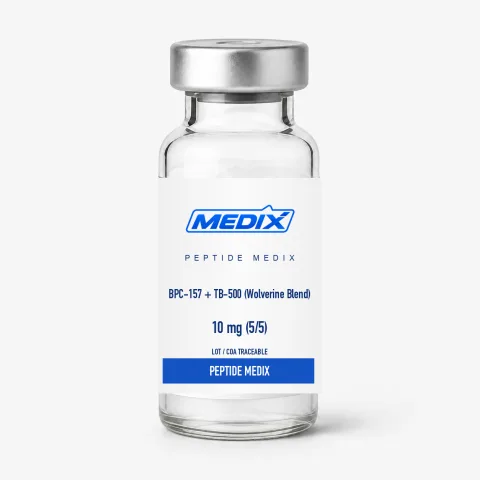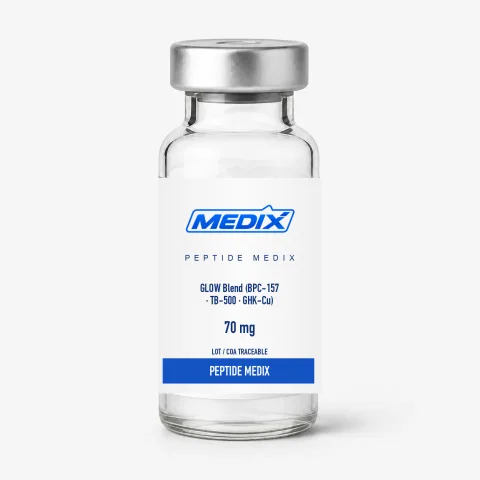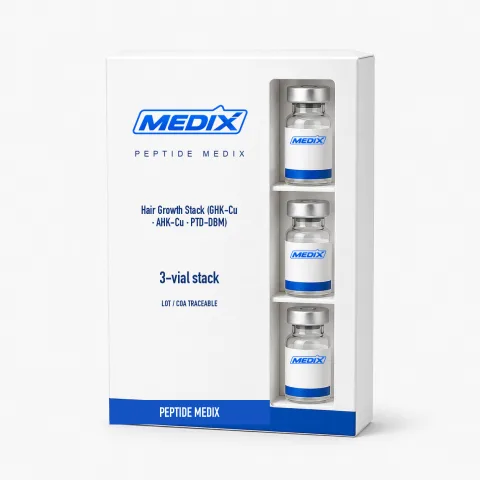
- Each component assayed to ≥99% (HPLC), documented per lot
- Certificate of analysis tied to your lot number
- Tracked EU delivery, dispatched the next working day
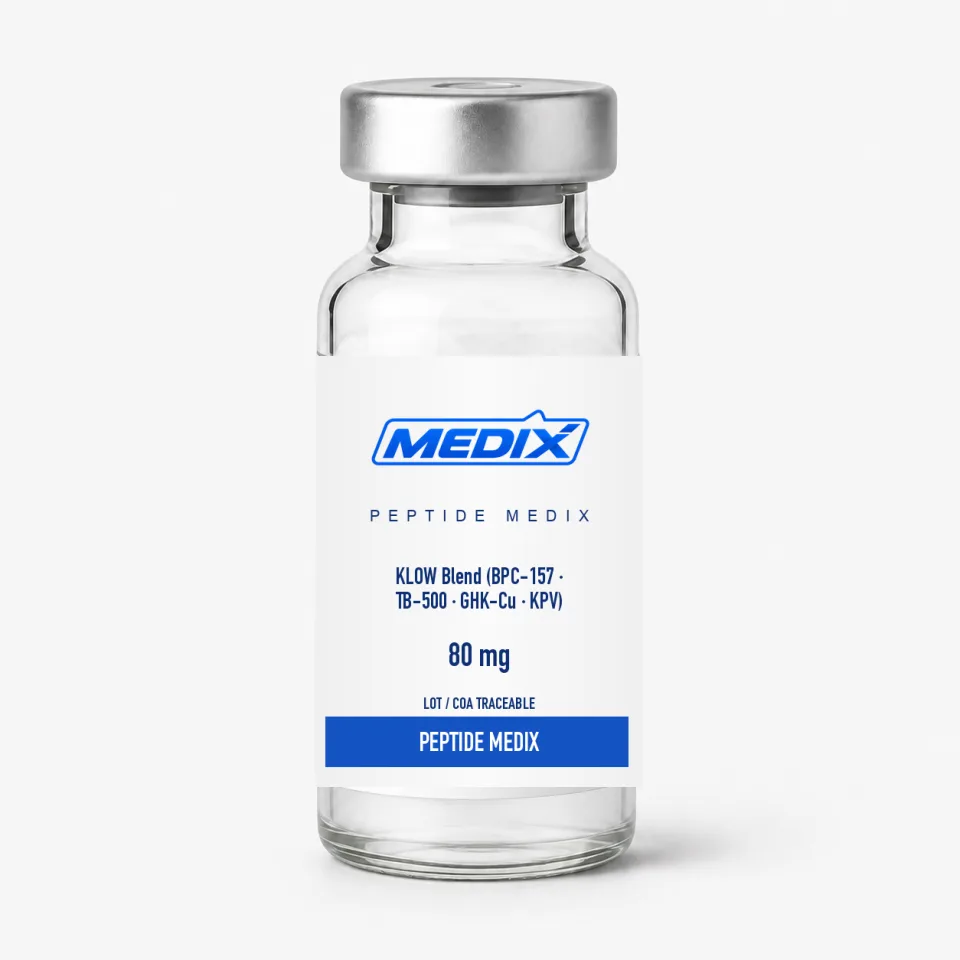
KLOW Blend (BPC-157 · TB-500 · GHK-Cu · KPV)
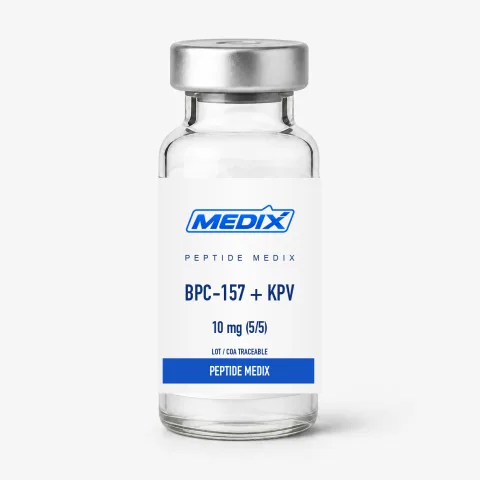
BPC-157, TB-500, GHK-Cu and KPV blended in a single 80 mg research vial
In stock1 format available
€204
This listing is currently unavailable. Contact us and we will tell you when it is back or suggest an equivalent.
Ask about this listing or request its COA- FormLyophilized powder in a sealed glass vial
- Research areasTissue repair, extracellular matrix remodelling, mucosal and inflammatory signalling
For laboratory research use only. Sold exclusively for in-vitro laboratory research by qualified professionals. Not for human or veterinary use, and not a medicine, food, cosmetic or dietary supplement. Terms and Conditions
Overview
Key facts
KLOW Blend is a co-formulated research product combining four much-studied peptides — BPC-157, TB-500, GHK-Cu and KPV — in one 80 mg lyophilised vial.
- Purity
- ≥99% by HPLC per component; lot-matched COA
- Form
- Lyophilized powder in a sealed glass vial
- Storage
- −20 °C, protected from light and moisture
- Available size
- 80 mg
For research use only. Not for human consumption.
KLOW Blend is a co-formulated research product combining four much-studied peptides — BPC-157, TB-500, GHK-Cu and KPV — in one 80 mg lyophilised vial. Its name is an acronym built from those components, and the formula exists because labs investigating tissue-repair signalling often run the four together rather than one by one. Putting them into one vial saves three reconstitutions and the dilution errors that come with them.
The four come from quite different peptide families. BPC-157 is a synthetic peptide of fifteen amino acids, based on part of a protein found in human gastric juice; TB-500 reproduces the region of thymosin beta-4 that binds actin; GHK-Cu is a copper(II)-carrying tripeptide first isolated from human blood plasma; and KPV is the last three amino acids of alpha-melanocyte-stimulating hormone. Where their research overlaps — wound models, the turnover of extracellular matrix and inflammatory signalling — is why they are grouped together.
What sets this listing apart
KLOW Blend combines BPC-157, TB-500, GHK-Cu (Copper Peptide) and KPV in one listing (80 mg). Components that are also sold on their own are linked below, each with its own specification and COA.
Same compound, other listings
Specifications
Supply & purity
- Form
- Lyophilized powder in a sealed glass vial
- Purity
- ≥99% by HPLC per component; lot-matched COA
Handling & storage
- Storage (lyophilized)
- −20 °C, protected from light and moisture
- Storage (reconstituted)
- 2–8 °C, used within the study window
Additional detail
- Product type
- Multi-peptide research blend, single vial
- Components
- BPC-157, TB-500 (thymosin beta-4 fragment), GHK-Cu, KPV
- Total peptide content
- 80 mg per vial
- Typical component split
- GHK-Cu 50 mg · BPC-157 10 mg · TB-500 10 mg · KPV 10 mg
- Component CAS numbers
- BPC-157 137525-51-0 · TB-500 885340-08-9 · GHK-Cu 89030-95-5 · KPV 67727-97-3
- Component classes
- Gastric pentadecapeptide, actin-binding thymosin fragment, copper-binding tripeptide, alpha-MSH-derived tripeptide
- Appearance
- White to off-white powder; light blue tint in solution from the copper complex
- Research areas
- Tissue repair, extracellular matrix remodelling, mucosal and inflammatory signalling
Questions about KLOW Blend (BPC-157 · TB-500 · GHK-Cu · KPV)
What does the name KLOW mean?
It is an acronym taken from the four peptides inside — KPV plus the shorthand letters labs commonly use for the copper peptide GHK-Cu, BPC-157 and TB-500. It is a formulation name used throughout the research-peptide market, not a trademarked substance.
How is the 80 mg split between the four?
A typical KLOW vial is dominated by GHK-Cu at 50 mg, with 10 mg each of BPC-157, TB-500 and KPV. The certificate of analysis for your lot states the exact content of each component and is the authoritative figure.
Is the blend tested by an independent lab?
Yes. Each lot undergoes HPLC testing for identity and purity and is released with its own certificate. As it is a blend, the COA gives results for every component separately. You can request the current lot COA before ordering.
Why choose a blend over four separate vials?
One vial means one reconstitution, one container and one dilution calculation, cutting handling errors in multi-compound studies. If your protocol needs to change the ratio between components, separate vials are better, because a blend locks the ratio in place.
How do I store the unopened vial?
At −20 °C, away from light and moisture, where the lyophilised powder stays stable for a long time. Brief transport at room temperature is normal for lyophilised peptides and needs no refrigerated shipping.
Related