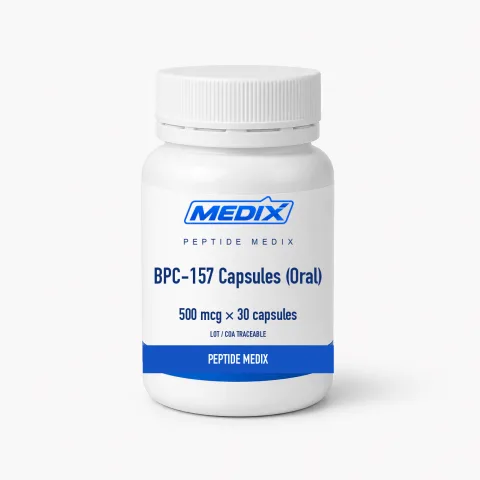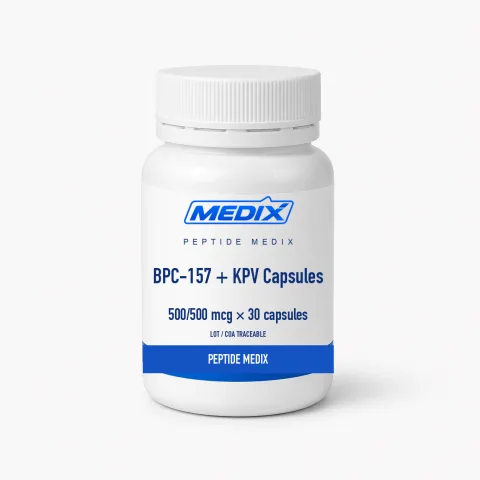
- HPLC-assayed purity of ≥99%
- Certificate of analysis tied to your lot number
- Tracked EU delivery, dispatched the next working day
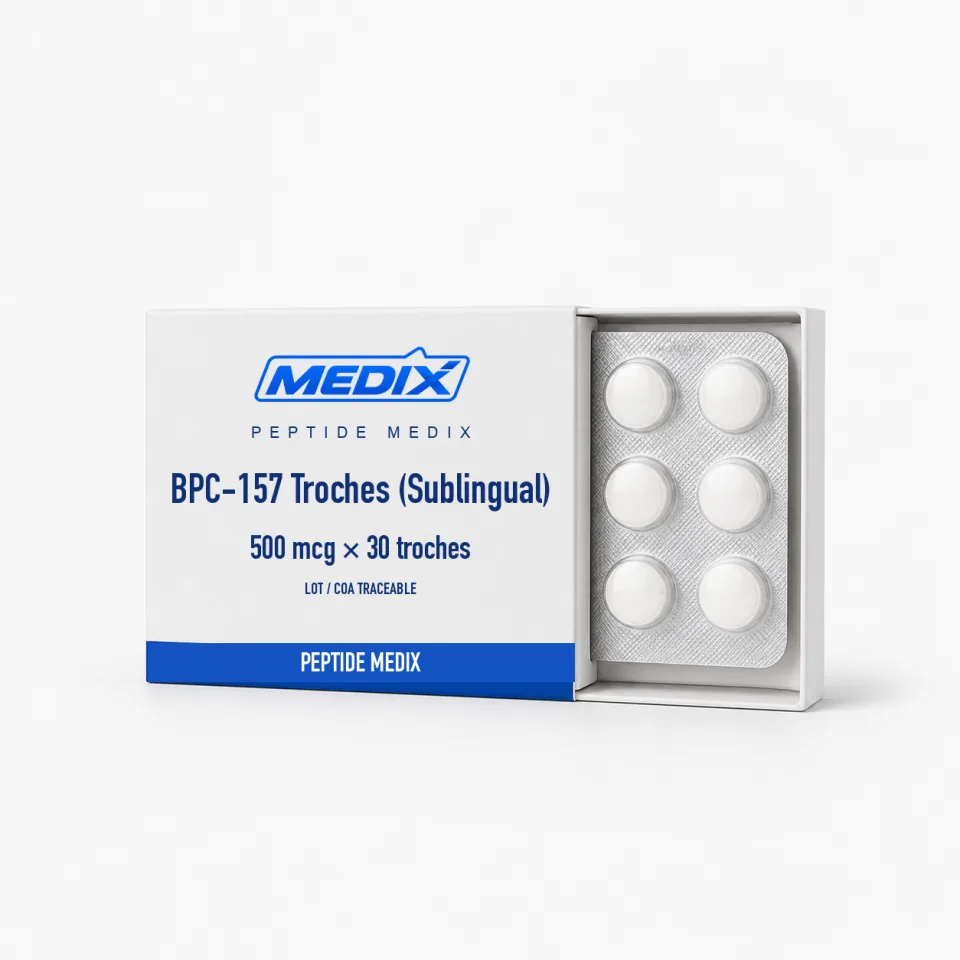
BPC-157 Troches (Sublingual)
BPC-157 in sublingual troche form — 500 mcg per troche
In stock1 format available
€76
This listing is currently unavailable. Contact us and we will tell you when it is back or suggest an equivalent.
Ask about this listing or request its COA- FormSublingual troche in a slowly dissolving compounding base
- Research areasGastrointestinal mucosal integrity, barrier function, transmucosal peptide delivery, formulation stability
For laboratory research use only. Sold exclusively for in-vitro laboratory research by qualified professionals. Not for human or veterinary use, and not a medicine, food, cosmetic or dietary supplement. Terms and Conditions
Overview
Key facts
This product delivers BPC-157 in a slow-dissolving sublingual base instead of as lyophilised powder that needs reconstitution.
- CAS number
- 137525-51-0
- Molecular formula
- C62H98N16O22
- Molecular weight
- 1419.55 g/mol
- Purity
- ≥99% by HPLC before compounding; lot-matched COA available
- Form
- Sublingual troche in a slowly dissolving compounding base
- Storage
- Cool, dry and dark in the closed pack; refrigeration extends shelf stability
- Available size
- 500 mcg · 30 troches
For research use only. Not for human consumption.
This product delivers BPC-157 in a slow-dissolving sublingual base instead of as lyophilised powder that needs reconstitution. Each troche contains 500 micrograms of the pentadecapeptide, and a pack contains thirty. The peptide is the same as in our vials and capsules: the 15-residue sequence Gly-Glu-Pro-Pro-Pro-Gly-Lys-Pro-Ala-Asp-Asp-Ala-Gly-Leu-Val, a partial fragment of body protection compound from human gastric juice, produced by solid-phase synthesis and HPLC-purified to ≥99%.
BPC-157 lends itself unusually well to transmucosal research because of its exceptional stability for a peptide of this size. The parent protein originates in the stomach, and stability studies report that the fragment withstands acidic aqueous conditions that would quickly break down most peptides. That is exactly why the literature covers oral, intragastric and now transmucosal routes, not just injection.
What sets this listing apart
BPC-157 Troches (Sublingual) – troches, 500 mcg. Sublingual troche in a slowly dissolving compounding base. Other BPC-157 listings differ in format, fill or combination partners; the specification and COA always refer to the listing you order.
Same compound, other listings
Specifications
Supply & purity
- Form
- Sublingual troche in a slowly dissolving compounding base
Additional detail
- Peptide content
- 500 mcg BPC-157 per troche
- Available size
- 30 troches per pack
- Active component
- BPC-157, synthetic gastric pentadecapeptide
- Amino acid sequence (active)
- Gly-Glu-Pro-Pro-Pro-Gly-Lys-Pro-Ala-Asp-Asp-Ala-Gly-Leu-Val
- CAS number (active)
- 137525-51-0
- Molecular formula (active)
- C62H98N16O22
- Molecular weight (active)
- 1419.55 g/mol
- Peptide purity
- ≥99% by HPLC before compounding; lot-matched COA available
- Delivery route studied
- Sublingual and buccal mucosal absorption
- Research areas
- Gastrointestinal mucosal integrity, barrier function, transmucosal peptide delivery, formulation stability
- Preparation required
- None — fixed unit content, no reconstitution or dilution step
- Storage
- Cool, dry and dark in the closed pack; refrigeration extends shelf stability
Questions about BPC-157 Troches (Sublingual)
What distinguishes the troches from BPC-157 capsules?
Both provide fixed 500 mcg units of the identical peptide, but they release it in different places. A capsule empties into the gastrointestinal tract, while a troche dissolves on the oral mucosa, allowing part of the peptide to pass that epithelium directly and avoid first-pass metabolism in the liver.
Is it the same peptide as the powder in the vials?
Yes. Our vials, capsules and troches all use the same HPLC-purified, solid-phase synthesised BPC-157. Only the delivery format varies, which allows matched comparisons between formats without introducing a second material variable.
What proportion of the peptide crosses the mucosa?
No published constant exists — finding out is the point of the research. Peptides of this molecular weight usually permeate the mucosa only modestly, and troche studies are set up specifically to measure that fraction under defined formulation conditions.
Which purity documents are available?
The peptide used in production is released at ≥99% purity by reversed-phase HPLC, and the lot's certificate of analysis can be requested. Filing it with your records links the compounded troches to the exact peptide lot inside them.
Why is temperature control stressed?
Heat softens troche bases and they absorb humidity from the air, which deforms them and speeds up peptide breakdown. Storing the closed pack cool, dry and dark preserves both the physical form and the peptide content for the planned period of use.
Related