- HPLC-assayed purity of ≥99%
- Certificate of analysis tied to your lot number
- Tracked EU delivery, dispatched the next working day
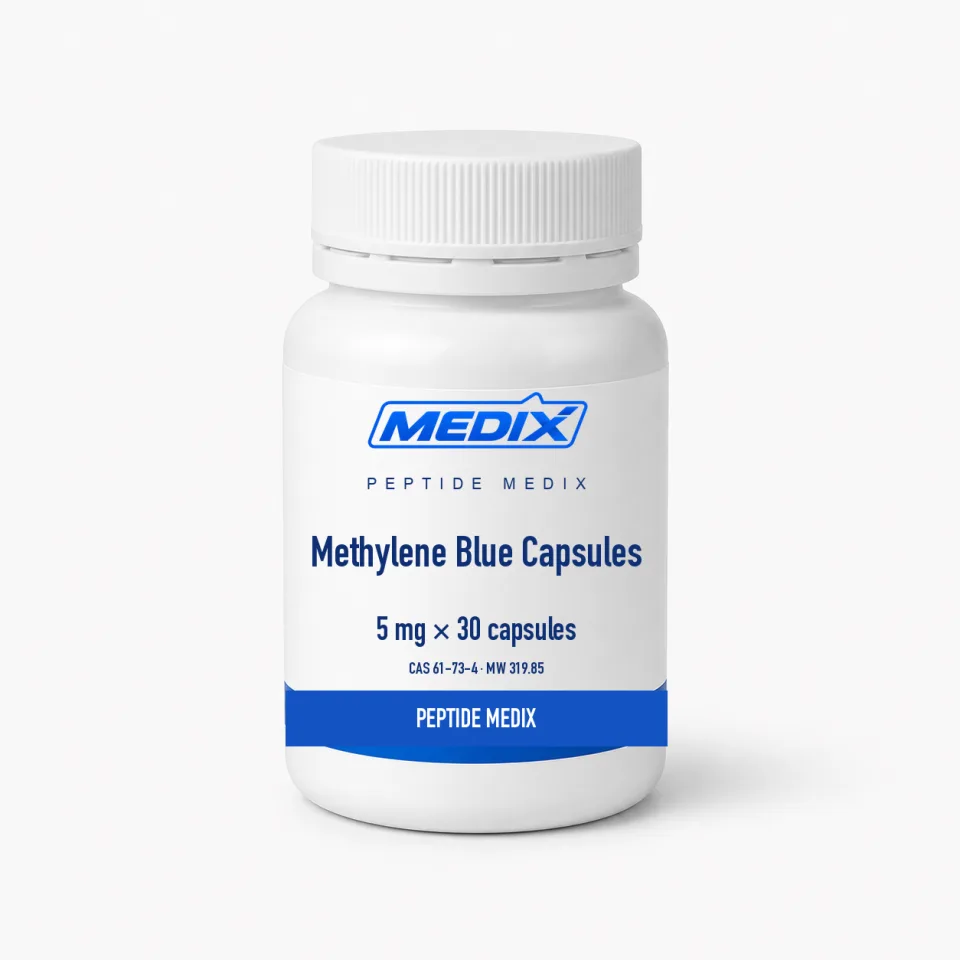
Methylene Blue Capsules
Methylthioninium chloride in capsules of 5 mg, 10 mg or 25 mg
In stock3 formats availableCAS 61-73-4
€46Range €46 – €72
This listing is currently unavailable. Contact us and we will tell you when it is back or suggest an equivalent.
Ask about this listing or request its COA- FormPre-filled oral-style capsules in a sealed bottle
- Mol. weight319.85 g/mol
- Research areasMitochondrial electron transport, redox cycling, MAO-A inhibition, protein aggregation assays, histological staining
For laboratory research use only. Sold exclusively for in-vitro laboratory research by qualified professionals. Not for human or veterinary use, and not a medicine, food, cosmetic or dietary supplement. Terms and Conditions
Overview
Key facts
Methylene blue — methylthioninium chloride — is a phenothiazinium dye first made in 1876 and among the oldest synthetic substances still used continuously in science.
- CAS number
- 61-73-4
- Molecular formula
- C16H18ClN3S
- Molecular weight
- 319.85 g/mol
- Form
- Pre-filled oral-style capsules in a sealed bottle
- Storage
- Cool, dry place in the sealed bottle, protected from light
- Available sizes
- 5 mg · 30 capsules · 10 mg · 30 capsules · 25 mg · 30 capsules
For research use only. Not for human consumption.
Methylene blue — methylthioninium chloride — is a phenothiazinium dye first made in 1876 and among the oldest synthetic substances still used continuously in science. It gave rise to the phenothiazine class of drugs, was the first synthetic agent deployed against malaria, and is still a routine stain in histology. What defines it is reversible redox cycling: the blue, oxidised dye takes up electrons to become colourless leucomethylene blue and then releases them again — a cycle behind most of its uses in research.
Sold as pre-filled capsules in three strengths, 30 per bottle, each lot with its own Certificate of Analysis.
Specifications
Identity
- CAS number
- 61-73-4
- Molecular formula
- C16H18ClN3S
- Molecular weight
- 319.85 g/mol
Supply & purity
- Form
- Pre-filled oral-style capsules in a sealed bottle
- Solubility
- Soluble in water and ethanol
Additional detail
- Available strengths
- 5 mg, 10 mg and 25 mg per capsule
- Count
- 30 capsules per bottle
- Compound
- Methylene blue (methylthioninium chloride)
- Chemical class
- Phenothiazinium redox dye, small molecule
- Appearance
- Dark green to blue crystalline powder; deep blue in aqueous solution
- Research areas
- Mitochondrial electron transport, redox cycling, MAO-A inhibition, protein aggregation assays, histological staining
- Storage
- Cool, dry place in the sealed bottle, protected from light
- Handling note
- Stains skin, fabric and lab surfaces; wear gloves and work over a protected bench
Questions about Methylene Blue Capsules
What kind of substance is methylene blue?
A phenothiazinium dye (methylthioninium chloride) that switches back and forth between a blue oxidised state and a colourless reduced one. Researchers use it in redox chemistry, mitochondrial studies and protein-aggregation assays, and it remains a classic histology stain.
Which strengths can I choose?
5 mg, 10 mg or 25 mg per capsule, 30 capsules to a bottle. Pre-measured capsules are handy when a protocol needs the same amount repeatedly and you would rather not weigh out a staining dye each time.
Does methylene blue belong to the peptides?
No — it is a small-molecule dye of 319.85 g/mol with no connection to peptides. We stock it because labs investigating mitochondrial function commonly work with both kinds of compound.
Is every lot analysed?
Yes, and each comes with its own Certificate of Analysis for identity and purity. Purity is especially important here: dye grades vary enormously, and metal contaminants can skew redox experiments.
How do I deal with stains and spills?
Wear gloves and cover your work surface. The dye marks skin, clothes and glass, and residues left on labware can contaminate later preparations and throw off spectrophotometric readings. Wipe up spills at once and, where possible, reserve dedicated glassware for dye work.
Related