- HPLC-assayed purity of ≥99%
- Certificate of analysis tied to your lot number
- Tracked EU delivery, dispatched the next working day
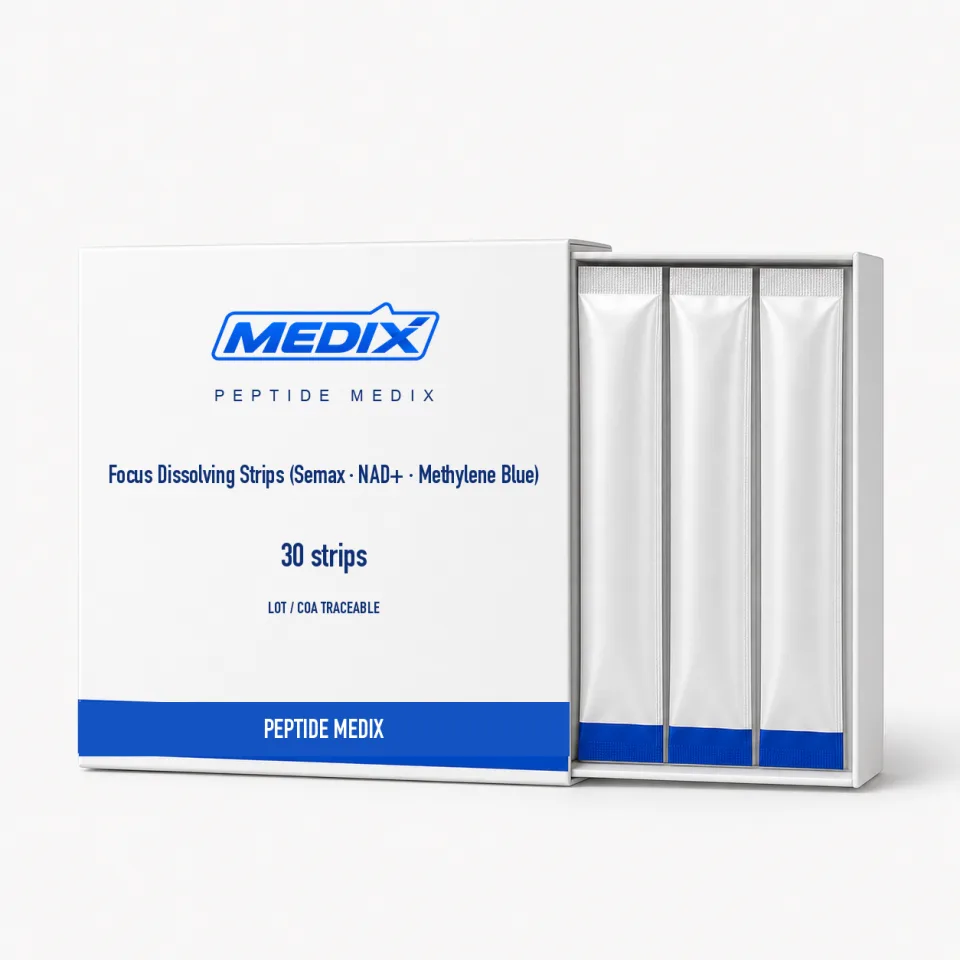
Focus Dissolving Strips (Semax · NAD+ · Methylene Blue)
Thin-film research strips combining Semax, NAD+ and methylene blue
In stock1 format available
€42
This listing is currently unavailable. Contact us and we will tell you when it is back or suggest an equivalent.
Ask about this listing or request its COA- FormFast-dissolving thin-film strips in a sealed pack
- Research areasAttention and memory paradigms, BDNF expression, mitochondrial redox and NAD+ metabolism, electron-transport chain models, delivery-format comparison
For laboratory research use only. Sold exclusively for in-vitro laboratory research by qualified professionals. Not for human or veterinary use, and not a medicine, food, cosmetic or dietary supplement. Terms and Conditions
Overview
Key facts
These dissolving strips combine three compounds that are normally studied one at a time — the heptapeptide Semax, the coenzyme NAD+ and the phenothiazinium dye methylene blue — in a single, pre-dosed thin film.
- Form
- Fast-dissolving thin-film strips in a sealed pack
- Storage
- Sealed, cool and dry, protected from light and moisture
- Available size
- 30 strips
For research use only. Not for human consumption.
These dissolving strips combine three compounds that are normally studied one at a time — the heptapeptide Semax, the coenzyme NAD+ and the phenothiazinium dye methylene blue — in a single, pre-dosed thin film. A pack contains 30 strips. Each film is a water-soluble polymer sheet with a set load per strip, so you can assemble a study arm by counting strips instead of weighing three materials, working out three dilutions and merging them into one vehicle.
Each active addresses a different aspect of one wider question: what constrains sustained cognitive performance at the cellular level? Semax (CAS 80714-61-0, Met-Glu-His-Phe-Pro-Gly-Pro) is a synthetic ACTH(4–10) analogue investigated via BDNF and NGF expression and attention tasks. NAD+ (CAS 53-84-9) is the pyridine dinucleotide coenzyme central to mitochondrial redox reactions and the substrate that sirtuins and PARPs consume. Methylene blue (CAS 61-73-4) is a redox-cycling dye that mitochondrial researchers study as an alternative electron carrier at low concentration.
Putting a neuropeptide, a redox coenzyme and a redox-active dye into one film gives researchers a single test article spanning signalling, cofactor supply and electron transport at once — handy for exploratory arms, although isolating any single contribution requires the individual compounds. Every raw material is HPLC-tested by an independent lab to ≥99% purity, with a COA for the lot.
What sets this listing apart
Focus Dissolving Strips (Semax · NAD+ · Methylene Blue) – dissolving strips. Fast-dissolving thin-film strips in a sealed pack. Other Semax listings differ in format, fill or combination partners; the specification and COA always refer to the listing you order.
Same compound, other listings
Specifications
Supply & purity
- Form
- Fast-dissolving thin-film strips in a sealed pack
- Solubility
- Film matrix and all three actives disperse in water and bacteriostatic water
Additional detail
- Pack size
- 30 individual film strips
- Actives
- Semax, NAD+ (nicotinamide adenine dinucleotide) and methylene blue, pre-loaded per strip
- Purity (raw materials)
- ≥99% by HPLC per component; lot-matched COA available
- Semax identity
- CAS 80714-61-0; C37H51N9O10S; 813.93 g/mol; Met-Glu-His-Phe-Pro-Gly-Pro
- NAD+ identity
- CAS 53-84-9; C21H27N7O14P2; 663.43 g/mol
- Methylene blue identity
- CAS 61-73-4; C16H18ClN3S; 319.85 g/mol
- Compound classes
- Synthetic heptapeptide, pyridine dinucleotide coenzyme, phenothiazinium redox dye
- Appearance
- Coloured film — methylene blue imparts a deep blue tint to the matrix
- Research areas
- Attention and memory paradigms, BDNF expression, mitochondrial redox and NAD+ metabolism, electron-transport chain models, delivery-format comparison
- Storage
- Sealed, cool and dry, protected from light and moisture
- Handling note
- Methylene blue stains skin, gloves, fabric and bench surfaces — handle with dry gloves over a protected surface
Questions about Focus Dissolving Strips (Semax · NAD+ · Methylene Blue)
What does one strip contain?
A water-soluble film loaded with three actives: Semax, a synthetic heptapeptide analogue of ACTH(4–10); NAD+, the pyridine dinucleotide coenzyme; and methylene blue, a phenothiazinium redox dye. The amount per strip is set during manufacture and can only be changed by switching to the single-compound products.
How many strips are in a pack?
Each sealed pack holds thirty pre-dosed strips. Because every strip carries a fixed amount, you build study arms by counting strips — no weighing of three separate materials or combining three dilutions into one vehicle.
Are the ingredients independently tested, with a COA?
Yes. An independent lab analyses each raw material by HPLC to ≥99% purity and confirms its identity, and the Certificate of Analysis for your batch is available. Check that the pack's lot number matches the COA before logging results.
Why does the film leave stains?
Methylene blue is an intensely coloured dye — it is what tints the strips. Once moist, it marks skin, gloves, fabrics and benches, so handle strips with dry gloves over a covered surface and wipe up any spills with water before the colour fixes.
Is reconstitution necessary?
No. The film dissolves straight into aqueous media, so there is nothing to weigh, no solvent to add, no mixing or filtering and no bacteriostatic water to buy. The sealed pack also ships without cold chain, unlike lyophilised vials or ready-mixed solutions.
Can the strips show the effect of just one component?
No. A fixed three-part film cannot pin an observed change on any single active; it serves as an exploratory arm. For attribution, run Semax, NAD+ and methylene blue as single-compound formats in parallel with the combined strips.