- HPLC-assayed purity of ≥99%
- Certificate of analysis tied to your lot number
- Tracked EU delivery, dispatched the next working day
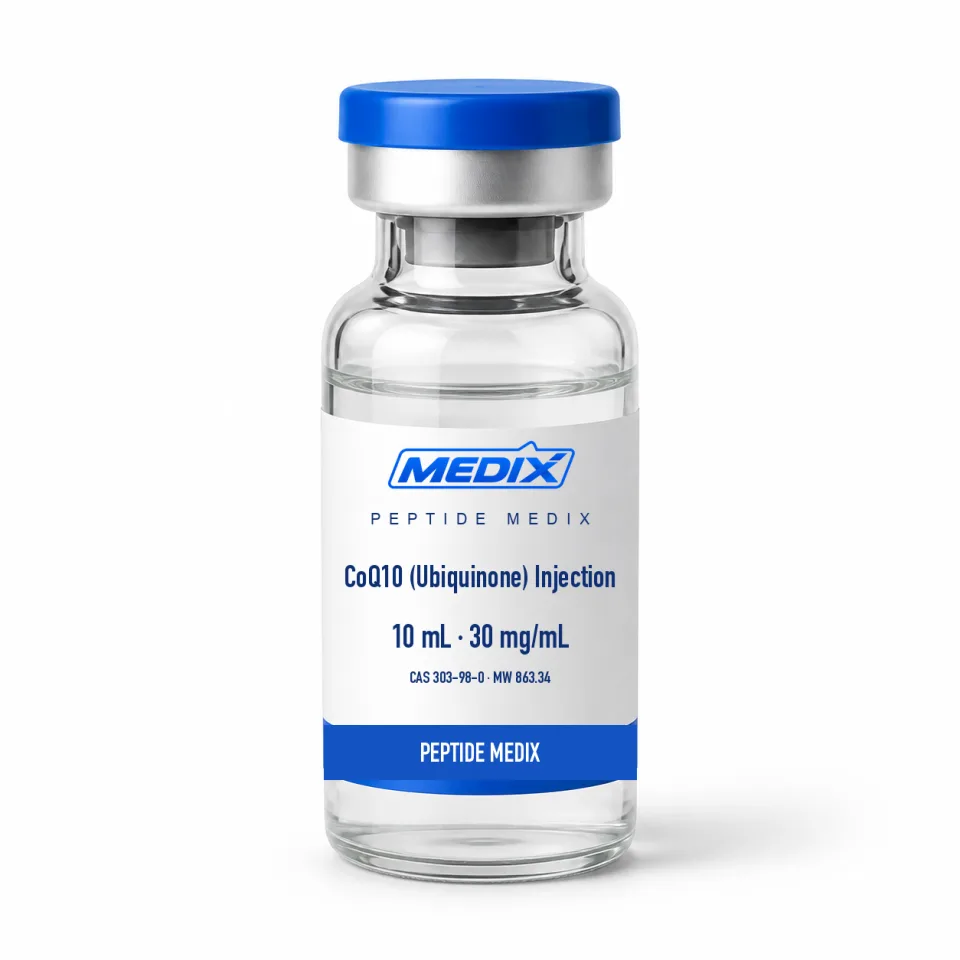
CoQ10 (Ubiquinone) Injection
Ubiquinone made water-compatible at 30 mg/mL — 10 mL vial for mitochondrial studies
In stock1 format availableCAS 303-98-0
€55
This listing is currently unavailable. Contact us and we will tell you when it is back or suggest an equivalent.
Ask about this listing or request its COA- Mol. weight863.34 g/mol
- Research areasMitochondrial bioenergetics, oxidative stress and lipid peroxidation, statin-associated CoQ10 depletion, mitochondrial myopathy models
For laboratory research use only. Sold exclusively for in-vitro laboratory research by qualified professionals. Not for human or veterinary use, and not a medicine, food, cosmetic or dietary supplement. Terms and Conditions
Overview
Key facts
Coenzyme Q10 (2,3-dimethoxy-5-methyl-6-decaprenyl-1,4-benzoquinone) is the fat-soluble carrier that passes electrons from respiratory complexes I and II on to complex III inside mitochondria.
- CAS number
- 303-98-0
- Molecular formula
- C59H90O4
- Molecular weight
- 863.34 g/mol
- Storage
- 2–8 °C preferred, tightly sealed and protected from light; do not freeze
- Available size
- 10 mL · 30 mg/mL
For research use only. Not for human consumption.
Coenzyme Q10 (2,3-dimethoxy-5-methyl-6-decaprenyl-1,4-benzoquinone) is the fat-soluble carrier that passes electrons from respiratory complexes I and II on to complex III inside mitochondria. Its benzoquinone head exists in three redox states — oxidised ubiquinone (the form in this vial), the partly reduced ubisemiquinone radical, and fully reduced ubiquinol — while its tail of ten isoprene units anchors it in the inner mitochondrial membrane.
The single 10 mL vial is filled at 30 mg/mL, i.e. 300 mg of ubiquinone in total. This format addresses a practical problem: coenzyme Q10 hardly dissolves in water, so aqueous experiments need a solubilising carrier, and making one from bulk powder in-house is a common cause of lab-to-lab variability. The vehicle is therefore part of the product, and vehicle-only controls should run through any study that uses it. Published research in this area includes mitochondrial bioenergetics and respirometry, lipid peroxidation and oxidative-stress markers, statin-related coenzyme Q10 depletion and models of mitochondrial myopathy. Store refrigerated at 2–8 °C, tightly closed and protected from light — the benzoquinone head is light-sensitive, and its breakdown is visible as a change in colour.
Specifications
Identity
- CAS number
- 303-98-0
- Molecular formula
- C59H90O4
- Molecular weight
- 863.34 g/mol
Supply & purity
- Solubility
- Practically insoluble in water; formulated with a solubilising carrier for aqueous use
Additional detail
- Concentration
- 30 mg/mL ubiquinone
- Vial size
- 10 mL (300 mg total content)
- Also known as
- Coenzyme Q10, ubiquinone, ubidecarenone, CoQ10
- Chemical class
- 1,4-benzoquinone with a ten-unit polyisoprenoid side chain
- Redox states
- Ubiquinone (oxidised) ⇄ ubisemiquinone ⇄ ubiquinol (reduced)
- Biochemical role
- Electron carrier between respiratory complexes I/II and III; membrane-phase antioxidant
- Research areas
- Mitochondrial bioenergetics, oxidative stress and lipid peroxidation, statin-associated CoQ10 depletion, mitochondrial myopathy models
- Storage
- 2–8 °C preferred, tightly sealed and protected from light; do not freeze
Questions about CoQ10 (Ubiquinone) Injection
Is it ubiquinone or ubiquinol?
Ubiquinone — the oxidised form and the more storage-stable of the two. Ubiquinol, the reduced form, oxidises quickly in air. Cells convert one into the other enzymatically, so the redox form supplied matters chiefly for stability and analytical work.
Why must it be kept away from light?
Light breaks down the benzoquinone head group, lowering the content and changing the colour of the liquid. Keep the vial in its box or wrapped up, and leave it on a brightly lit bench as briefly as possible, so the concentration stays as stated for as long as you use it.
Which documents accompany the vial?
A certificate of analysis for your lot, covering identity and content of the coenzyme Q10, is available. Keep it with your records so analytical results can be traced to the lot used to generate them.
Related