- Independent lab testing; per-lot COA on request
- Certificate of analysis tied to your lot number
- Tracked EU delivery, dispatched the next working day
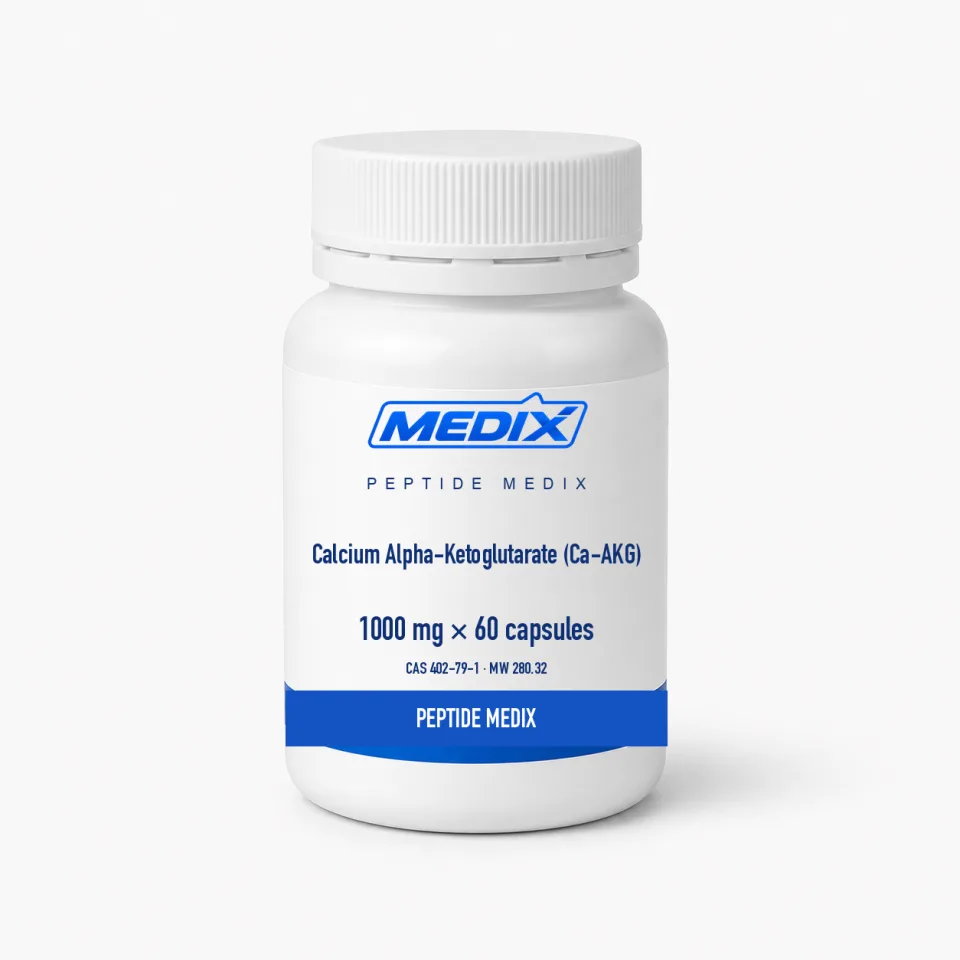
Calcium Alpha-Ketoglutarate (Ca-AKG)
Calcium salt of the TCA-cycle metabolite 2-oxoglutarate in 1000 mg capsules
In stock1 format availableCAS 402-79-1
€38
This listing is currently unavailable. Contact us and we will tell you when it is back or suggest an equivalent.
Ask about this listing or request its COA- FormWhite to off-white crystalline powder, encapsulated
- Research areasMitochondrial metabolism, epigenetic regulation, HIF signalling, nitrogen balance, aging biology
For laboratory research use only. Sold exclusively for in-vitro laboratory research by qualified professionals. Not for human or veterinary use, and not a medicine, food, cosmetic or dietary supplement. Terms and Conditions
Overview
Key facts
Ca-AKG — calcium alpha-ketoglutarate — is the calcium salt of alpha-ketoglutaric acid, which biochemists usually call 2-oxoglutarate, a core intermediate of the tricarboxylic acid (Krebs) cycle.
- CAS number
- 402-79-1
- Purity
- Third-party tested; lot-matched COA available
- Form
- White to off-white crystalline powder, encapsulated
- Storage
- Cool, dry, sealed container protected from light and moisture
- Available size
- 1000 mg · 60 capsules
For research use only. Not for human consumption.
Ca-AKG — calcium alpha-ketoglutarate — is the calcium salt of alpha-ketoglutaric acid, which biochemists usually call 2-oxoglutarate, a core intermediate of the tricarboxylic acid (Krebs) cycle. Pairing the acid with calcium converts a moisture-attracting, strongly acidic solid into a stable powder that flows freely and is much easier to weigh, encapsulate and keep, so research material is almost always sold as the salt rather than the free acid.
2-Oxoglutarate occupies one of metabolism's busiest crossroads. Isocitrate dehydrogenase produces it and the alpha-ketoglutarate dehydrogenase complex consumes it; it takes up amino groups during transamination, connecting carbon and nitrogen metabolism; and it is an essential co-substrate of the large class of 2-oxoglutarate-dependent dioxygenases, including TET DNA demethylases, JmjC histone demethylases and the prolyl hydroxylases controlling HIF-1α. It is this last function that makes a plain Krebs-cycle metabolite so common in epigenetic and ageing research.
Specifications
Identity
- CAS number
- 402-79-1
Supply & purity
- Form
- White to off-white crystalline powder, encapsulated
- Purity
- Third-party tested; lot-matched COA available
- Available sizes
- 1000 mg × 60 capsules
- Solubility
- Sparingly soluble in water; solubility of the calcium salt is lower than that of the free acid
Additional detail
- Chemical class
- Calcium salt of alpha-ketoglutaric acid (2-oxoglutaric acid)
- Free acid
- Alpha-ketoglutaric acid, C5H6O5, 146.11 g/mol, CAS 328-50-7
- Also known as
- Ca-AKG, calcium 2-oxoglutarate, calcium alpha-ketoglutarate
- Metabolic role
- TCA-cycle intermediate between isocitrate and succinyl-CoA
- Key enzymes
- Isocitrate dehydrogenase (produces it), alpha-ketoglutarate dehydrogenase complex (consumes it), transaminases
- Cofactor role
- Co-substrate for 2-oxoglutarate-dependent dioxygenases including TET enzymes, JmjC histone demethylases and prolyl hydroxylases
- Research areas
- Mitochondrial metabolism, epigenetic regulation, HIF signalling, nitrogen balance, aging biology
- Storage
- Cool, dry, sealed container protected from light and moisture
Questions about Calcium Alpha-Ketoglutarate (Ca-AKG)
How do AKG and Ca-AKG differ?
AKG means the alpha-ketoglutarate anion, available as free acid or as a salt; Ca-AKG is specifically its calcium salt. The salt attracts far less moisture and is much less acidic than the free acid, so it is stable enough to weigh and put into capsules — the same anion in a more convenient solid.
Why is a Krebs-cycle intermediate studied in ageing research?
2-Oxoglutarate is a required co-substrate for a large dioxygenase family that includes TET DNA demethylases, JmjC histone demethylases and HIF prolyl hydroxylases. This gives a simple metabolite direct influence over epigenetic and hypoxia signalling, which explains its recurring presence in ageing studies.
Can I get purity documentation?
Yes. The material is tested by an independent lab and the lot's certificate of analysis is available on request. As Ca-AKG is a small molecule, not a peptide, it is tested with small-molecule identity and purity methods instead of the HPLC peptide-purity assays used for most of our range.
How is Ca-AKG best stored?
In a sealed container, somewhere cool and dry, away from light and humidity. The calcium salt is much more stable than the free acid, yet loose powder still picks up moisture from the air and clumps if left open — close the container after every use.
Is Ca-AKG readily water-soluble?
No, it dissolves only sparingly; the calcium salt is much less soluble in water than the free acid. Protocols for solutions often apply gentle heat and stirring, or begin with alpha-ketoglutaric acid and adjust the pH with a separate base so the calcium contribution remains controlled.
What connects it to NMN and spermidine?
Only the research theme. All three are common in metabolic and ageing-biology papers, but they work through different mechanisms — supplying NAD+ precursor, driving autophagy and polyamine signalling, and providing a dioxygenase co-substrate, respectively. Listing them together reflects shared subject matter, not a combined protocol.
Related