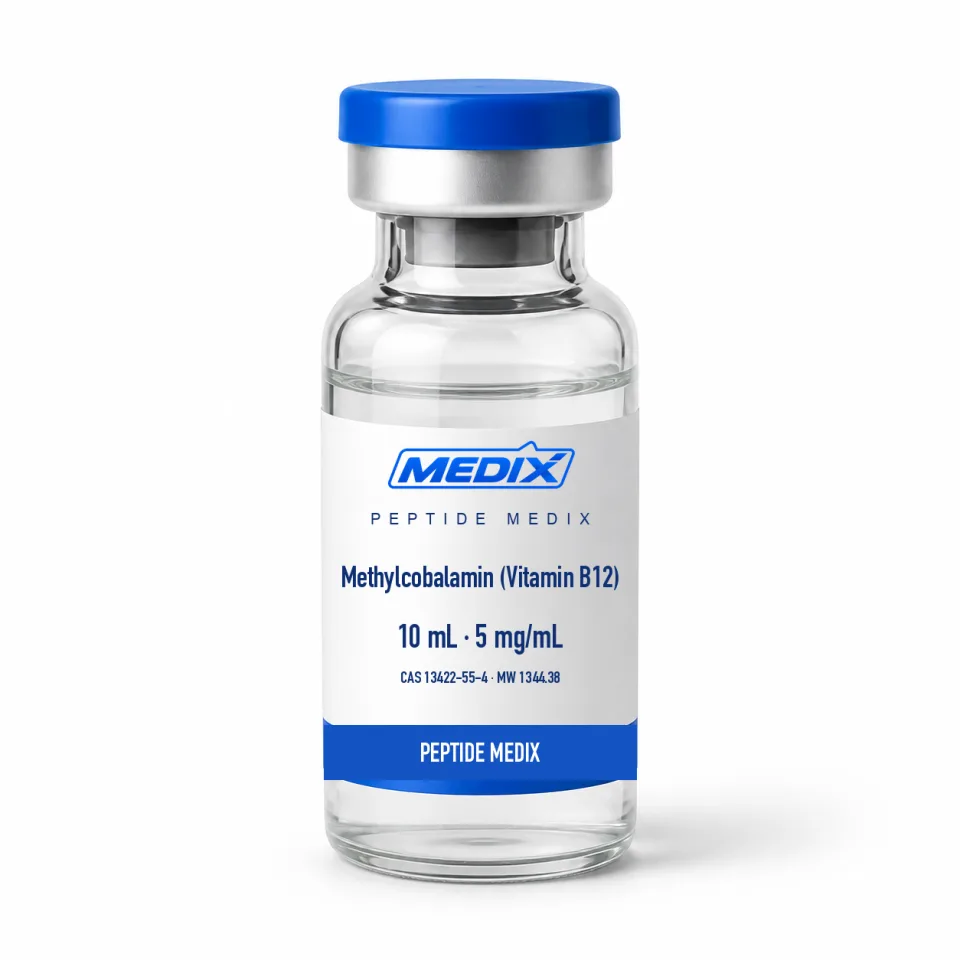
- HPLC-assayed purity of ≥99%
- Certificate of analysis tied to your lot number
- Tracked EU delivery, dispatched the next working day
Methylcobalamin (Vitamin B12)
Methylcobalamin (vitamin B12) solution at 5 mg/mL in 10 mL and 30 mL amber vials
In stock2 formats availableCAS 13422-55-4
€34Range €34 – €68
This listing is currently unavailable. Contact us and we will tell you when it is back or suggest an equivalent.
Ask about this listing or request its COA- FormClear deep-red aqueous solution in an amber vial
- Mol. weight1344.38 g/mol
- Research areasOne-carbon and folate metabolism, homocysteine studies, methylation research, neurological models
For laboratory research use only. Sold exclusively for in-vitro laboratory research by qualified professionals. Not for human or veterinary use, and not a medicine, food, cosmetic or dietary supplement. Terms and Conditions
Overview
Key facts
Methylcobalamin is one of vitamin B12's two coenzyme forms within the cobalt-based corrinoid family.
- CAS number
- 13422-55-4
- Molecular formula
- C63H91CoN13O14P
- Molecular weight
- 1344.38 g/mol
- Form
- Clear deep-red aqueous solution in an amber vial
- Storage
- Refrigerated 2–8 °C, protected from light; do not freeze
- Available sizes
- 10 mL · 5 mg/mL · 30 mL · 5 mg/mL
For research use only. Not for human consumption.
Methylcobalamin is one of vitamin B12's two coenzyme forms within the cobalt-based corrinoid family. At its heart is a cobalt ion enclosed in a corrin ring, topped by a methyl group as the upper axial ligand — the feature separating it from cyanocobalamin, which has cyanide in that position, and from adenosylcobalamin, the mitochondrial coenzyme.
In biochemical terms it serves methionine synthase, the cytosolic enzyme that takes a methyl group from 5-methyltetrahydrofolate and adds it to homocysteine to regenerate methionine. That single step ties B12 status to folate metabolism, homocysteine levels and the supply of S-adenosylmethionine for methylation throughout the cell — links investigated in one-carbon metabolism, methylation and neurological models.
It comes as a ready-to-use aqueous solution, 5 mg/mL, in amber vials of 10 mL or 30 mL. Its deep red colour derives from the cobalt–corrin chromophore and doubles as a warning: cobalamins are highly sensitive to light, so protecting the material from light is the key handling rule. A Certificate of Analysis is available for each lot.
What sets this listing apart
Methylcobalamin (Vitamin B12) – vial, 10/30 mL. Clear deep-red aqueous solution in an amber vial. Other Methylcobalamin listings differ in format, fill or combination partners; the specification and COA always refer to the listing you order.
Same compound, other listings
Specifications
Identity
- CAS number
- 13422-55-4
- Molecular formula
- C63H91CoN13O14P
- Molecular weight
- 1344.38 g/mol
Supply & purity
- Form
- Clear deep-red aqueous solution in an amber vial
- Available sizes
- 10 mL and 30 mL vials
Additional detail
- Concentration
- 5 mg/mL methylcobalamin
- Chemical class
- Cobalamin (corrinoid) coenzyme, vitamin B12 family
- Axial ligand
- Methyl group at the upper (beta) cobalt position
- Enzyme role
- Cofactor for methionine synthase (MTR)
- Research areas
- One-carbon and folate metabolism, homocysteine studies, methylation research, neurological models
- Photosensitivity
- High — degrades under ambient and UV light; keep in amber glass and shielded
- Storage
- Refrigerated 2–8 °C, protected from light; do not freeze
Questions about Methylcobalamin (Vitamin B12)
What exactly is methylcobalamin?
A coenzyme form of vitamin B12 in which a methyl group sits in the upper axial position of the central cobalt ion. It is the cofactor that methionine synthase needs in one-carbon metabolism.
Why not cyanocobalamin?
Cyanocobalamin has a cyanide ligand in that position and must be converted inside the cell before it can function as a coenzyme, whereas methylcobalamin is already active. Cyanocobalamin is, however, more stable in light — why it prevails as an analytical standard.
At what strength and in which sizes?
5 mg/mL, in amber vials of 10 mL or 30 mL. It is ready to use, so you can dilute it straight into your experimental system without weighing or reconstituting anything.
How critical is light protection?
Very. Visible light breaks the cobalt–carbon bond, turning methylcobalamin into hydroxocobalamin and other products; a vial left under room lighting can lose a substantial share of its content within hours. Amber glass and dim handling conditions are essential.
Is each lot analysed?
Yes. Every lot comes with a Certificate of Analysis confirming identity, concentration and purity. Since light damage is the main risk, checking the deep red colour and the spectrophotometric profile when the vial arrives is a worthwhile extra step.
Related