- HPLC purity ≥98%, with a COA for each lot on request
- Certificate of analysis tied to your lot number
- Tracked EU delivery, dispatched the next working day
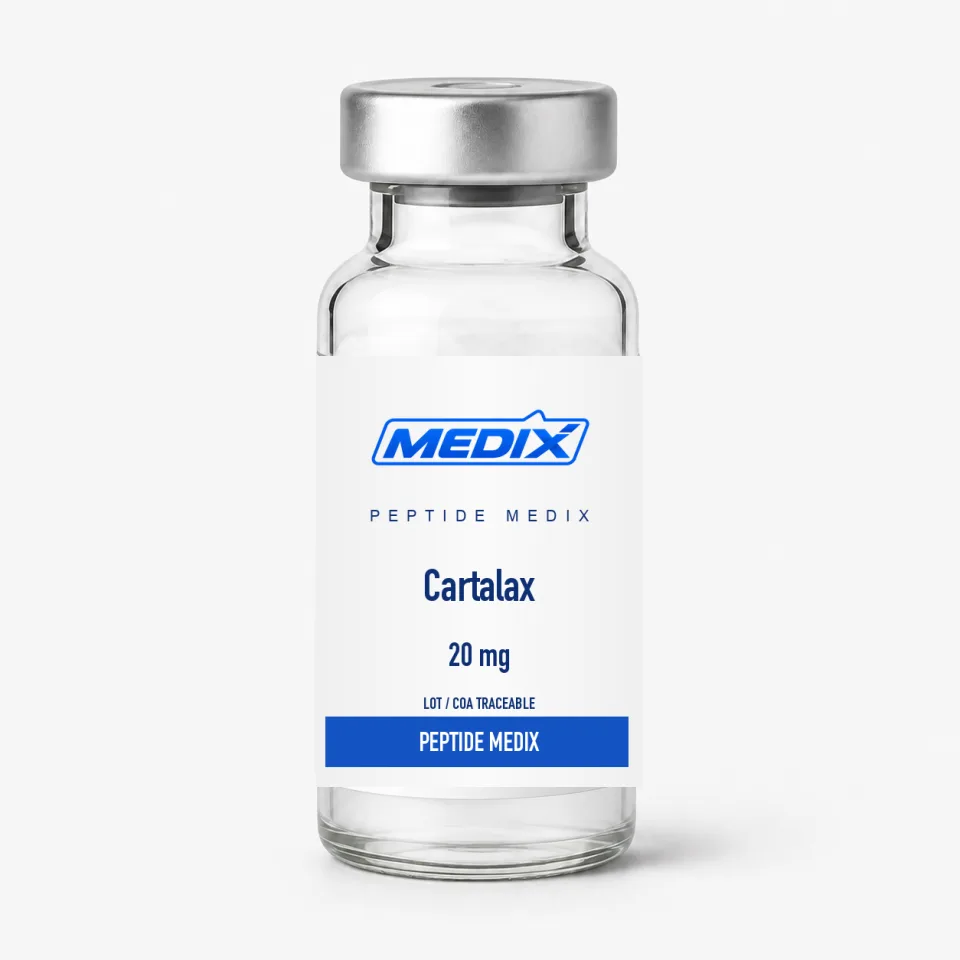
Cartalax
Synthetic Ala-Glu-Asp bioregulator tripeptide used in cartilage research
In stock1 format available
€63
This listing is currently unavailable. Contact us and we will tell you when it is back or suggest an equivalent.
Ask about this listing or request its COA- FormLyophilized powder, sealed glass vial
- Mol. weight333.30 g/mol
- Research areasChondrocyte biology, cartilage matrix expression, peptide–DNA interaction models, cellular senescence
For laboratory research use only. Sold exclusively for in-vitro laboratory research by qualified professionals. Not for human or veterinary use, and not a medicine, food, cosmetic or dietary supplement. Terms and Conditions
Overview
Key facts
Cartalax is the synthetic tripeptide Ala-Glu-Asp (AED), one of the short peptides that came out of the Russian bioregulator programme led by Vladimir Khavinson at the St Petersburg Institute of Bioregulation and Gerontology.
- Molecular formula
- C12H19N3O8
- Molecular weight
- 333.30 g/mol
- Amino acid sequence
- H-Ala-Glu-Asp-OH
- Purity
- ≥98% by HPLC; lot-matched COA available
- Form
- Lyophilized powder, sealed glass vial
- Storage
- −20 °C, sealed and protected from light and moisture
- Available size
- 20 mg
For research use only. Not for human consumption.
Cartalax is the synthetic tripeptide Ala-Glu-Asp (AED), one of the short peptides that came out of the Russian bioregulator programme led by Vladimir Khavinson at the St Petersburg Institute of Bioregulation and Gerontology. There it is classed as the bioregulator for cartilage and connective tissue — the synthetic counterpart of Sigumir, a peptide fraction isolated from animal cartilage.
According to the bioregulator hypothesis, very short tissue-linked peptides work on gene expression rather than through conventional receptors: acidic tri- and tetrapeptides are proposed to enter cells, reach the nucleus and bind promoter regions or histone-associated DNA directly, adjusting the transcription of tissue-specific genes. Cartalax is among the sequences most often used to test this in cartilage and chondrocyte models, and its near relatives — Vesugen (Lys-Glu-Asp), Chonluten (Glu-Asp-Gly) and Epitalon (Ala-Glu-Asp-Gly) — make up a family in which swapping a single residue is claimed to change the target tissue.
It is supplied as lyophilised powder in a sealed 20 mg vial, with a certificate of analysis for each lot. To be clear: bioregulator research comes from a fairly small group of laboratories and journals, and independent confirmation is still scarce. This is not a medicine, supplement or consumer product.
Specifications
Identity
- Molecular formula
- C12H19N3O8
- Molecular weight
- 333.30 g/mol
- Amino acid sequence
- H-Ala-Glu-Asp-OH
- Chain length
- 3 amino acids, free N-terminus and C-terminus
- Peptide class
- Synthetic short-chain bioregulator (Khavinson peptide family)
Supply & purity
- Form
- Lyophilized powder, sealed glass vial
- Purity
- ≥98% by HPLC; lot-matched COA available
- Available sizes
- 20 mg
- Solubility
- Freely soluble in water and bacteriostatic water; solutions are acidic
Handling & storage
- Storage (lyophilized)
- −20 °C, sealed and protected from light and moisture
- Storage (reconstituted)
- 2–8 °C, used within the study window
Additional detail
- Also known as
- AED peptide, Ala-Glu-Asp, cartilage bioregulator peptide
- Associated tissue
- Cartilage and connective tissue
- Related sequences
- Vesugen (Lys-Glu-Asp), Chonluten (Glu-Asp-Gly), Epitalon (Ala-Glu-Asp-Gly), Vilon (Lys-Glu)
- Research areas
- Chondrocyte biology, cartilage matrix expression, peptide–DNA interaction models, cellular senescence
Questions about Cartalax
How does Cartalax differ from Sigumir?
Sigumir is an extract — a peptide fraction from animal cartilage with an undefined composition. Cartalax is one fully synthetic tripeptide, Ala-Glu-Asp, produced by solid-phase synthesis. As the defined synthetic equivalent within the same programme, it is much easier to work with experimentally.
What is its relationship to Epitalon?
A close one. Epitalon is Ala-Glu-Asp-Gly — Cartalax's three residues plus a C-terminal glycine. In the bioregulator framework, that one additional residue supposedly moves the tissue association from cartilage to the pineal gland, and this claim is itself a frequent topic of comparative studies.
Which purity documents are included?
The material is supplied at ≥98% by HPLC, and the certificate for your lot can be requested. Very short peptides such as this usually give clean assays; the COA includes identity by mass spectrometry as well as the HPLC purity value.
How do I reconstitute and store it?
It dissolves easily in bacteriostatic or sterile water — run the diluent down the side of the vial and swirl gently. The resulting solution is acidic, so buffer it or check the pH before adding it to culture medium. Keep the sealed powder at −20 °C and the solution at 2–8 °C, using it within the study period.
How solid is the evidence for bioregulator peptides?
Thin. Most studies come from a handful of labs, often in regional journals, with small samples and little independent replication. The suggested mechanism — peptides acting directly on DNA — is unusual and remains a hypothesis. Including scrambled-sequence controls is recommended.
Why is only one vial size available?
20 mg is the standard fill for every Khavinson bioregulator we list, which keeps lot handling and documentation uniform when researchers compare several family members side by side within one study.
Related