- HPLC purity ≥99% with mass-based identity check; per-lot COA on request
- Certificate of analysis tied to your lot number
- Tracked EU delivery, dispatched the next working day
Tissue Repair & Healing Peptides
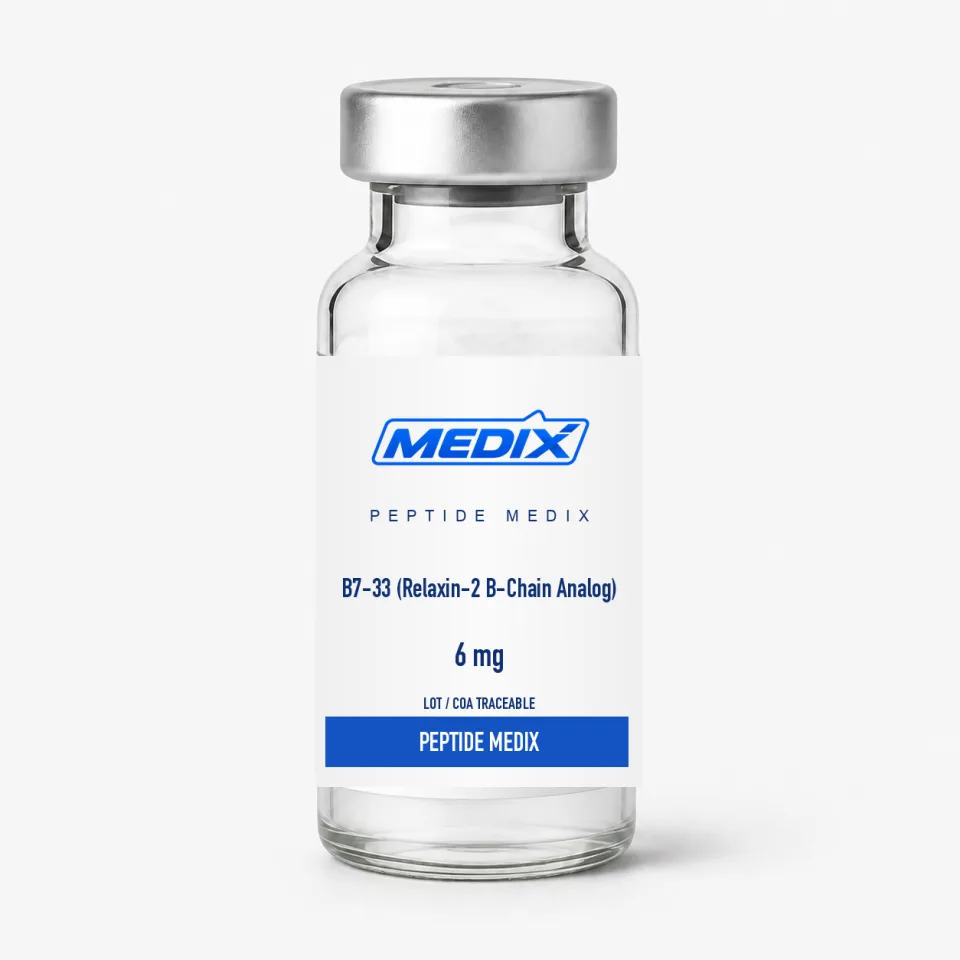
B7-33 (Relaxin-2 B-Chain Analog)
Single-chain 27-residue relaxin-2 B-chain analogue researched as an RXFP1 agonist
In stock1 format available
€63
This listing is currently unavailable. Contact us and we will tell you when it is back or suggest an equivalent.
Ask about this listing or request its COA- FormLyophilized powder, sealed glass research vial
- Research areasRXFP1 signaling bias, fibroblast biology, extracellular-matrix turnover, fibrosis and vascular-response models
For laboratory research use only. Sold exclusively for in-vitro laboratory research by qualified professionals. Not for human or veterinary use, and not a medicine, food, cosmetic or dietary supplement. Terms and Conditions
Overview
Key facts
B7-33 is a synthetic single-chain peptide taken from the receptor-binding part of the human relaxin-2 B chain.
- Amino acid sequence
- Val-Ile-Lys-Leu-Ser-Gly-Arg-Glu-Leu-Val-Arg-Ala-Gln-Ile-Ala-Ile-Ser-Gl…
- Purity
- ≥99% by HPLC; mass-based identity confirmation; lot-matched COA available
- Form
- Lyophilized powder, sealed glass research vial
- Storage
- −20 °C, sealed and protected from light and moisture
- Available size
- 6 mg
For research use only. Not for human consumption.
B7-33 is a synthetic single-chain peptide taken from the receptor-binding part of the human relaxin-2 B chain. Its 27 amino acids keep the arginine-rich motif that relaxin family peptide receptor 1 (RXFP1) recognises, but drop the native hormone's two chains and three disulfides. The name reflects the span covered — B-chain positions 7 to 33 — and since there is no cysteine in the sequence, no oxidative folding is required. The outcome is a linear analogue that is simpler to make and characterise than complete relaxin-2.
Its pharmacological appeal lies in how a single chain alters receptor signalling, not in copying relaxin. Studies at RXFP1 describe it as a biased agonist that favours one arm of the receptor's output rather than the cAMP-heavy profile seen with the native two-chain hormone — which is why researchers test it alongside relaxin-2 rather than as a substitute. Assay choice follows the fibrosis biology of the pathway: fibroblast and myofibroblast cultures, collagen and matrix metalloproteinase expression, and models of cardiac, renal and vascular remodelling. It is stocked as one 6 mg fill; keep it sealed at −20 °C, refrigerate working stocks for a set period, aliquot instead of refreezing, and confirm buffer compatibility for each assay.
Specifications
Identity
- Amino acid sequence
- Val-Ile-Lys-Leu-Ser-Gly-Arg-Glu-Leu-Val-Arg-Ala-Gln-Ile-Ala-Ile-Ser-Gly-Met-Ser-Thr-Trp-Ser-Lys-Arg-Ser-Leu
- Chain length
- 27 amino acids
- Peptide class
- Linear human relaxin-2 B-chain analog
Supply & purity
- Form
- Lyophilized powder, sealed glass research vial
- Purity
- ≥99% by HPLC; mass-based identity confirmation; lot-matched COA available
- Solubility
- Water-soluble research peptide; buffer compatibility should be validated for the selected assay
Handling & storage
- Storage (lyophilized)
- −20 °C, sealed and protected from light and moisture
Additional detail
- Available size
- 6 mg
- Primary research target
- Relaxin family peptide receptor 1 (RXFP1)
- Research areas
- RXFP1 signaling bias, fibroblast biology, extracellular-matrix turnover, fibrosis and vascular-response models
- Distinction
- Not native relaxin-2 or serelaxin; contains one engineered linear chain and no disulfide-linked A chain
- Storage (in solution)
- 2–8 °C for a defined study window; aliquot for longer holds
Questions about B7-33 (Relaxin-2 B-Chain Analog)
What is B7-33?
A synthetic 27-amino-acid analogue based on the B chain of human relaxin-2. It preserves the principal RXFP1-binding motif in a single linear chain, so it is structurally much simpler than native relaxin, whose A and B chains are linked by disulfide bonds.
Which target does B7-33 act on in research?
Its main reported target is RXFP1, the natural receptor for relaxin-2. Studies look at receptor signalling, matrix production by fibroblasts, fibrotic remodelling and vascular readouts; outcomes vary with cell type, receptor density and study design.
What purity records are provided?
The peptide is released at ≥99% purity by reversed-phase HPLC, with identity verified against the expected mass. A certificate of analysis bearing the vial's lot number is available for your study files.
How is B7-33 stored?
Store the unopened lyophilised vial at −20 °C, dry and out of the light. Once prepared, refrigerate working stocks for short-term use and aliquot for longer studies so a single solution is not frozen and thawed over and over.