- HPLC purity ≥99%, with a COA for each lot on request
- Certificate of analysis tied to your lot number
- Tracked EU delivery, dispatched the next working day
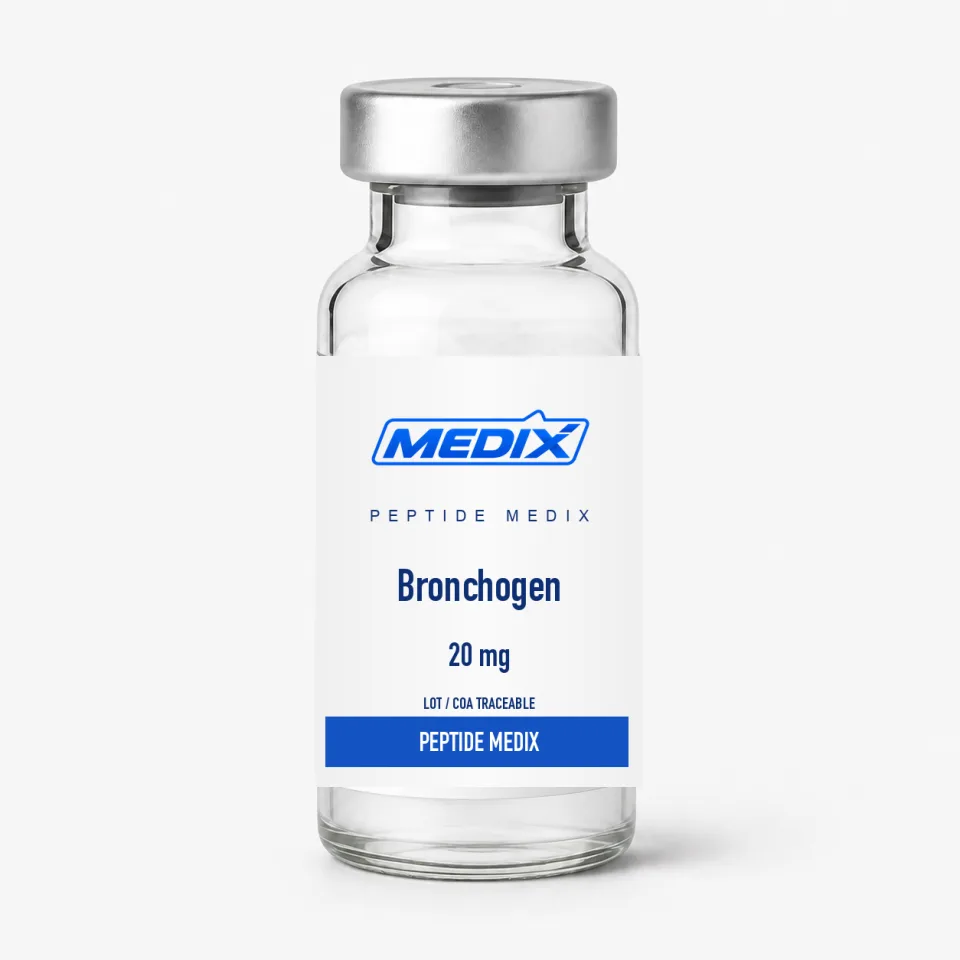
Bronchogen
AEDL (Ala-Glu-Asp-Leu) tetrapeptide for research on bronchial tissue models
In stock1 format available
€63
This listing is currently unavailable. Contact us and we will tell you when it is back or suggest an equivalent.
Ask about this listing or request its COA- FormLyophilized powder in a sealed glass vial
- Mol. weight446.46 g/mol
- Research areasBronchial epithelial culture, lung tissue models, epithelial differentiation markers, gene expression
For laboratory research use only. Sold exclusively for in-vitro laboratory research by qualified professionals. Not for human or veterinary use, and not a medicine, food, cosmetic or dietary supplement. Terms and Conditions
Overview
Key facts
Bronchogen is the synthetic tetrapeptide L-alanyl-L-glutamyl-L-aspartyl-L-leucine — Ala-Glu-Asp-Leu, abbreviated AEDL.
- Molecular formula
- C18H30N4O9
- Molecular weight
- 446.46 g/mol
- Amino acid sequence
- Ala-Glu-Asp-Leu (AEDL), linear tetrapeptide
- Purity
- ≥99% by HPLC; lot-matched COA available
- Form
- Lyophilized powder in a sealed glass vial
- Storage
- −20 °C, sealed and protected from light and moisture
- Available size
- 20 mg
For research use only. Not for human consumption.
Bronchogen is the synthetic tetrapeptide L-alanyl-L-glutamyl-L-aspartyl-L-leucine — Ala-Glu-Asp-Leu, abbreviated AEDL. In the Khavinson series of short-peptide bioregulators it is the sequence linked to bronchial and lung tissue, and it followed the same route as the rest of the family: researchers first examined an organ-derived peptide extract, then pinpointed a short candidate sequence, and finally adopted the defined synthetic tetrapeptide as the research material.
Of the three Ala-Glu-Asp peptides, AEDL is the hydrophobic one. Cortagen finishes with proline and Cardiogen with arginine, whereas Bronchogen finishes with leucine, an uncharged, branched aliphatic residue. On a backbone of only four residues, that one change noticeably shifts solubility, reversed-phase retention and the ratio of polar to nonpolar surface — which is why the three behave differently under the same analytical method although three-quarters of their sequence is identical.
Laboratory studies with AEDL mainly involve bronchial epithelial cell cultures, rodent lung tissue preparations and expression analyses of epithelial differentiation and surfactant-associated markers. We supply Bronchogen in a 20 mg lyophilised vial, made by solid-phase peptide synthesis and HPLC-purified to a ≥99% specification, with a certificate of analysis for each lot. For laboratory research only.
Specifications
Identity
- Molecular formula
- C18H30N4O9
- Molecular weight
- 446.46 g/mol
- Amino acid sequence
- Ala-Glu-Asp-Leu (AEDL), linear tetrapeptide
- Peptide class
- Khavinson short-peptide bioregulator (tetrapeptide)
Supply & purity
- Form
- Lyophilized powder in a sealed glass vial
- Purity
- ≥99% by HPLC; lot-matched COA available
- Available sizes
- 20 mg
- Solubility
- Bacteriostatic or sterile water; readily soluble in aqueous buffers
Handling & storage
- Storage (lyophilized)
- −20 °C, sealed and protected from light and moisture
- Storage (reconstituted)
- 2–8 °C, protected from light; use within the study window
Additional detail
- Tissue association
- Bronchial and lung peptide preparations
- Research areas
- Bronchial epithelial culture, lung tissue models, epithelial differentiation markers, gene expression
- Sequence relationship
- Shares the Ala-Glu-Asp core with Cortagen (AEDP) and Cardiogen (AEDR)
Questions about Bronchogen
What is Bronchogen?
The synthetic tetrapeptide Ala-Glu-Asp-Leu (AEDL), part of the Khavinson short-peptide bioregulator series, where it is associated with bronchial and lung tissue. It is sold as a lyophilised research chemical exclusively for laboratory use.
How do you verify its quality?
Every lot is tested by HPLC against a ≥99% purity specification, and the matching certificate of analysis can be requested. It shows the batch number, purity result, identity confirmation and a physical description of the material.
What difference does the leucine make?
Leucine carries a branched, uncharged and hydrophobic side chain, making AEDL the least polar of the three Ala-Glu-Asp peptides. Solubility and reversed-phase retention shift accordingly, so HPLC methods optimised for Cardiogen or Cortagen frequently need to be adapted.
Why isn't a CAS number given?
This sequence has no widely accepted CAS registry number, so we leave the field empty instead of printing a value we cannot verify. Its identity is defined by sequence, molecular formula and weight, all confirmed on the lot's COA.
What are the storage conditions?
Store the sealed lyophilised vial at −20 °C, away from light and humidity. After reconstitution, keep the solution at 2–8 °C for the planned study period, or freeze single-use aliquots so it is not frozen and thawed repeatedly.