- HPLC-assayed purity of ≥99%
- Certificate of analysis tied to your lot number
- Tracked EU delivery, dispatched the next working day
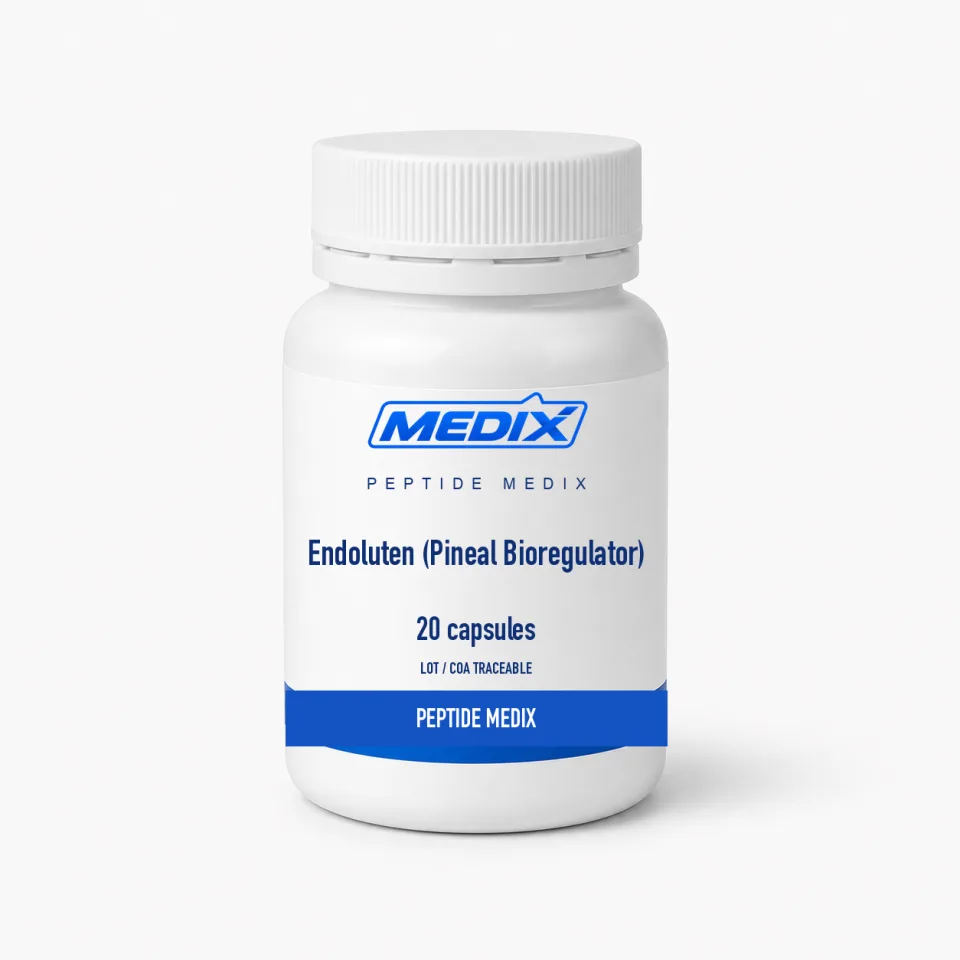
Endoluten (Pineal Bioregulator)
Peptide complex from pineal tissue in capsules — bottles of 20 or 60
In stock2 formats available
€72Range €72 – €182
This listing is currently unavailable. Contact us and we will tell you when it is back or suggest an equivalent.
Ask about this listing or request its COA- FormOral capsule, sealed bottle with tamper-evident closure
- Research areasPineal and circadian signalling, melatonin rhythm models, cellular ageing endpoints
For laboratory research use only. Sold exclusively for in-vitro laboratory research by qualified professionals. Not for human or veterinary use, and not a medicine, food, cosmetic or dietary supplement. Terms and Conditions
Overview
Key facts
Endoluten is a bioregulator preparation linked to the pineal gland, offered here in capsule bottles of 20 or 60.
- Form
- Oral capsule, sealed bottle with tamper-evident closure
- Storage
- Cool, dry conditions away from direct light; refrigeration extends shelf stability
- Available sizes
- 20 capsules · 60 capsules
For research use only. Not for human consumption.
Endoluten is a bioregulator preparation linked to the pineal gland, offered here in capsule bottles of 20 or 60. It is not a single molecule with a single sequence, the way a synthetic peptide such as Epitalon is. Instead, it is a mixture of small peptides extracted from the pineal glands of young cattle, using the extraction and fractionation methods that Vladimir Khavinson's bioregulator programme developed at its gerontology institute in St Petersburg.
That programme — commonly referred to as the cytamin or cytomax approach — rests on the idea of tissue specificity: peptide fractions from a particular organ were thought to influence gene expression in cells of that same organ. A pineal preparation was therefore investigated in pineal and circadian settings, a thymic one in immunological settings, and so forth. Endoluten represents the pineal branch of the family, and its best-known synthetic relative, the AEDG tetrapeptide Epitalon, came from the same research line as a structurally defined stand-in for the pineal extract's activity.
Specifications
Supply & purity
- Form
- Oral capsule, sealed bottle with tamper-evident closure
Additional detail
- Available counts
- 20 capsules, 60 capsules
- Active
- Low-molecular-weight peptide complex from bovine pineal gland
- Molecule type
- Peptide fraction (mixture) — no single sequence or CAS number applies
- Preparation class
- Khavinson-type peptide bioregulator, cytamin/cytomax family
- Tissue association
- Pineal gland
- Synthetic counterpart
- Epitalon (Ala-Glu-Asp-Gly), the defined-structure pineal tetrapeptide
- Documentation
- Peptide content and identity testing; lot-matched COA available
- Excipients
- Inert capsule fill and shell components; no added actives
- Research areas
- Pineal and circadian signalling, melatonin rhythm models, cellular ageing endpoints
- Storage
- Cool, dry conditions away from direct light; refrigeration extends shelf stability
- Preparation required
- None — fixed unit content, no reconstitution step
Questions about Endoluten (Pineal Bioregulator)
What is Endoluten?
A peptide bioregulator preparation from bovine pineal gland, delivered in capsules. It is not a single synthetic sequence but a low-molecular-weight peptide fraction made with the extraction method developed in the Russian bioregulator research programme.
How does it compare with Epitalon?
Epitalon is a single synthetic peptide of four amino acids, Ala-Glu-Asp-Gly, whose structure, formula and CAS number are all known. Endoluten is a mixture taken from the same tissue. Epitalon gives cleaner answers about mechanism, whereas Endoluten stands for the original extract from which that line of research began.
Is there a sequence or CAS number for it?
No. Since the product is a peptide fraction and not one molecule, it has no single amino-acid sequence and no CAS registry entry. It is described instead by how much peptide it contains and by identity tests, both recorded on the certificate for each lot.
What paperwork is available?
On request we send the certificate that matches the lot number on your bottle, giving that batch's peptide content and identity test results. For an extract, these lot-specific records are the only reliable way to know what a given bottle really contains.
Which bottle size suits a lab best?
The 20-capsule bottle works for short pilots and comparison arms; the 60-capsule bottle means fewer lots across a longer study — worth considering, since variation between lots is naturally greater for an extract than for a synthetic peptide.
How should I store the capsules?
Sealed, cool, dry and away from direct light, with the desiccant left in the bottle. Refrigeration is optional but prolongs stability. Don't decant the capsules into open containers, and discard any that have softened, stuck together or changed colour.
Related