- HPLC-assayed purity of ≥99%
- Certificate of analysis tied to your lot number
- Tracked EU delivery, dispatched the next working day
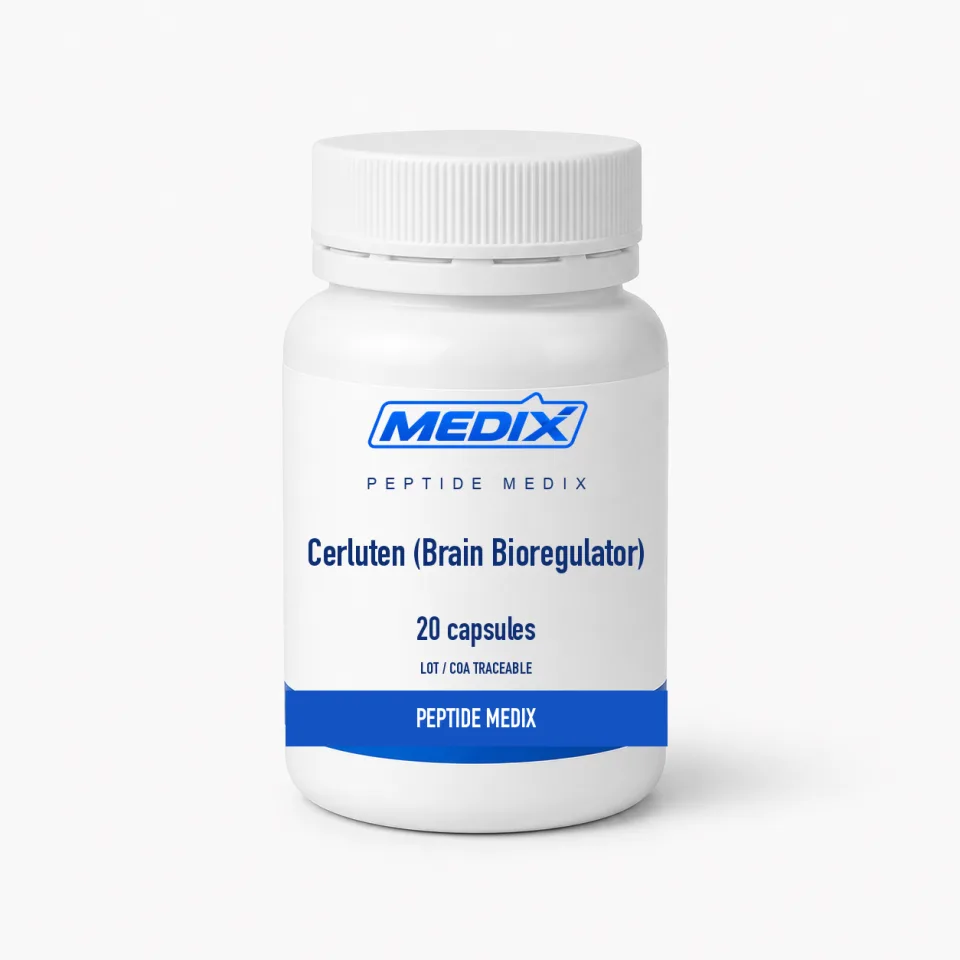
Cerluten (Brain Bioregulator)
Natural brain-derived peptide complex in capsules — 20 or 60 per pack
In stock2 formats available
€72Range €72 – €182
This listing is currently unavailable. Contact us and we will tell you when it is back or suggest an equivalent.
Ask about this listing or request its COA- FormOral capsule in a sealed bottle
- Research areasTissue-specific peptide regulation, neuronal ageing models, gene-expression hypotheses, comparative bioregulator studies
For laboratory research use only. Sold exclusively for in-vitro laboratory research by qualified professionals. Not for human or veterinary use, and not a medicine, food, cosmetic or dietary supplement. Terms and Conditions
Overview
Key facts
Cerluten is a natural complex of peptides, not one defined molecule.
- Form
- Oral capsule in a sealed bottle
- Storage
- Cool, dry and dark in the closed bottle; refrigeration extends shelf stability
- Available sizes
- 20 capsules · 60 capsules
For research use only. Not for human consumption.
Cerluten is a natural complex of peptides, not one defined molecule. It is part of the Cytomax range from the St Petersburg bioregulator programme linked to Vladimir Khavinson, in which low-molecular-weight peptide fractions are extracted from a given animal tissue and studied in relation to that same tissue. Cerluten is the series' brain preparation, alongside Vladonix (thymus), Ventfort (blood vessels) and Endoluten (pineal gland).
It is made by extracting and fractionating nervous tissue from young cattle, so the final complex consists of peptides under about ten kilodaltons plus amino acids and trace elements. Being a mixture, it has no CAS number, molecular formula or single amino acid sequence; it is identified by its fraction profile and source tissue rather than by structure — a sharp contrast with synthetic bioregulators like Pinealon or Cortagen.
Specifications
Supply & purity
- Form
- Oral capsule in a sealed bottle
- Available sizes
- 20 capsules; 60 capsules
Additional detail
- Product type
- Natural peptide complex (mixture), not a single-sequence peptide
- Source tissue
- Nervous tissue of young cattle, extracted and fractionated
- Composition
- Water-soluble peptide fractions with free amino acids and trace elements, plus inert capsule excipients
- Molecular weight range
- Peptide fractions below approximately 10 kDa
- Compound class
- Tissue-derived peptide bioregulator (Cytomax-type natural complex)
- Series relationship
- Brain preparation of the Cytomax line; the synthetic counterparts in the Cytogen line are defined short sequences
- Comparable preparations
- Cortexin and Cerebrolysin, both nervous-tissue polypeptide complexes
- Analytical documentation
- Identity and fraction-profile testing per lot; COA available
- Research areas
- Tissue-specific peptide regulation, neuronal ageing models, gene-expression hypotheses, comparative bioregulator studies
- Storage
- Cool, dry and dark in the closed bottle; refrigeration extends shelf stability
- Preparation required
- None — fixed unit content, no reconstitution step
Questions about Cerluten (Brain Bioregulator)
Why doesn't Cerluten have a CAS number or sequence?
It is a fractionated extract from tissue, not a synthesised compound. The product contains numerous peptides smaller than roughly 10 kDa together with amino acids and trace elements, so it is characterised by source tissue and fraction profile rather than a single structure.
How is it different from Pinealon or Cortagen?
Pinealon (EDR) and Cortagen (AEDP) are synthetic peptides with defined sequences that can be characterised exactly by mass and HPLC. Cerluten belongs to the older, extract-based branch of the same programme, so it is a mixture, not a compound.
How does it compare with Cortexin?
Both are peptide complexes from nervous tissue with comparable molecular-weight profiles. What differs is the format: Cortexin is a lyophilised vial to reconstitute, whereas Cerluten comes in capsules, which puts the two into different delivery settings for research.
Which documents are provided?
The lot's certificate of analysis, covering identity and fraction-profile testing, is available. With extracts this paperwork matters even more than usual, as batch-to-batch composition varies in ways that synthetic peptides do not.
How robust is the evidence?
Modest. The studies come mostly from a single research programme, appear largely in Russian-language journals and have rarely been replicated independently or tested under blinded, controlled conditions. It should be seen as an object of ongoing research, not a proven intervention.