- HPLC purity ≥99%, with a COA for each lot on request
- Certificate of analysis tied to your lot number
- Tracked EU delivery, dispatched the next working day
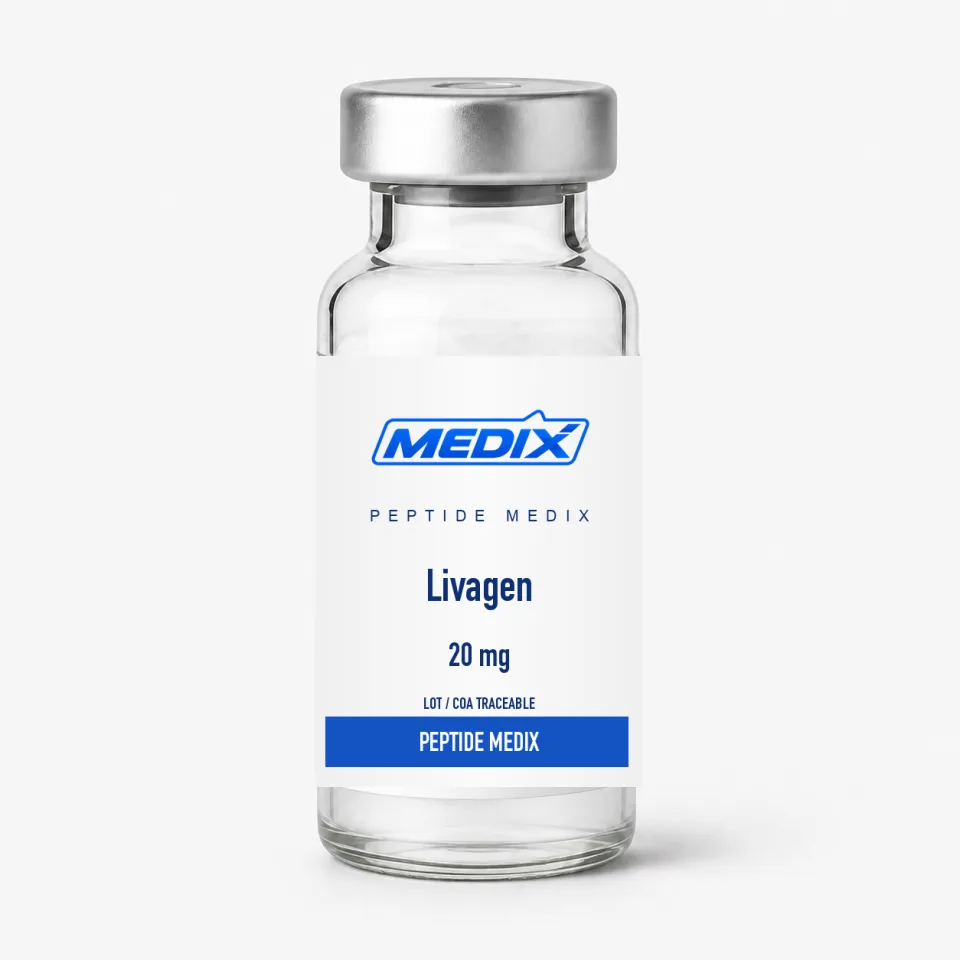
Livagen
KEDA (Lys-Glu-Asp-Ala) tetrapeptide for liver and chromatin research models
In stock1 format available
€63
This listing is currently unavailable. Contact us and we will tell you when it is back or suggest an equivalent.
Ask about this listing or request its COA- FormLyophilized powder in a sealed glass vial
- Mol. weight461.47 g/mol
- Research areasChromatin decondensation, lymphocyte cytogenetics, hepatocyte culture, liver tissue models
For laboratory research use only. Sold exclusively for in-vitro laboratory research by qualified professionals. Not for human or veterinary use, and not a medicine, food, cosmetic or dietary supplement. Terms and Conditions
Overview
Key facts
Livagen is the synthetic tetrapeptide L-lysyl-L-glutamyl-L-aspartyl-L-alanine — Lys-Glu-Asp-Ala, or KEDA.
- Molecular formula
- C18H31N5O9
- Molecular weight
- 461.47 g/mol
- Amino acid sequence
- Lys-Glu-Asp-Ala (KEDA), linear tetrapeptide
- Purity
- ≥99% by HPLC; lot-matched COA available
- Form
- Lyophilized powder in a sealed glass vial
- Storage
- −20 °C, sealed and protected from light and moisture
- Available size
- 20 mg
For research use only. Not for human consumption.
Livagen is the synthetic tetrapeptide L-lysyl-L-glutamyl-L-aspartyl-L-alanine — Lys-Glu-Asp-Ala, or KEDA. Within the Khavinson series of short bioregulator peptides it is linked to liver tissue. As with its relatives, it started life as a tissue-derived peptide extract before being narrowed down to a defined synthetic sequence, so that experiments could use one characterised molecule.
KEDA stands out in the series because it figures heavily in cytogenetic research, not just in organ-specific studies. Several published experiments treated cultured human lymphocytes — including those from elderly donors — with KEDA and described changes in heterochromatin decondensation and in the activity of ribosomal gene regions judged by staining. These studies are the evidence most often quoted for the idea that such ultrashort peptides reach the nucleus and alter chromatin structure.
Apart from chromatin work, labs use Livagen in hepatocyte cultures and rodent liver models, measuring markers of tissue structure, protein synthesis and gene expression. We ship it in a 20 mg lyophilised vial made by SPPS and HPLC-purified to a ≥99% specification; the lot's certificate of analysis is available on request. Laboratory research only.
Specifications
Identity
- Molecular formula
- C18H31N5O9
- Molecular weight
- 461.47 g/mol
- Amino acid sequence
- Lys-Glu-Asp-Ala (KEDA), linear tetrapeptide
- Peptide class
- Khavinson short-peptide bioregulator (tetrapeptide)
Supply & purity
- Form
- Lyophilized powder in a sealed glass vial
- Purity
- ≥99% by HPLC; lot-matched COA available
- Available sizes
- 20 mg
- Solubility
- Bacteriostatic or sterile water; readily soluble in aqueous buffers
Handling & storage
- Storage (lyophilized)
- −20 °C, sealed and protected from light and moisture
- Storage (reconstituted)
- 2–8 °C, protected from light; use within the study window
Additional detail
- Tissue association
- Liver peptide preparations
- Research areas
- Chromatin decondensation, lymphocyte cytogenetics, hepatocyte culture, liver tissue models
- Sequence relationship
- Vesugen (KED) extended by a C-terminal alanine residue
Questions about Livagen
What is Livagen?
KEDA — the synthetic tetrapeptide Lys-Glu-Asp-Ala — a member of the Khavinson bioregulator series that the literature associates with liver tissue. It comes as a lyophilised research chemical for laboratory investigation only.
Is purity documented independently?
Yes. HPLC testing against a ≥99% specification is carried out on every lot, and a certificate of analysis is available that records the batch code, purity found, identity confirmation and a description of the powder.
Why does Livagen appear in chromatin research?
Cytogenetic studies exposed cultured human lymphocytes to KEDA and reported greater heterochromatin decondensation and nucleolar organiser activity, most clearly in cells from older donors. That work is the reference most frequently cited for the chromatin hypothesis underlying this peptide family.
No CAS number — why?
There isn't a generally accepted CAS entry for KEDA, so we prefer to leave the field empty rather than show an unverified number. What defines the peptide — its sequence, formula and mass — is confirmed on the lot COA.
How should I store it?
Keep sealed vials at −20 °C away from light and moisture. Once reconstituted, a fridge at 2–8 °C is suitable for the planned study period; for longer storage, freeze it in single-use portions.