- HPLC purity ≥99%, with a COA for each lot on request
- Certificate of analysis tied to your lot number
- Tracked EU delivery, dispatched the next working day
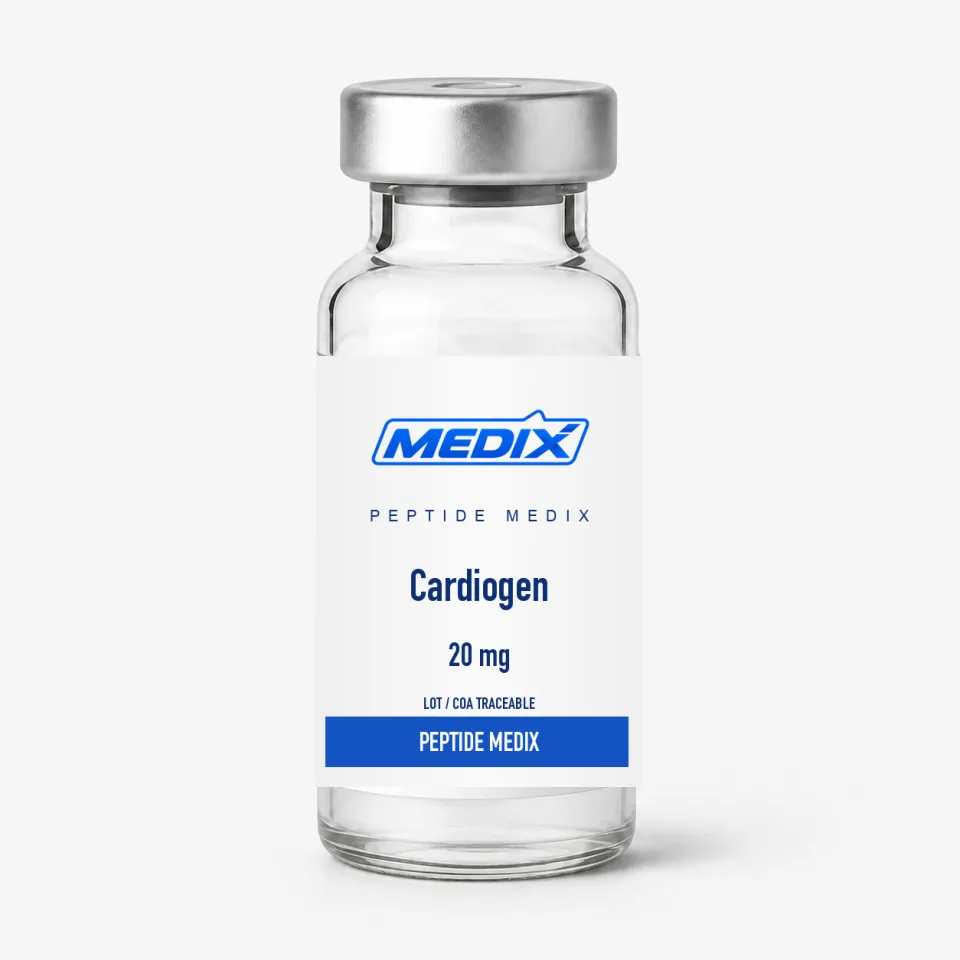
Cardiogen
AEDR (Ala-Glu-Asp-Arg) tetrapeptide for research in cardiac tissue models
In stock1 format available
€63
This listing is currently unavailable. Contact us and we will tell you when it is back or suggest an equivalent.
Ask about this listing or request its COA- FormLyophilized powder in a sealed glass vial
- Mol. weight489.48 g/mol
- Research areasCardiomyocyte culture, stem-cell differentiation models, myocardial tissue, gene expression
For laboratory research use only. Sold exclusively for in-vitro laboratory research by qualified professionals. Not for human or veterinary use, and not a medicine, food, cosmetic or dietary supplement. Terms and Conditions
Overview
Key facts
Cardiogen is the synthetic tetrapeptide L-alanyl-L-glutamyl-L-aspartyl-L-arginine (Ala-Glu-Asp-Arg, AEDR).
- Molecular formula
- C18H31N7O9
- Molecular weight
- 489.48 g/mol
- Amino acid sequence
- Ala-Glu-Asp-Arg (AEDR), linear tetrapeptide
- Purity
- ≥99% by HPLC; lot-matched COA available
- Form
- Lyophilized powder in a sealed glass vial
- Storage
- −20 °C, sealed and protected from light and moisture
- Available size
- 20 mg
For research use only. Not for human consumption.
Cardiogen is the synthetic tetrapeptide L-alanyl-L-glutamyl-L-aspartyl-L-arginine (Ala-Glu-Asp-Arg, AEDR). It represents the heart in the Khavinson series of short-peptide bioregulators and was developed the way its siblings were: peptide extracts from cardiac tissue came first, a short candidate sequence was then isolated, and finally the synthetic tetrapeptide took over from the extract as a defined, reproducible research material.
With arginine in position four, Cardiogen has a strongly basic side chain not found in the other Ala-Glu-Asp peptides. Its guanidinium group is positively charged at neutral pH, making AEDR zwitterionic in a different sense from Cortagen or Bronchogen and changing how it interacts with negatively charged surfaces, nucleic acids and ion-exchange resins. Anyone running chromatography or binding assays across the series will notice this, as retention times and apparent affinities can differ markedly from the neutral or hydrophobic members.
Studies using AEDR include cardiomyocyte and stem-cell differentiation cultures, isolated heart-tissue preparations, expression analyses of a small gene panel and rodent work on age-related changes in myocardium. We supply Cardiogen in a 20 mg lyophilised vial, synthesised by SPPS and HPLC-purified to a ≥99% specification, with a certificate of analysis for the lot. Laboratory research use only.
Specifications
Identity
- Molecular formula
- C18H31N7O9
- Molecular weight
- 489.48 g/mol
- Amino acid sequence
- Ala-Glu-Asp-Arg (AEDR), linear tetrapeptide
- Peptide class
- Khavinson short-peptide bioregulator (tetrapeptide)
Supply & purity
- Form
- Lyophilized powder in a sealed glass vial
- Purity
- ≥99% by HPLC; lot-matched COA available
- Available sizes
- 20 mg
- Solubility
- Bacteriostatic or sterile water; readily soluble in aqueous buffers
Handling & storage
- Storage (lyophilized)
- −20 °C, sealed and protected from light and moisture
- Storage (reconstituted)
- 2–8 °C, protected from light; use within the study window
Additional detail
- Tissue association
- Heart and myocardial peptide preparations
- Research areas
- Cardiomyocyte culture, stem-cell differentiation models, myocardial tissue, gene expression
- Sequence relationship
- Shares the Ala-Glu-Asp core with Cortagen (AEDP) and Bronchogen (AEDL)
Questions about Cardiogen
What is Cardiogen?
A synthetic tetrapeptide, Ala-Glu-Asp-Arg (AEDR), belonging to the Khavinson bioregulator series and linked in that body of work to cardiac tissue. It comes as a lyophilised research chemical intended solely for laboratory investigation.
How do you confirm its purity?
Batches are tested by HPLC against a ≥99% purity specification; the certificate for your lot is available on request and lists batch number, measured purity, identity check and the physical appearance of the powder.
Why is there no CAS number?
AEDR does not have a broadly recognised CAS registry entry, and we would rather leave the field empty than fill it with an unconfirmed number. The peptide is identified by its sequence, formula and molecular weight, each verified on the lot certificate.
Why does the arginine matter?
At neutral pH arginine's guanidinium group is positively charged — a feature none of the other Ala-Glu-Asp peptides in the series share. It alters behaviour on chromatography columns and in binding experiments, so analytical methods usually need tweaking for Cardiogen.
What storage does the vial need?
Unopened, keep the lyophilised vial at −20 °C in the dark and away from moisture. Once reconstituted, refrigerate at 2–8 °C for the duration of the planned work, or freeze it in single-use portions if you need it over a longer period.