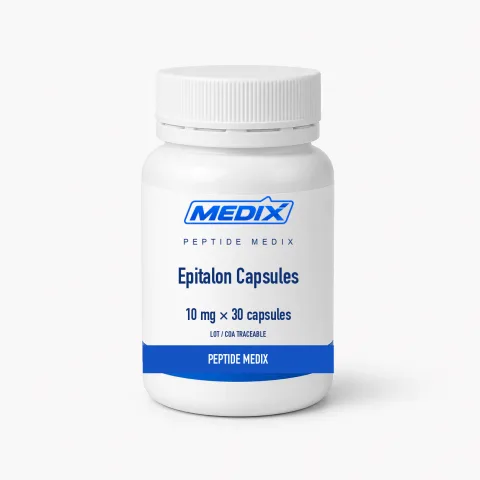
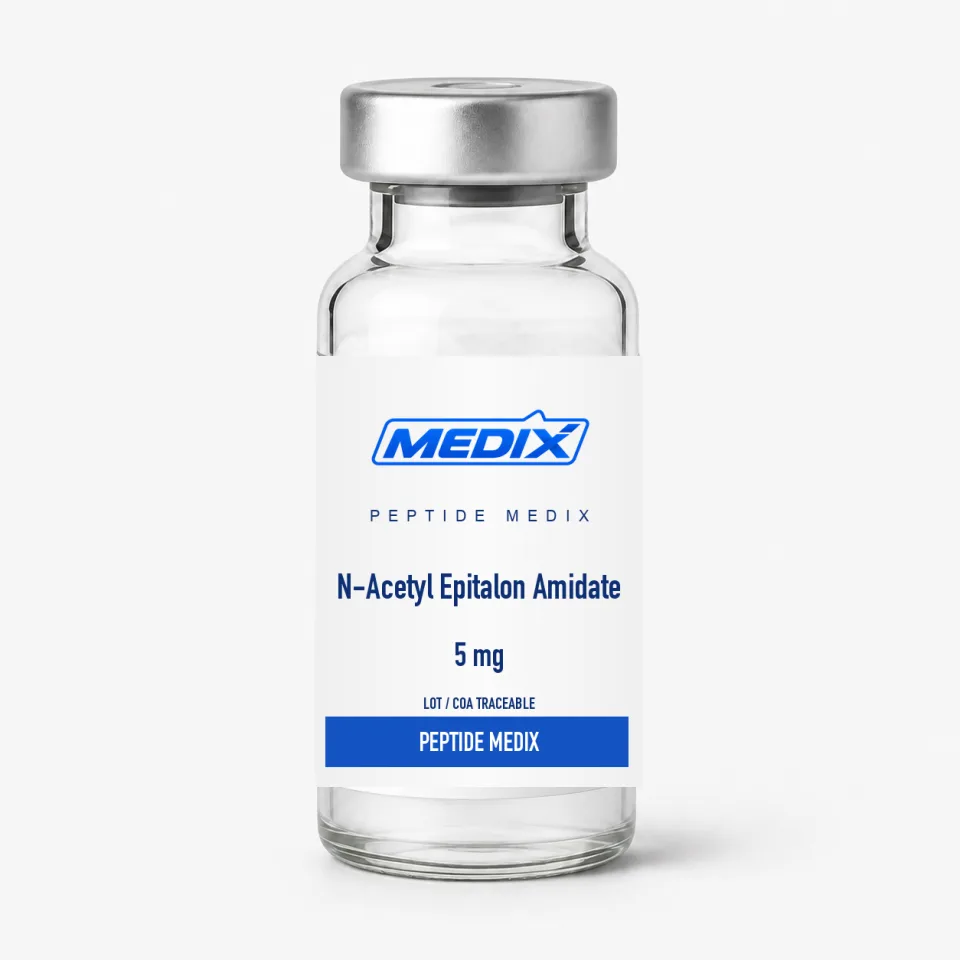
- HPLC purity ≥99%, with a COA for each lot on request
- Certificate of analysis tied to your lot number
- Tracked EU delivery, dispatched the next working day
N-Acetyl Epitalon Amidate
End-protected epitalon analogue Ac-Ala-Glu-Asp-Gly-NH2 in research vials
In stock2 formats available
€55Range €55 – €97
This listing is currently unavailable. Contact us and we will tell you when it is back or suggest an equivalent.
Ask about this listing or request its COA- FormLyophilized white to off-white powder in a sealed glass vial
- Mol. weight≈431.4 g/mol
- Research areasPeptide stability and degradation kinetics, telomerase and senescence models, circadian and pineal signalling
For laboratory research use only. Sold exclusively for in-vitro laboratory research by qualified professionals. Not for human or veterinary use, and not a medicine, food, cosmetic or dietary supplement. Terms and Conditions
Overview
Key facts
N-Acetyl Epitalon Amidate is a chemically protected form of epitalon, the tetrapeptide Ala-Glu-Asp-Gly originally made as a synthetic stand-in for the pineal extract epithalamin.
- Molecular formula
- C16H25N5O9
- Molecular weight
- ≈431.4 g/mol
- Amino acid sequence
- Ac-Ala-Glu-Asp-Gly-NH2
- Purity
- ≥99% by HPLC; lot-matched COA available
- Form
- Lyophilized white to off-white powder in a sealed glass vial
- Storage
- −20 °C, sealed and protected from light and moisture
- Available sizes
- 5 mg · 10 mg
For research use only. Not for human consumption.
N-Acetyl Epitalon Amidate is a chemically protected form of epitalon, the tetrapeptide Ala-Glu-Asp-Gly originally made as a synthetic stand-in for the pineal extract epithalamin. Two changes are applied without altering the amino-acid order: the free N-terminal amine is capped with an acetyl group, and the C-terminal carboxyl becomes a primary amide — giving Ac-Ala-Glu-Asp-Gly-NH2.
Both are routine protective tactics in medicinal chemistry. Free termini are what aminopeptidases and carboxypeptidases attack first, so capping them removes the easiest targets for enzymes. Masking the charged ends also changes the net charge and polarity of an already tiny, very hydrophilic peptide — which is why end-protected analogues are used in permeability and mucosal-transit studies as well as in simple stability experiments.
Specifications
Identity
- Molecular formula
- C16H25N5O9
- Molecular weight
- ≈431.4 g/mol
- Amino acid sequence
- Ac-Ala-Glu-Asp-Gly-NH2
- Peptide class
- Terminally protected synthetic bioregulator tetrapeptide
Supply & purity
- Form
- Lyophilized white to off-white powder in a sealed glass vial
- Purity
- ≥99% by HPLC; lot-matched COA available
- Available sizes
- 5 mg, 10 mg
- Solubility
- Readily soluble in sterile or bacteriostatic water
Handling & storage
- Storage (lyophilized)
- −20 °C, sealed and protected from light and moisture
- Storage (reconstituted)
- 2–8 °C; aliquot to avoid repeated freeze-thaw cycles
Additional detail
- Parent peptide
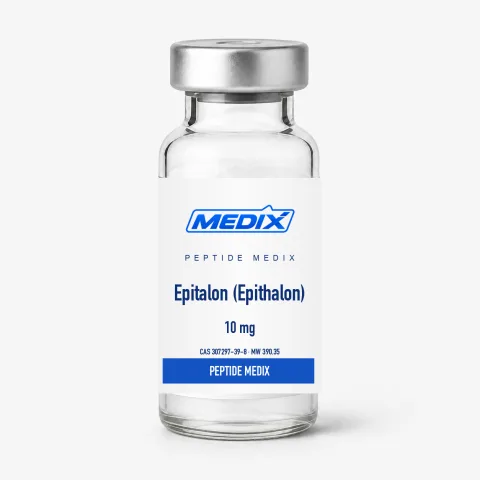
- Epitalon (epithalon, AEDG), CAS 307297-39-8, 390.35 g/mol
- Modifications
- N-terminal acetyl cap; C-terminal carboxyl converted to a primary amide
- Synthesis
- Solid-phase peptide synthesis with preparative reversed-phase HPLC purification
- Research areas
- Peptide stability and degradation kinetics, telomerase and senescence models, circadian and pineal signalling
Questions about N-Acetyl Epitalon Amidate
What distinguishes it from ordinary epitalon?
The sequence is unchanged — Ala-Glu-Asp-Gly. What differs is chemical protection at each end: an N-terminal acetyl and a C-terminal primary amide. These caps block exopeptidases, which is why labs choose this analogue for stability-focused studies.
Does end-capping make it more potent?
Not automatically. Being more stable metabolically is not the same as being intrinsically more potent, and terminal groups can contribute to target binding. The only sound comparison is to test both peptides in one assay, measuring intact peptide alongside the functional readout.
Which purity documents accompany it?
Every lot is released at ≥99% purity by reversed-phase HPLC with mass-spectrometric identity confirmation, and its certificate of analysis is available. Filing the COA with your records keeps the material and the resulting data linked.
What should I dissolve it in?
Being very hydrophilic, it dissolves easily in sterile or bacteriostatic water, and aqueous buffers work for cell culture. Pick a diluent that suits your assay chemistry — bear in mind that the benzyl alcohol in bacteriostatic water is not tolerated by some cell-based systems.
How should reconstituted solution be kept?
At 2–8 °C for short working periods, or in aliquots at −20 °C or colder for longer. Repeated freezing and thawing and long spells at room temperature are the main reasons measured potency drifts in small peptides, so single-use aliquots are the better approach.