- HPLC purity ≥99%, documented per lot
- Certificate of analysis tied to your lot number
- Tracked EU delivery, dispatched the next working day
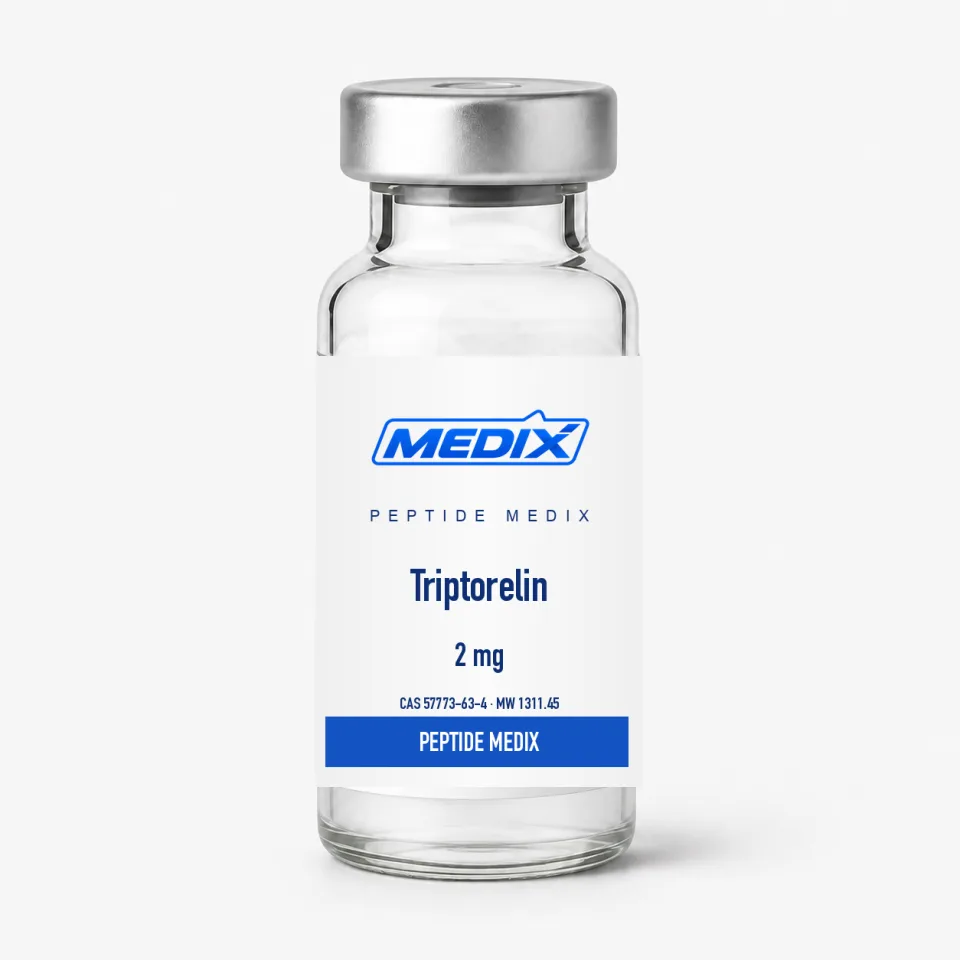
Triptorelin
Long-acting GnRH superagonist carrying a D-Trp6 substitution
In stock1 format availableCAS 57773-63-4
€51
This listing is currently unavailable. Contact us and we will tell you when it is back or suggest an equivalent.
Ask about this listing or request its COA- FormLyophilized white to off-white powder, sealed glass vial
- Mol. weight1311.45 g/mol
- Research areasGnRH receptor desensitisation, reversible HPG-axis suppression models, superagonist structure–activity work
For laboratory research use only. Sold exclusively for in-vitro laboratory research by qualified professionals. Not for human or veterinary use, and not a medicine, food, cosmetic or dietary supplement. Terms and Conditions
Overview
Key facts
Triptorelin is a synthetic ten-residue analogue of gonadotropin-releasing hormone in which D-tryptophan takes the place of glycine at position 6.
- CAS number
- 57773-63-4
- Molecular formula
- C64H82N18O13
- Molecular weight
- 1311.45 g/mol
- Amino acid sequence
- pGlu-His-Trp-Ser-Tyr-D-Trp-Leu-Arg-Pro-Gly-NH2
- Purity
- ≥99% by HPLC; lot-matched COA
- Form
- Lyophilized white to off-white powder, sealed glass vial
- Storage
- −20 °C, desiccated and protected from light
- Available size
- 2 mg
For research use only. Not for human consumption.
Triptorelin is a synthetic ten-residue analogue of gonadotropin-releasing hormone in which D-tryptophan takes the place of glycine at position 6. That one swap is the entire design: it prevents enzymes from cutting the Gly6–Leu7 bond — the main way native GnRH is broken down — and locks in a shape with higher receptor affinity. The result is far stronger and longer-acting than the natural hormone, which is exactly what “GnRH superagonist” means.
Its effects are intentionally two-phased, which is what makes it interesting experimentally. At first, it strongly stimulates gonadotrophs, causing a short-lived surge of luteinising hormone and follicle-stimulating hormone. With continued exposure, the opposite happens: GnRH receptors are internalised, uncoupled from their signalling partners and downregulated, and gonadotropin output drops well below baseline. Native GnRH is cleared too fast to keep receptors occupied, so this paradoxical suppression is practically impossible to achieve without an analogue — which is why triptorelin became a standard lab tool for inducing reversible suppression of the axis in models.
Specifications
Identity
- CAS number
- 57773-63-4
- Molecular formula
- C64H82N18O13
- Molecular weight
- 1311.45 g/mol
- Amino acid sequence
- pGlu-His-Trp-Ser-Tyr-D-Trp-Leu-Arg-Pro-Gly-NH2
- Peptide class
- Linear amidated decapeptide; GnRH superagonist analogue
Supply & purity
- Form
- Lyophilized white to off-white powder, sealed glass vial
- Purity
- ≥99% by HPLC; lot-matched COA
- Solubility
- Soluble in water and bacteriostatic water; dilute acetic acid or a trace of DMSO aids stubborn lots
Handling & storage
- Storage (lyophilized)
- −20 °C, desiccated and protected from light
- Storage (reconstituted)
- 2–8 °C for short-term use; aliquot and freeze for longer holds
Additional detail
- Available size
- 2 mg
- Receptor target
- GnRH receptor (GnRHR) on pituitary gonadotrophs, Gq/11-coupled
- Research areas
- GnRH receptor desensitisation, reversible HPG-axis suppression models, superagonist structure–activity work
Questions about Triptorelin
Why is triptorelin called a superagonist and not just an agonist?
Its D-tryptophan at position 6 prevents the enzymatic cleavage that removes native GnRH within minutes, and it stabilises a higher-affinity conformation. Together these give far greater potency and duration than the parent hormone — the meaning of “superagonist”.
How can an agonist end up suppressing the axis it stimulates?
Gonadotrophs are tuned to pulsed signals. A long-lasting agonist occupies the receptors continuously, triggering internalisation, uncoupling and downregulation; after an initial surge, gonadotropin output falls below baseline — something fast-clearing native GnRH cannot bring about.
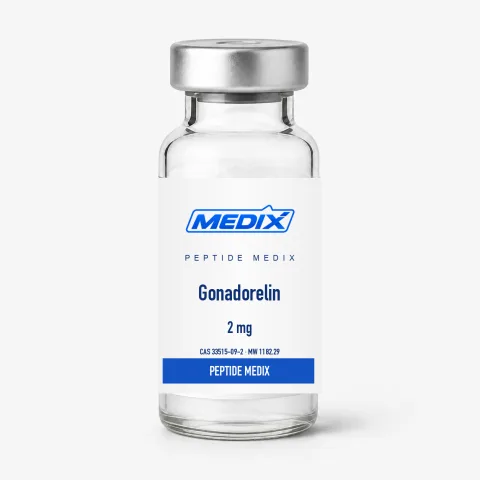
How does it relate to gonadorelin?
Both act on the same pituitary receptor but over completely different timescales. Gonadorelin, native GnRH, disappears within minutes and suits pulsed stimulation; triptorelin lingers and suits the study of receptor desensitisation. Together they form a natural matched pair.
Can I obtain a certificate of analysis?
Yes. Reverse-phase HPLC (≥99% purity) and mass spectrometry characterise each lot, and the COA is provided on request. The batch number on the vial matches the document, keeping measurements traceable to a defined analysis.
Why is only a 2 mg vial available?
Triptorelin is so potent that receptor-level and cell-culture studies use very little of it, so 2 mg covers most designs easily. Offering one size also means an entire series can usually run from one lot, eliminating batch variation as a confounder.
Does it need extra protection from light?
Yes, more than most peptides its size: it contains two oxidation-prone tryptophans. Keep vials and solutions away from light and limit air in the headspace — amber tubes or foil-wrapped aliquots are worth the small extra effort.