- HPLC-assayed purity of ≥99%
- Certificate of analysis tied to your lot number
- Tracked EU delivery, dispatched the next working day
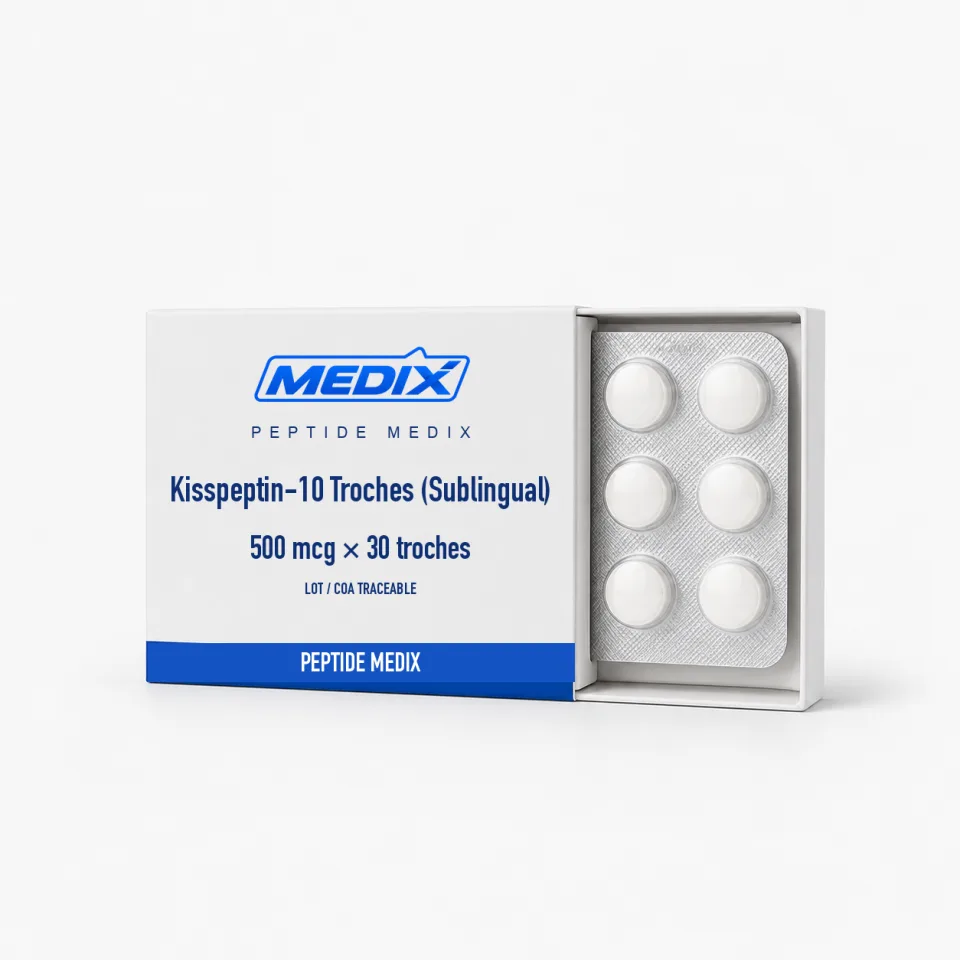
Kisspeptin-10 Troches (Sublingual)
KISS1R decapeptide agonist in sublingual troches, 500 mcg each
In stock1 format available
€85
This listing is currently unavailable. Contact us and we will tell you when it is back or suggest an equivalent.
Ask about this listing or request its COA- FormSublingual troche in a slowly dissolving compounding base
- Research areasGnRH pulse generation, HPG-axis regulation, transmucosal peptide delivery, formulation stability
For laboratory research use only. Sold exclusively for in-vitro laboratory research by qualified professionals. Not for human or veterinary use, and not a medicine, food, cosmetic or dietary supplement. Terms and Conditions
Overview
Key facts
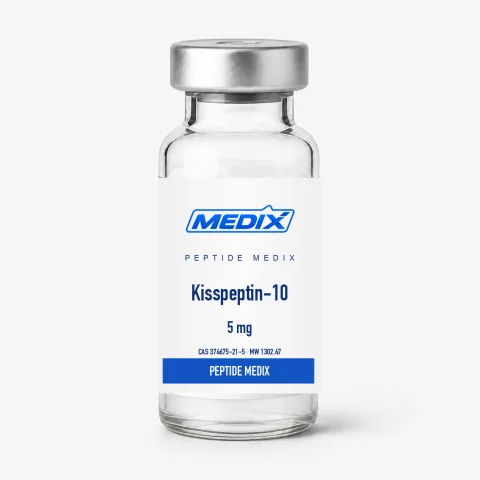
These troches deliver kisspeptin-10 — the C-terminal ten-residue fragment encoded by KISS1 — sublingually in a slow-dissolving base, 500 micrograms per troche and thirty per pack.
- CAS number
- 374675-21-5
- Molecular formula
- C63H83N17O14
- Molecular weight
- 1302.47 g/mol
- Purity
- ≥99% by HPLC before compounding; lot-matched COA available
- Form
- Sublingual troche in a slowly dissolving compounding base
- Storage
- Cool, dry and dark in the closed pack; refrigeration extends shelf stability
- Available size
- 500 mcg · 30 troches
For research use only. Not for human consumption.
These troches deliver kisspeptin-10 — the C-terminal ten-residue fragment encoded by KISS1 — sublingually in a slow-dissolving base, 500 micrograms per troche and thirty per pack. It is the same amidated decapeptide we offer as lyophilised powder, Tyr-Asn-Trp-Asn-Ser-Phe-Gly-Leu-Arg-Phe-NH2, whose C-terminal Arg-Phe-amide is required to activate KISS1R, the Gq-coupled receptor first catalogued as GPR54.
Kisspeptin signalling heads the reproductive hormone cascade. Hypothalamic kisspeptin neurons trigger GnRH release, which then controls LH and FSH secretion, and it was the discovery of loss-of-function KISS1R mutations that proved the pathway is needed for puberty. Because it sits so far upstream, the peptide is used in neuroendocrine research and not only in receptor-level studies.
Specifications
Supply & purity
- Form
- Sublingual troche in a slowly dissolving compounding base
Additional detail
- Peptide content
- 500 mcg kisspeptin-10 per troche
- Available size
- 30 troches per pack
- Active component
- Kisspeptin-10, C-terminal decapeptide fragment of kisspeptin-54 (metastin)
- Amino acid sequence (active)
- Tyr-Asn-Trp-Asn-Ser-Phe-Gly-Leu-Arg-Phe-NH2
- CAS number (active)
- 374675-21-5
- Molecular formula (active)
- C63H83N17O14
- Molecular weight (active)
- 1302.47 g/mol
- Receptor target
- KISS1R (GPR54), a Gq/11-coupled class A GPCR
- Peptide purity
- ≥99% by HPLC before compounding; lot-matched COA available
- Delivery route studied
- Sublingual and buccal mucosal absorption
- Research areas
- GnRH pulse generation, HPG-axis regulation, transmucosal peptide delivery, formulation stability
- Storage
- Cool, dry and dark in the closed pack; refrigeration extends shelf stability
Questions about Kisspeptin-10 Troches (Sublingual)
How are the troches different from the kisspeptin-10 vial?
The peptide is exactly the same; only the format varies. The vial contains lyophilised powder that you dissolve at any concentration, whereas each troche is a fixed 500 mcg unit in a dissolving base, designed for research on transmucosal delivery.
How do they compare with the nasal spray?
Both are transmucosal routes, but through different tissues. Nasal mucosa is thin, richly supplied with blood vessels and clears quickly; sublingual mucosa provides longer contact over a smaller absorbing surface. Testing both with the same peptide lot is a classic route-comparison design.
Which documents are supplied?
The peptide used in production is released at ≥99% purity by reversed-phase HPLC with identity confirmed by mass spectrometry, and the lot certificate is available. File it with your records so results can be linked to the exact peptide lot.
How should I store the troches?
Sealed, cool, dry and dark. Heat softens the base and it soaks up moisture from the air, both of which damage the troches and speed up peptide breakdown. Refrigeration in a closed container lengthens their usable life.
Related