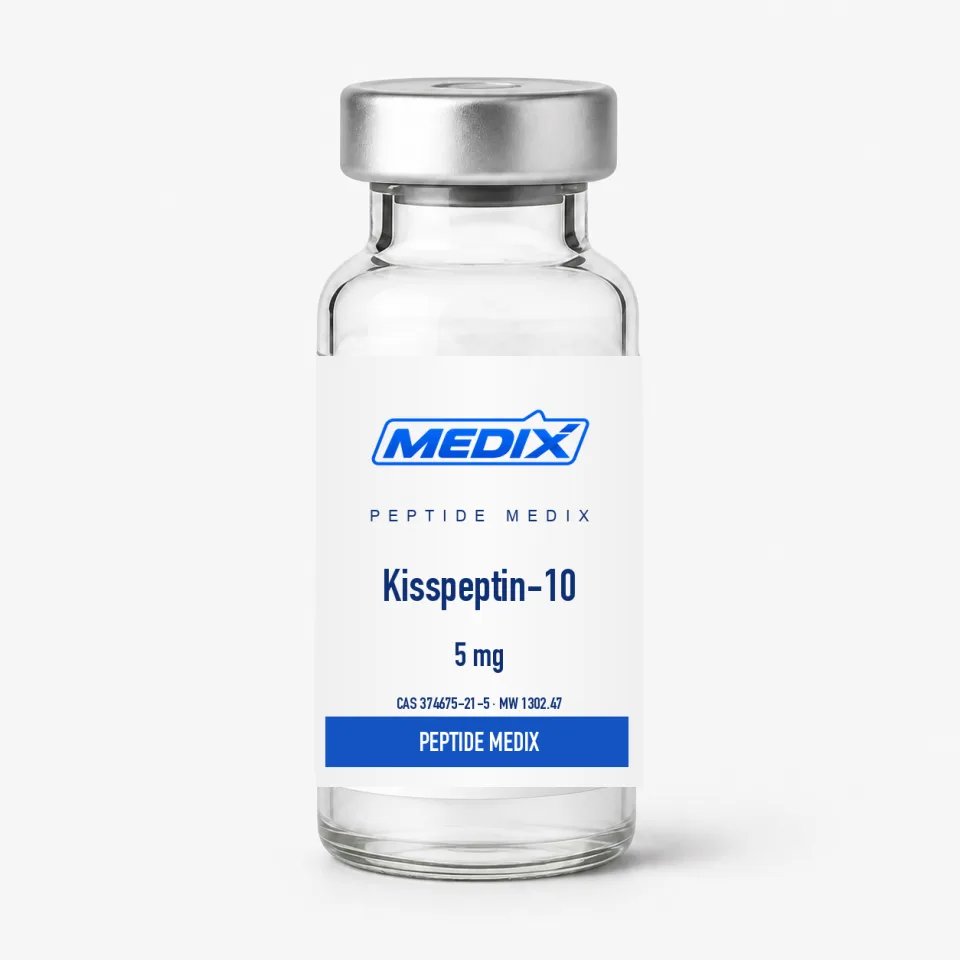
- HPLC purity ≥99%, documented per lot
- Certificate of analysis tied to your lot number
- Tracked EU delivery, dispatched the next working day
Kisspeptin-10
KISS1-derived decapeptide agonist of the KISS1R (GPR54) receptor
In stock2 formats availableCAS 374675-21-5
€42Range €42 – €63
This listing is currently unavailable. Contact us and we will tell you when it is back or suggest an equivalent.
Ask about this listing or request its COA- FormLyophilized white to off-white powder, sealed glass vial
- Mol. weight1302.47 g/mol
- Research areasGnRH pulse generation, HPG-axis regulation, puberty onset models, metastasis suppression
For laboratory research use only. Sold exclusively for in-vitro laboratory research by qualified professionals. Not for human or veterinary use, and not a medicine, food, cosmetic or dietary supplement. Terms and Conditions
Overview
Key facts
Kisspeptin-10 consists of the last ten residues at the C-terminus of kisspeptin-54, which the KISS1 gene encodes.
- CAS number
- 374675-21-5
- Molecular formula
- C63H83N17O14
- Molecular weight
- 1302.47 g/mol
- Amino acid sequence
- Tyr-Asn-Trp-Asn-Ser-Phe-Gly-Leu-Arg-Phe-NH2
- Purity
- ≥99% by HPLC; lot-matched COA
- Form
- Lyophilized white to off-white powder, sealed glass vial
- Storage
- −20 °C, desiccated and protected from light
- Available sizes
- 5 mg · 10 mg
For research use only. Not for human consumption.
Kisspeptin-10 consists of the last ten residues at the C-terminus of kisspeptin-54, which the KISS1 gene encodes. It is the shortest sequence that keeps full activity at KISS1R — the G-protein-coupled receptor first listed as GPR54 — and both its C-terminal amide and the final Arg-Phe motif are indispensable for binding. KISS1 was originally discovered by cancer researchers as a suppressor of metastasis, hence the family's alternative name metastin, long before its role in reproductive neuroendocrinology emerged.
Two properties of this decapeptide determine how it should be handled. It finishes with the Arg-Phe-NH2 motif that defines the RFamide family, and the receptor needs that amide, so losing it is a degradation pathway to keep in mind during long incubations; it also contains a tryptophan, which is prone to oxidation and light damage. Keep vials dry at −20 °C and aliquot solutions rather than thawing them repeatedly; if a lot resists dissolving, a little dilute acetic acid or DMSO can help before dilution into buffer. Research focuses on reproductive neuroendocrinology — GnRH pulse generation in hypothalamic preparations, gonadotropin responses in rodents, onset of puberty — with a continuing line of work on the parent gene's role in suppressing metastasis.
What sets this listing apart
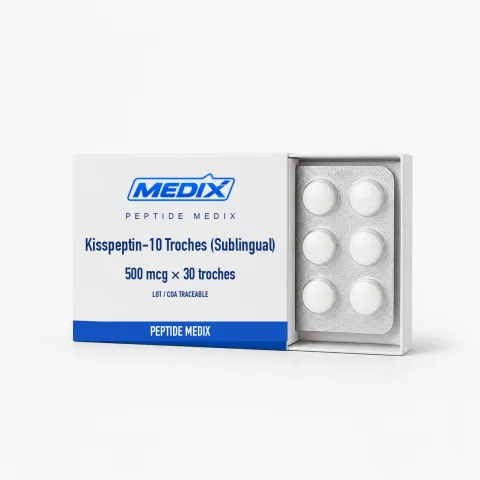
Kisspeptin-10 – vial, 5/10 mg. Lyophilized white to off-white powder, sealed glass vial. Other Kisspeptin-10 listings differ in format, fill or combination partners; the specification and COA always refer to the listing you order.
Same compound, other listings
Specifications
Identity
- CAS number
- 374675-21-5
- Molecular formula
- C63H83N17O14
- Molecular weight
- 1302.47 g/mol
- Amino acid sequence
- Tyr-Asn-Trp-Asn-Ser-Phe-Gly-Leu-Arg-Phe-NH2
- Peptide class
- Linear amidated decapeptide; RFamide-related peptide
Supply & purity
- Form
- Lyophilized white to off-white powder, sealed glass vial
- Purity
- ≥99% by HPLC; lot-matched COA
- Available sizes
- 5 mg, 10 mg
- Solubility
- Soluble in water and bacteriostatic water; dilute acetic acid or DMSO aids stubborn lots
Handling & storage
- Storage (lyophilized)
- −20 °C, desiccated and protected from light
- Storage (reconstituted)
- 2–8 °C for immediate use; aliquot at −20 °C or below for longer holds
Additional detail
- Receptor target
- KISS1R (GPR54), a Gq/11-coupled class A GPCR
- Research areas
- GnRH pulse generation, HPG-axis regulation, puberty onset models, metastasis suppression
Questions about Kisspeptin-10
How are Kisspeptin-10 and kisspeptin-54 related?
Kisspeptin-10 is the final ten amino acids of kisspeptin-54, the complete KISS1 gene product. It keeps practically all of the activity at KISS1R, making it the convenient tool compound, though it is cleared faster than its longer parent — a difference researchers often use on purpose.
Which receptor does it activate?
KISS1R, once known as the orphan receptor GPR54 — a class A GPCR coupled to Gq/11 and abundant on GnRH neurons. This puts kisspeptin signalling immediately upstream of the hypothalamic–pituitary–gonadal axis in the models that study it.
Is its purity independently confirmed?
Yes. Reverse-phase HPLC shows ≥99% purity and mass spectrometry confirms identity for every lot, and you can request the lot's certificate. The vial's batch number matches the COA, so your measurements trace back to a defined analysis.
How does it compare with gonadorelin or triptorelin?
Kisspeptin-10 works one level higher up the axis: it stimulates GnRH neurons, whereas gonadorelin is GnRH itself and triptorelin a GnRH analogue, both acting directly at pituitary GnRH receptors. That hierarchy is why all three are often included in one study.
Which sizes are available, and how are they stored?
Lyophilised vials of 5 mg and 10 mg. Keep sealed vials at −20 °C, dry and away from light. Once reconstituted, store at 2–8 °C for short-term use, or aliquot and freeze, avoiding repeated freeze–thaw cycles.
Why would a metastasis-suppressor gene matter for reproduction?
KISS1 got its name from cancer biology before human genetic studies revealed its receptor's reproductive role. Both functions are real: the same peptide–receptor pair works in different tissue contexts, and both fields use Kisspeptin-10 as their reference agonist.