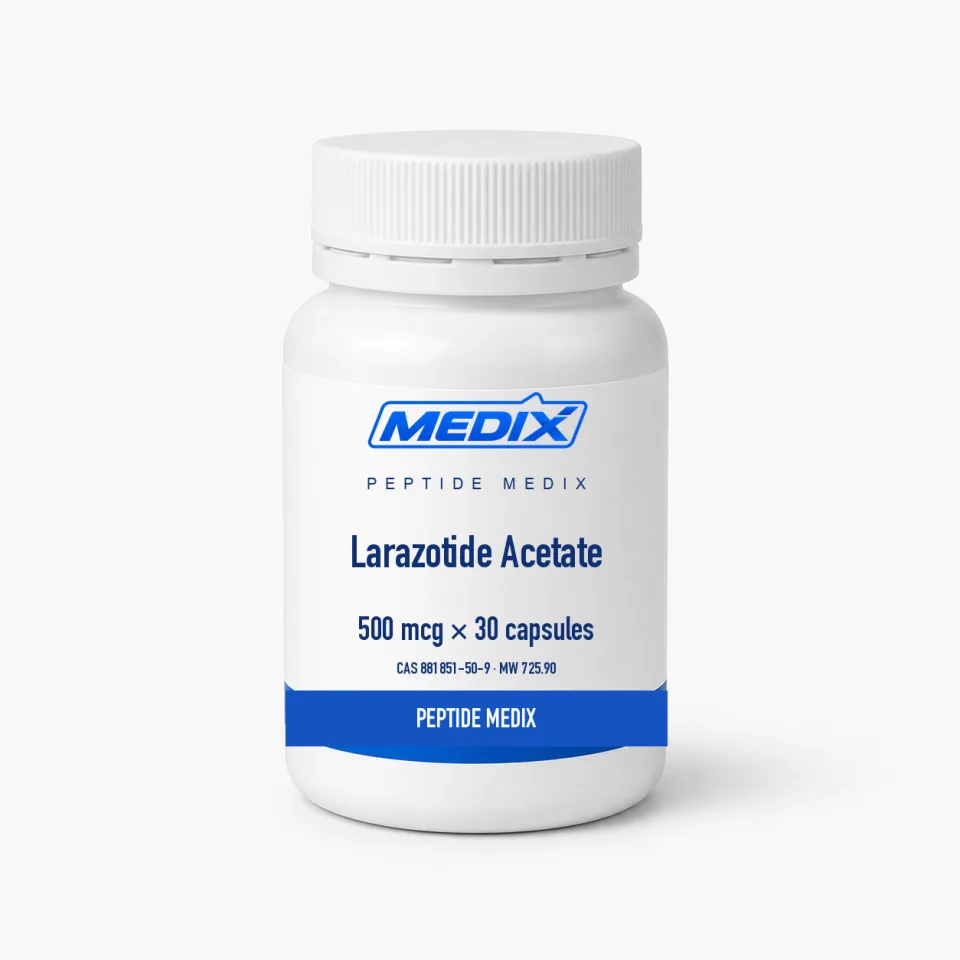
- HPLC purity ≥99%, with a COA for each lot on request
- Certificate of analysis tied to your lot number
- Tracked EU delivery, dispatched the next working day
Larazotide Acetate
Larazotide acetate — tight-junction research octapeptide of eight residues
In stock2 formats availableCAS 881851-50-9
€72Range €72 – €127
This listing is currently unavailable. Contact us and we will tell you when it is back or suggest an equivalent.
Ask about this listing or request its COA- FormOral capsule, sealed bottle with tamper-evident closure
- Mol. weight725.90 g/mol
- Research areasIntestinal permeability, tight-junction proteins, celiac and barrier models
For laboratory research use only. Sold exclusively for in-vitro laboratory research by qualified professionals. Not for human or veterinary use, and not a medicine, food, cosmetic or dietary supplement. Terms and Conditions
Overview
Key facts
Larazotide acetate is a synthetic eight-residue peptide, Gly-Gly-Val-Leu-Val-Gln-Pro-Gly, developed to antagonise the zonulin receptor pathway that controls intestinal tight junctions.
- CAS number
- 881851-50-9
- Molecular formula
- C32H55N9O10
- Molecular weight
- 725.90 g/mol
- Amino acid sequence
- Gly-Gly-Val-Leu-Val-Gln-Pro-Gly
- Purity
- ≥99% by HPLC; lot-matched COA available
- Form
- Oral capsule, sealed bottle with tamper-evident closure
- Storage
- Cool, dry conditions away from direct light; keep desiccant in the bottle
- Available sizes
- 500 mcg · 30 capsules · 500 mcg · 60 capsules
For research use only. Not for human consumption.
Larazotide acetate is a synthetic eight-residue peptide, Gly-Gly-Val-Leu-Val-Gln-Pro-Gly, developed to antagonise the zonulin receptor pathway that controls intestinal tight junctions. Zonulin, a human protein, opens up the junctional complexes between epithelial cells; larazotide was designed to counter that opening, not to hit some downstream inflammatory target.
It differs from most of our peptides in two ways. First, it is intentionally poorly absorbed: the aim is to work at the epithelial surface inside the gut lumen rather than to reach the bloodstream, which is why we offer it as oral capsules of 500 micrograms, in counts of 30 and 60. Second, for a peptide of its type it has a relatively large human trial record, including phase 2 studies in coeliac disease.
We make it by solid-phase synthesis and purify it by reversed-phase HPLC to ≥99% before filling; the certificate of analysis matches the lot number on the bottle. Research focuses on epithelial barrier permeability, the behaviour of tight-junction proteins and the zonulin pathway. Supplied strictly as research material.
Specifications
Identity
- CAS number
- 881851-50-9
- Molecular formula
- C32H55N9O10
- Molecular weight
- 725.90 g/mol
- Amino acid sequence
- Gly-Gly-Val-Leu-Val-Gln-Pro-Gly
- Chain length
- 8 amino acids (octapeptide), acetate salt
- Peptide class
- Tight-junction regulator; zonulin pathway antagonist
Supply & purity
- Form
- Oral capsule, sealed bottle with tamper-evident closure
- Purity
- ≥99% by HPLC; lot-matched COA available
Additional detail
- Peptide per capsule
- 500 mcg larazotide acetate
- Available counts
- 30 capsules, 60 capsules
- Absorption profile
- Reported as minimally absorbed; acts locally within the gut lumen
- Research areas
- Intestinal permeability, tight-junction proteins, celiac and barrier models
- Storage
- Cool, dry conditions away from direct light; keep desiccant in the bottle
Questions about Larazotide Acetate
What is larazotide acetate?
A synthetic eight-amino-acid peptide (Gly-Gly-Val-Leu-Val-Gln-Pro-Gly) designed to block the zonulin pathway that governs intestinal tight junctions. We supply it as a 500 microgram oral research capsule for use in models of epithelial barrier permeability.
How does it differ from other gut research peptides?
It has a defined structural target instead of a loosely described mechanism, and it is meant to act inside the gut lumen rather than throughout the body. It also has a relatively extensive human trial history, phase 2 studies in coeliac disease among them.
What did the coeliac studies find?
Phase 2 trials tested it during controlled gluten challenge; a phase 2b programme in patients with ongoing symptoms despite a gluten-free diet reported that its primary endpoint was missed, while several secondary and symptom endpoints reached significance. It has no marketing authorisation.
Why is low absorption intended?
The target lies on the apical side of the intestinal epithelium, not in the circulation. The pharmacological goal is for the peptide to stay in the gut lumen, where it can reach tight junctions, so limited systemic uptake is deliberate rather than a shortcoming.
Can I get a certificate of analysis?
Yes. After reversed-phase HPLC purification to ≥99%, its mass is confirmed against the expected 725.90 g/mol, and the certificate carrying the lot number on your bottle is available on request, before or after ordering.
Related