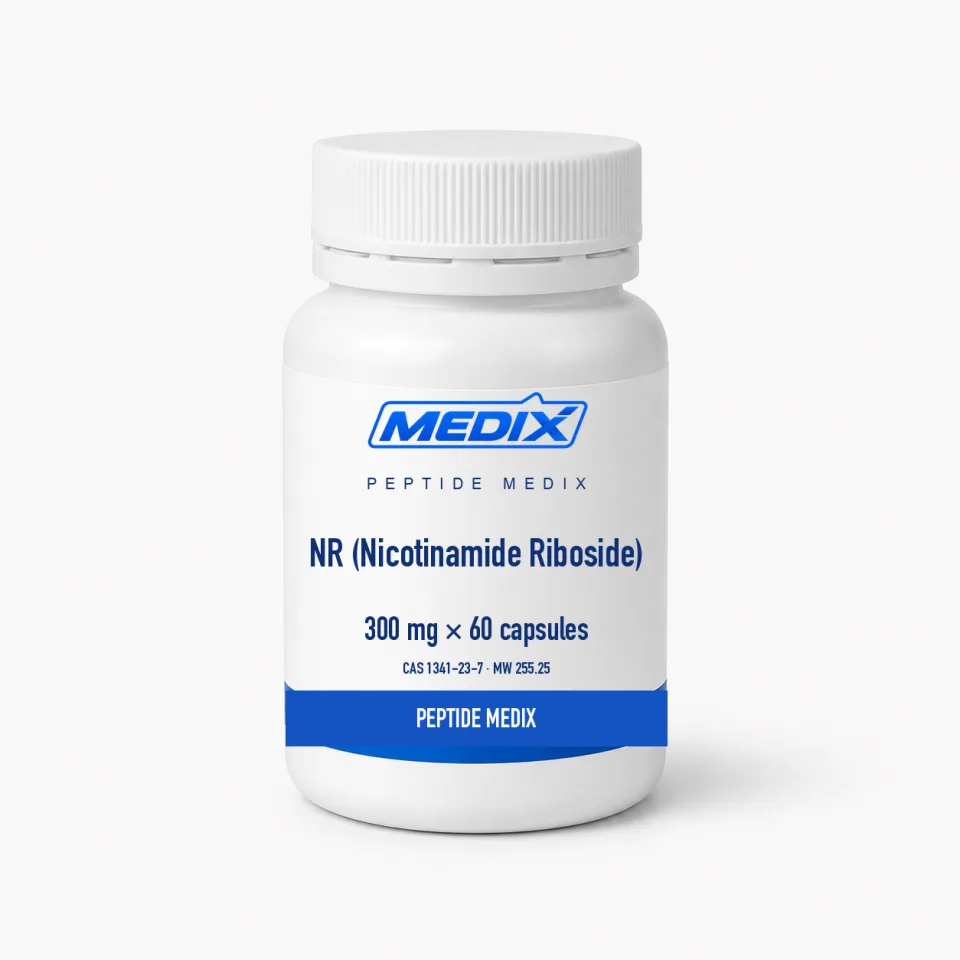
- HPLC-tested, with a per-lot COA on request
- Certificate of analysis tied to your lot number
- Tracked EU delivery, dispatched the next working day
NR (Nicotinamide Riboside)
Nicotinamide riboside — a pyridine-nucleoside NAD+ precursor in 300 mg capsules
In stock1 format availableCAS 1341-23-7
€51
This listing is currently unavailable. Contact us and we will tell you when it is back or suggest an equivalent.
Ask about this listing or request its COA- FormOral capsules in a sealed bottle with desiccant
- Mol. weight255.25 g/mol (nicotinamide riboside cation)
- Research areasNAD+ salvage flux, sirtuin and PARP biology, mitochondrial function, aging models
For laboratory research use only. Sold exclusively for in-vitro laboratory research by qualified professionals. Not for human or veterinary use, and not a medicine, food, cosmetic or dietary supplement. Terms and Conditions
Overview
Key facts
Nicotinamide riboside is a form of vitamin B3 in which nicotinamide is attached to a ribose sugar — the same as NMN, minus the phosphate.
- CAS number
- 1341-23-7
- Molecular weight
- 255.25 g/mol (nicotinamide riboside cation)
- Purity
- HPLC tested; lot-matched COA available
- Form
- Oral capsules in a sealed bottle with desiccant
- Storage
- Room temperature in the sealed bottle, dry and protected from light; refrigeration extends shelf life
- Available size
- 300 mg · 60 capsules
For research use only. Not for human consumption.
Nicotinamide riboside is a form of vitamin B3 in which nicotinamide is attached to a ribose sugar — the same as NMN, minus the phosphate. It was recognised as an NAD+ precursor in its own right after researchers described a separate salvage pathway for it in yeast. Mammalian cells handle it with two dedicated kinases, NRK1 and NRK2, which add a phosphate to form NMN; NMNAT enzymes then convert that NMN into NAD+.
Because of this two-step route, NR is a genuine research tool and not merely yet another niacin. It joins the pathway after the nicotinamide phosphoribosyltransferase step, so it can raise NAD+ even in systems where that enzyme is the bottleneck or has been blocked. Isotope labelling can also tell researchers whether the nucleoside was taken up intact or first broken down to nicotinamide by purine nucleoside phosphorylase in the gut and liver. And since NAD+ is what sirtuins, PARPs and CD38 consume, the supply of its precursors underpins a large body of metabolic and ageing research.
Specifications
Identity
- CAS number
- 1341-23-7
- Molecular weight
- 255.25 g/mol (nicotinamide riboside cation)
Supply & purity
- Form
- Oral capsules in a sealed bottle with desiccant
- Purity
- HPLC tested; lot-matched COA available
- Available sizes
- 300 mg × 60 capsules
- Solubility
- Freely soluble in water; the chloride salt is hygroscopic and acid-stable
Additional detail
- Common salt form
- Nicotinamide riboside chloride, CAS 23111-00-4, 290.70 g/mol
- Compound class
- Pyridine nucleoside; vitamin B3 vitamer and NAD+ precursor
- Also known as
- NR, niagen, nicotinamide ribofuranoside
- Metabolic route
- NR → NMN via NRK1/NRK2 → NAD+ via NMNAT1-3
- Competing route
- Cleavage to nicotinamide and ribose by purine nucleoside phosphorylase
- Research areas
- NAD+ salvage flux, sirtuin and PARP biology, mitochondrial function, aging models
- Storage
- Room temperature in the sealed bottle, dry and protected from light; refrigeration extends shelf life
Questions about NR (Nicotinamide Riboside)
What separates NR from NMN?
NR is the nucleoside with no phosphate; NMN is NR carrying a phosphate at its 5' position. NR therefore needs NRK1 or NRK2 to add that phosphate before NMNAT can make NAD+, while NMN has already passed that stage. Which of the two works better in a given tissue is still debated.
In what salt form is it supplied?
We normally supply nicotinamide riboside as its chloride salt, since the free base does not stay stable as a solid. The 255.25 g/mol figure refers to the NR cation alone; with the chloride included, the formula weight is roughly 290.70 g/mol.
Which documents are included?
Every lot is HPLC-tested for purity and identity, and the certificate for the bottle you receive is available. This matters for NR because the usual quality problem, breakdown to nicotinamide, shows up clearly in the chromatogram.
What topics has NR research covered?
Published work has looked at NAD+ salvage flux, how active sirtuins and PARPs are, mitochondrial respiration, liver metabolism in animals on special diets, and protection of nerve and inner-ear cells after damage. Tracer studies have also measured what fraction of the nucleoside reaches tissues outside the gut intact.
How should NR be stored?
Keep the closed bottle dry and dark at room temperature, or refrigerated for longer storage. The chloride salt absorbs moisture, so leave the desiccant inside and keep opening times short. Prepare solutions fresh and avoid alkaline conditions, which speed up hydrolysis.
Related