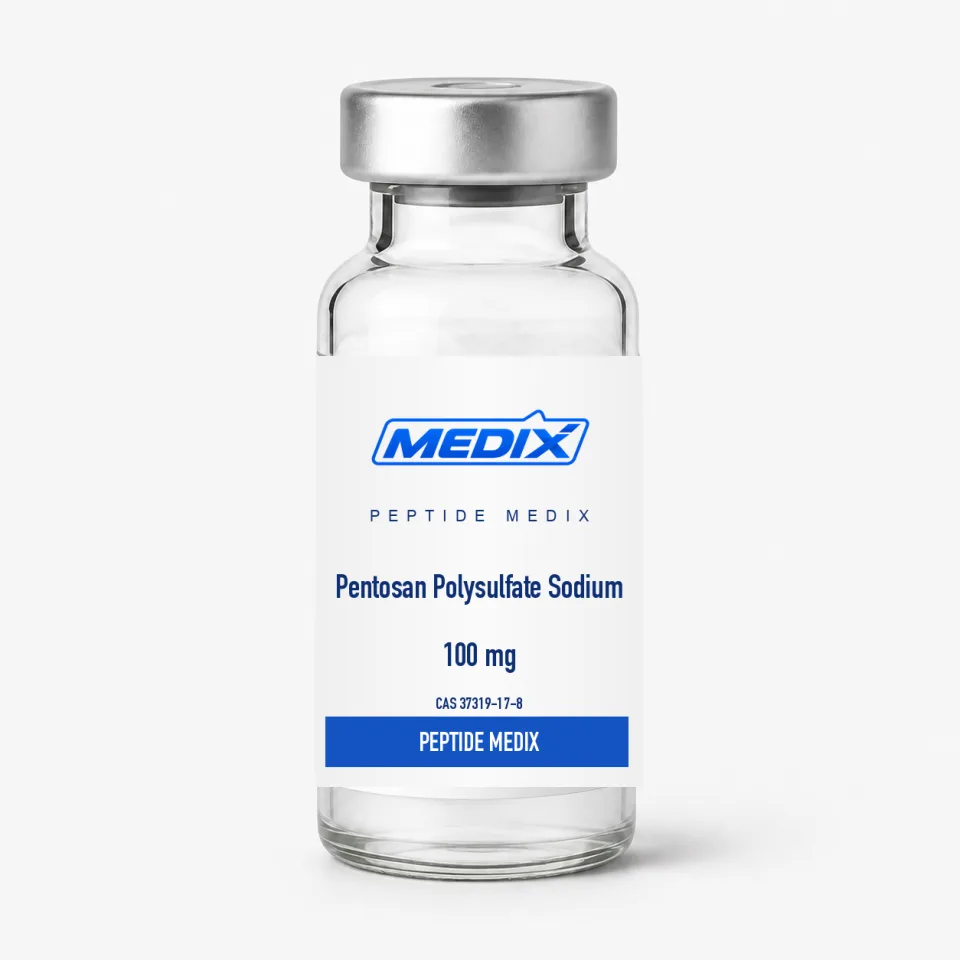
- Independent lab testing; per-lot COA on request
- Certificate of analysis tied to your lot number
- Tracked EU delivery, dispatched the next working day
Tissue Repair & Healing Peptides
Pentosan Polysulfate Sodium
Semi-synthetic sulfated xylan polysaccharide in 100 mg and 250 mg vials
In stock2 formats availableCAS 37319-17-8
€72Range €72 – €140
This listing is currently unavailable. Contact us and we will tell you when it is back or suggest an equivalent.
Ask about this listing or request its COA- FormLyophilized powder, sealed glass vial
- Mol. weightPolydisperse; average molecular weight typically reported in the 4,000–6,000 Da range
- Research areasCartilage and connective-tissue matrix, urothelial and epithelial barrier models, glycocalyx biology, growth-factor and protease binding
For laboratory research use only. Sold exclusively for in-vitro laboratory research by qualified professionals. Not for human or veterinary use, and not a medicine, food, cosmetic or dietary supplement. Terms and Conditions
Overview
Key facts
Although it sits among our repair products, pentosan polysulfate sodium (PPS) is no peptide: it is a semi-synthetic sulfated polysaccharide produced by chemically sulfating xylan from beechwood hemicellulose.
- CAS number
- 37319-17-8
- Molecular weight
- Polydisperse; average molecular weight typically reported in the 4,000–6,000 Da range
- Purity
- Third-party tested; lot-matched COA available
- Form
- Lyophilized powder, sealed glass vial
- Storage
- 2–8 °C or below, sealed, protected from light and moisture — the powder is hygroscopic
- Available sizes
- 100 mg · 250 mg
For research use only. Not for human consumption.
Although it sits among our repair products, pentosan polysulfate sodium (PPS) is no peptide: it is a semi-synthetic sulfated polysaccharide produced by chemically sulfating xylan from beechwood hemicellulose. The result is an unbranched chain of β-1,4-linked xylopyranose units bearing sulfate esters, with a minor share of 4-O-methylglucuronic acid side groups. Chains are short for a polysaccharide — typically around 4–6 kDa — and that pairing of short length with dense negative charge gives PPS a heparin-like character without heparin's strong anticoagulant effect.
Researchers use PPS as a glycosaminoglycan mimic. Its sulfation lets it bind the same positively charged protein surfaces that native GAGs like heparan sulfate and chondroitin sulfate attach to — growth factors, complement proteins, proteases and cartilage matrix components. This has made it a frequent tool compound in cartilage and connective-tissue models, in research on epithelial barrier function and in glycocalyx studies.
Specifications
Identity
- CAS number
- 37319-17-8
- Molecular weight
- Polydisperse; average molecular weight typically reported in the 4,000–6,000 Da range
Supply & purity
- Form
- Lyophilized powder, sealed glass vial
- Purity
- Third-party tested; lot-matched COA available
- Available sizes
- 100 mg, 250 mg
- Solubility
- Freely soluble in water; gives a clear, slightly viscous solution
Handling & storage
- Storage (lyophilized)
- 2–8 °C or below, sealed, protected from light and moisture — the powder is hygroscopic
- Storage (reconstituted)
- 2–8 °C, used within the study window
Additional detail
- Chemical class
- Semi-synthetic sulfated polysaccharide (sulfated xylan), sodium salt
- Source material
- Xylan from beechwood hemicellulose, chemically sulfated
- Backbone
- β-1,4-linked xylopyranose units with sulfate ester substitution and occasional 4-O-methylglucuronic acid side residues
- Also known as
- PPS, sodium pentosan polysulfate, xylan polysulfate
- Functional description
- Glycosaminoglycan mimetic; low-affinity, heparin-like polyanion
- Research areas
- Cartilage and connective-tissue matrix, urothelial and epithelial barrier models, glycocalyx biology, growth-factor and protease binding
Questions about Pentosan Polysulfate Sodium
Does pentosan polysulfate count as a peptide?
No. Although it is listed in the tissue-repair category next to BPC-157 and TB-500, PPS is a sulfated polysaccharide — a xylan chain of β-1,4-linked xylopyranose units carrying sulfate esters. The grouping follows research area, not chemical class.
Why isn't an exact molecular weight stated?
The material is polydisperse. Sulfating natural xylan yields a range of chain lengths and sulfation levels rather than one species, so lots are specified by their average molecular weight — usually about 4,000–6,000 Da — together with the degree of sulfation.
Which purity documents are available?
It is tested by an independent lab, and the certificate for your lot can be requested. For a polysaccharide, the COA gives identity, average molecular weight and sulfur or sulfate content instead of the HPLC purity used for our synthetic peptides.
How do I reconstitute and store it?
The powder absorbs moisture, so let the vial reach room temperature before opening to prevent condensation. It dissolves readily in water and aqueous buffers — add the diluent gently along the glass and swirl, don't shake. Keep sealed powder at 2–8 °C or colder, and solutions at 2–8 °C.