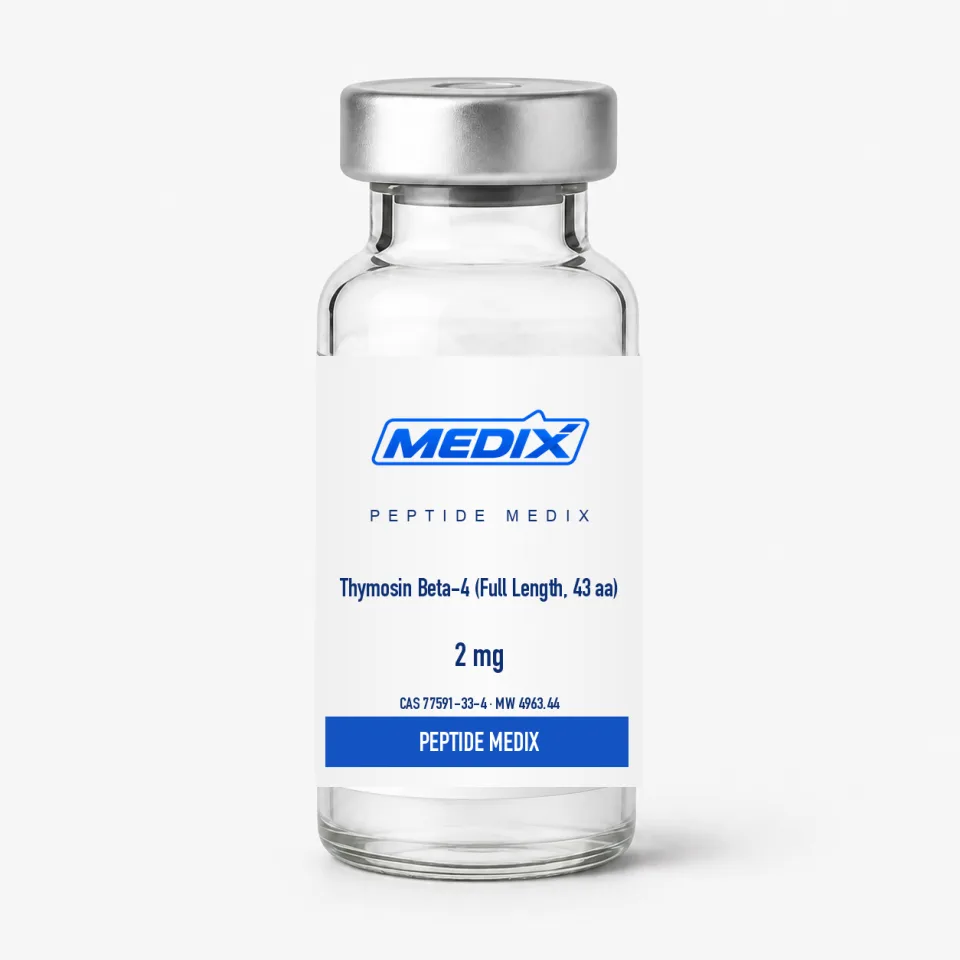
- HPLC purity ≥99%, with a COA for each lot on request
- Certificate of analysis tied to your lot number
- Tracked EU delivery, dispatched the next working day
Tissue Repair & Healing Peptides
Thymosin Beta-4 (Full Length, 43 aa)
Complete 43-residue acetylated thymosin beta-4 — the intact actin-sequestering protein
In stock2 formats availableCAS 77591-33-4
€97Range €97 – €191
This listing is currently unavailable. Contact us and we will tell you when it is back or suggest an equivalent.
Ask about this listing or request its COA- FormLyophilized powder, sealed glass vial with crimped stopper
- Mol. weight4963.44 g/mol
- Research areasActin dynamics, cell migration, wound closure, angiogenesis, cardiac and corneal repair
For laboratory research use only. Sold exclusively for in-vitro laboratory research by qualified professionals. Not for human or veterinary use, and not a medicine, food, cosmetic or dietary supplement. Terms and Conditions
Overview
Key facts
What you receive here is thymosin beta-4 in full — all 43 amino acids, with the natural N-terminal acetyl group — rather than the seven-residue actin-binding fragment marketed as TB-500.
- CAS number
- 77591-33-4
- Molecular weight
- 4963.44 g/mol
- Amino acid sequence
- Ac-Ser-Asp-Lys-Pro-Asp-Met-Ala-Glu-Ile-Glu-Lys-Phe-Asp-Lys-Ser-Lys-Leu…
- Purity
- ≥99% by HPLC; lot-matched COA available
- Form
- Lyophilized powder, sealed glass vial with crimped stopper
- Storage
- −20 °C, sealed and protected from light and moisture
- Available sizes
- 2 mg · 5 mg
For research use only. Not for human consumption.
What you receive here is thymosin beta-4 in full — all 43 amino acids, with the natural N-terminal acetyl group — rather than the seven-residue actin-binding fragment marketed as TB-500. In mammalian cells this protein is among the most abundant inside the cell and is the main sequesterer of G-actin: it binds actin monomers one-to-one, holding back a reserve that controls how fast filaments can grow.
The difference from the fragment is experimentally important. TB-500 copies only the central actin-binding motif, LKKTETQ, while the full protein has further structure linked to interactions beyond actin — with reported partners in cell migration, angiogenesis and inflammatory signalling. To find out whether an effect needs the entire protein or just the motif, you need both molecules, which is why labs normally test them together.
Specifications
Identity
- CAS number
- 77591-33-4
- Molecular weight
- 4963.44 g/mol
- Amino acid sequence
- Ac-Ser-Asp-Lys-Pro-Asp-Met-Ala-Glu-Ile-Glu-Lys-Phe-Asp-Lys-Ser-Lys-Leu-Lys-Lys-Thr-Glu-Thr-Gln-Glu-Lys-Asn-Pro-Leu-Pro-Ser-Lys-Glu-Thr-Ile-Glu-Gln-Glu-Lys-Gln-Ala-Gly-Glu-Ser
- Chain length
- 43 amino acids, N-terminally acetylated
- Peptide class
- Beta-thymosin family; G-actin sequestering protein
Supply & purity
- Form
- Lyophilized powder, sealed glass vial with crimped stopper
- Purity
- ≥99% by HPLC; lot-matched COA available
- Available sizes
- 2 mg, 5 mg
- Solubility
- Readily soluble in sterile or bacteriostatic water; highly hydrophilic and acidic
Handling & storage
- Storage (lyophilized)
- −20 °C, sealed and protected from light and moisture
- Storage (reconstituted)
- 2–8 °C, protected from light; aliquot for longer holds
Additional detail
- Key motif
- LKKTETQ actin-binding motif at residues 17–23
- Relationship to TB-500
- TB-500 is the acetylated 17–23 fragment of this sequence
- Research areas
- Actin dynamics, cell migration, wound closure, angiogenesis, cardiac and corneal repair
Questions about Thymosin Beta-4 (Full Length, 43 aa)
What distinguishes this from TB-500?
TB-500 is the acetylated seven-residue fragment covering positions 17–23 of this sequence; this product is the whole 43-residue protein containing that motif plus everything around it. Labs use both to test whether the motif by itself explains a particular effect.
Why are the vials smaller than those for TB-500?
Making a 43-residue peptide at high purity is much harder than making a seven-residue fragment, so the full-length protein comes in 2 mg and 5 mg vials. In moles the gap is even bigger, as the full protein is roughly five and a half times heavier.
Which purity data and documents come with it?
HPLC testing to ≥99% plus mass-spectrometric identity for each lot, with its certificate of analysis available. Mass spectrometry is especially important here, as this acidic, disordered protein runs abnormally on gels and size-exclusion columns.
What is its molecular function?
It captures monomeric G-actin in a one-to-one complex and keeps it out of the polymerising pool, serving as the cell's main actin buffer. That puts it at the heart of research on cytoskeletal dynamics, cell migration and processes relying on fast filament turnover.
How should it be stored?
Unopened lyophilised vials: −20 °C, away from light and moisture. Reconstituted: 2–8 °C for short studies, or aliquoted and frozen for longer. Avoid repeated freeze–thaw and, in long experiments, watch the internal methionine for oxidation.