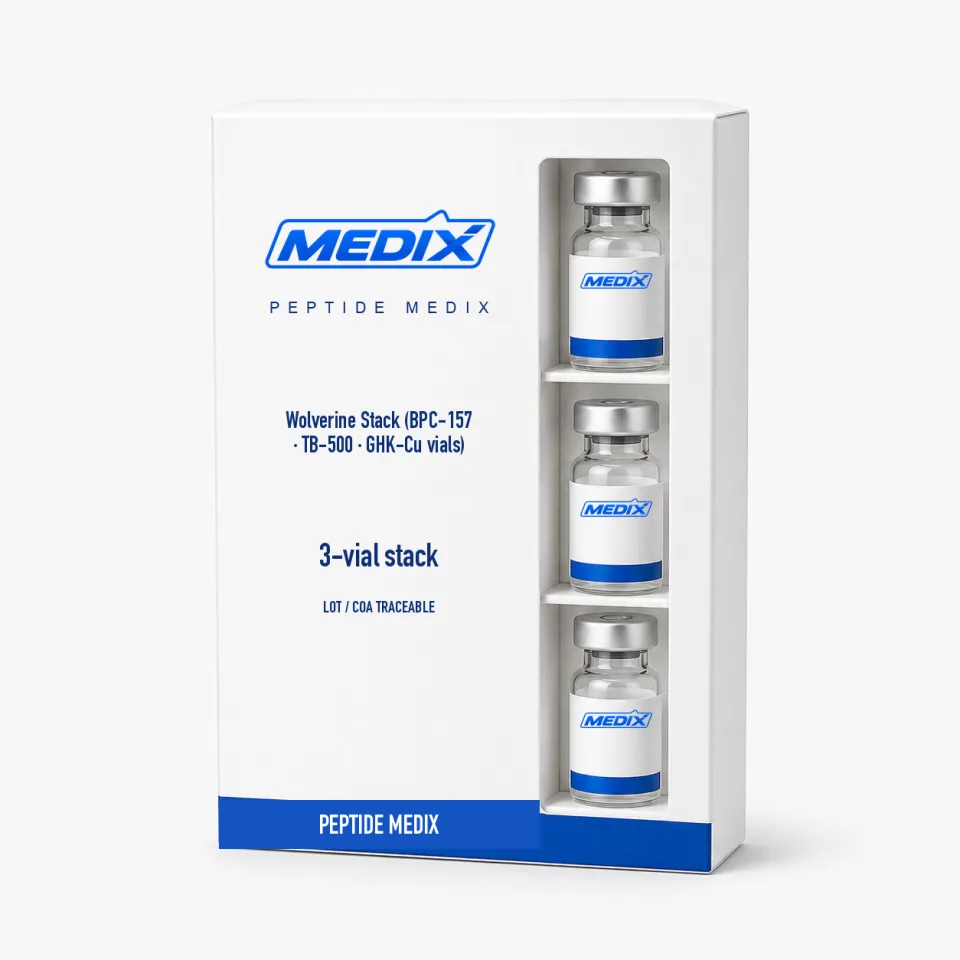
- Every vial assayed to ≥99% (HPLC) with its own lot COA
- Certificate of analysis tied to your lot number
- Tracked EU delivery, dispatched the next working day
Wolverine Stack (BPC-157 · TB-500 · GHK-Cu vials)
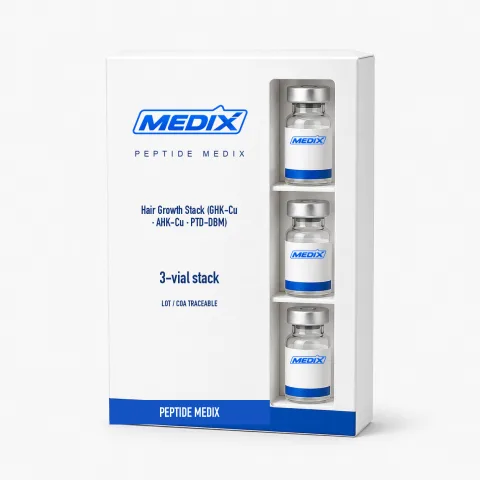
BPC-157, TB-500 and GHK-Cu in three separately sealed vials for repair-model research
In stock1 format available
€80
This listing is currently unavailable. Contact us and we will tell you when it is back or suggest an equivalent.
Ask about this listing or request its COA- FormLyophilized powder in each vial, individually stoppered and capped
- Research areasTendon and ligament models, cell migration, extracellular matrix synthesis
For laboratory research use only. Sold exclusively for in-vitro laboratory research by qualified professionals. Not for human or veterinary use, and not a medicine, food, cosmetic or dietary supplement. Terms and Conditions
Overview
Key facts
In this stack, BPC-157, TB-500 and GHK-Cu arrive as three separately sealed freeze-dried vials, not as one pre-mixed blend — and that is the whole point.
- Purity
- ≥99% by HPLC per vial; separate lot-matched COA for each
- Form
- Lyophilized powder in each vial, individually stoppered and capped
- Storage
- −20 °C, protected from light and moisture
- Available size
- 3-vial stack
For research use only. Not for human consumption.
In this stack, BPC-157, TB-500 and GHK-Cu arrive as three separately sealed freeze-dried vials, not as one pre-mixed blend — and that is the whole point. A blend fixes the proportions of its ingredients when it is made; a set of separate vials lets your study design decide, so you can dissolve each peptide at the concentration you want and vary it independently between experimental groups.
Each vial has its own lot number and certificate of analysis, with HPLC assay at ≥99% purity. Since nothing is pre-mixed, a lab can also run any one component alone while the other two stay sealed at −20 °C. Supplied as a research chemical for laboratory investigation only.
What sets this listing apart
Wolverine Stack combines BPC-157, TB-500 and GHK-Cu (Copper Peptide) in one listing. Components that are also sold on their own are linked below, each with its own specification and COA.
Same compound, other listings
Specifications
Supply & purity
- Form
- Lyophilized powder in each vial, individually stoppered and capped
- Purity
- ≥99% by HPLC per vial; separate lot-matched COA for each
Handling & storage
- Storage (lyophilized)
- −20 °C, protected from light and moisture
- Storage (reconstituted)
- 2–8 °C, protected from light
Additional detail
- Product type
- Multi-vial research kit — three separately sealed vials
- Kit contents
- One BPC-157 vial, one TB-500 vial, one GHK-Cu vial
- BPC-157
- CAS 137525-51-0 · C62H98N16O22 · 1419.55 g/mol
- TB-500
- CAS 885340-08-9 · C38H68N10O14 · 889.02 g/mol
- GHK-Cu
- CAS 89030-95-5 · C14H24N6O4·Cu · 403.93 g/mol
- BPC-157 sequence
- Gly-Glu-Pro-Pro-Pro-Gly-Lys-Pro-Ala-Asp-Asp-Ala-Gly-Leu-Val
- TB-500 sequence
- Ac-Leu-Lys-Lys-Thr-Glu-Thr-Gln (thymosin beta-4 actin-binding domain)
- Research areas
- Tendon and ligament models, cell migration, extracellular matrix synthesis
- Reconstitution
- Each vial prepared separately; concentrations chosen per protocol
Questions about Wolverine Stack (BPC-157 · TB-500 · GHK-Cu vials)
How does this kit differ from GLOW Blend?
GLOW Blend combines these same three peptides in one vial at a fixed 50/10/10 mg split. The Wolverine Stack keeps them apart, so the researcher — not the formulation — determines each component's ratio, concentration and timing.
Does every vial have its own COA?
Yes. The vials come from separate production lots, and each has a certificate giving HPLC identity and purity for its peptide — three documents rather than one blend report. Current lot COAs can be requested before you order.
Can I use one vial and keep the others for later?
Yes, and that's one of the practical benefits of separate vials. Kept sealed in the freezer (−20 °C), shielded from light and damp, unopened freeze-dried vials stay stable for well over a year — so the other components can wait until your protocol needs them.
What gives the GHK-Cu solution its blue colour?
The copper(II) ion held within the tripeptide complex. A clear, light blue solution is what you should see and shows the copper peptide has dissolved; a colourless result or a green-brown tint would be unexpected.
Related