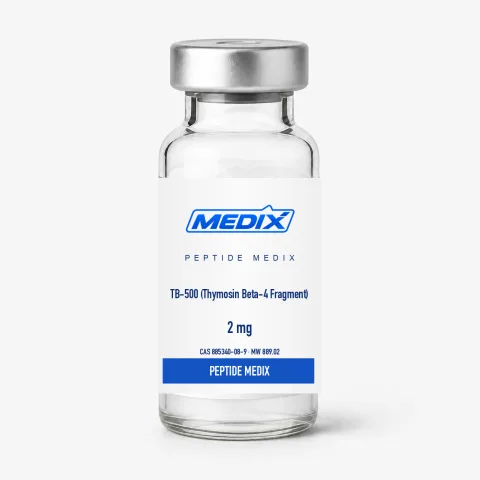
- HPLC-assayed purity of ≥99%
- Certificate of analysis tied to your lot number
- Tracked EU delivery, dispatched the next working day
Tissue Repair & Healing Peptides
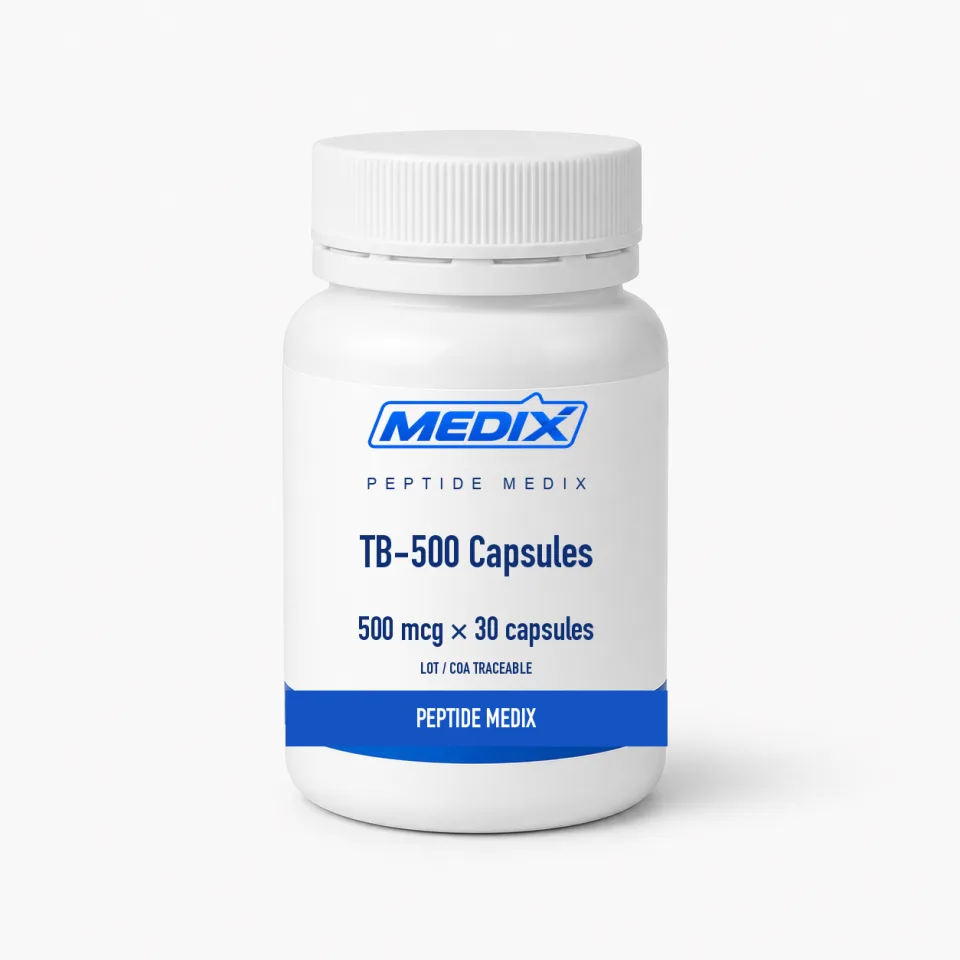
TB-500 Capsules
TB-500 research capsules for oral-route studies — 500 mcg each, 30 per bottle
In stock1 format availableCAS 885340-08-9
€72
This listing is currently unavailable. Contact us and we will tell you when it is back or suggest an equivalent.
Ask about this listing or request its COA- FormOral capsule, sealed bottle with tamper-evident closure and desiccant
- Mol. weight889.02 g/mol
- Research areasCell migration, wound closure, angiogenesis, oral versus parenteral route comparison
For laboratory research use only. Sold exclusively for in-vitro laboratory research by qualified professionals. Not for human or veterinary use, and not a medicine, food, cosmetic or dietary supplement. Terms and Conditions
Overview
Key facts
TB-500 is the heptapeptide Ac-Leu-Lys-Lys-Thr-Glu-Thr-Gln — the actin-binding region of the 43-residue protein thymosin beta-4.
- CAS number
- 885340-08-9
- Molecular formula
- C38H68N10O14
- Molecular weight
- 889.02 g/mol
- Amino acid sequence
- Ac-Leu-Lys-Lys-Thr-Glu-Thr-Gln
- Purity
- ≥99% by HPLC; lot-matched COA available
- Form
- Oral capsule, sealed bottle with tamper-evident closure and desiccant
- Storage
- Cool, dry conditions away from direct light; refrigeration extends shelf stability
- Available size
- 500 mcg · 30 capsules
For research use only. Not for human consumption.
TB-500 is the heptapeptide Ac-Leu-Lys-Lys-Thr-Glu-Thr-Gln — the actin-binding region of the 43-residue protein thymosin beta-4. Being short and N-terminally acetylated, it is a fairly sturdy research peptide; nevertheless, taken orally, it faces stomach acid and pancreatic proteases like any peptide — and measuring exactly that is what route-comparison studies set out to do.
There are thirty capsules per bottle, each containing 500 micrograms. The peptide in them is the very same material — made by solid-phase synthesis and cleaned up by HPLC — that goes into our freeze-dried vials: CAS 885340-08-9, C38H68N10O14, 889.02 g/mol. That means a study can move from one format to the other while keeping identical lot chemistry. Two neighbouring products explain why this one exists: the vial lets you decide concentration and route, while full-length thymosin beta-4 provides the complete 43-residue protein, of which Ac-Leu-Lys-Lys-Thr-Glu-Thr-Gln is merely the actin-binding stretch. The capsule covers the remaining case — when the oral route is exactly what you are testing, and giving the same fixed amount at each time point keeps preparation error out of the comparison. Keep it cool, dry and dark, with the desiccant left in the bottle.
What sets this listing apart
TB-500 Capsules – capsules, 500 mcg. Oral capsule, sealed bottle with tamper-evident closure and desiccant. Other TB-500 listings differ in format, fill or combination partners; the specification and COA always refer to the listing you order.
Same compound, other listings
Specifications
Identity
- CAS number
- 885340-08-9
- Molecular formula
- C38H68N10O14
- Molecular weight
- 889.02 g/mol
- Amino acid sequence
- Ac-Leu-Lys-Lys-Thr-Glu-Thr-Gln
- Chain length
- 7 amino acids, N-terminally acetylated
Supply & purity
- Form
- Oral capsule, sealed bottle with tamper-evident closure and desiccant
Additional detail
- Peptide per capsule
- 500 mcg TB-500
- Available count
- 30 capsules
- Peptide purity
- ≥99% by HPLC; lot-matched COA available
- Active peptide
- TB-500, acetylated thymosin beta-4 fragment (residues 17–23)
- Parent protein
- Thymosin beta-4, a 43-residue G-actin sequestering protein
- Research areas
- Cell migration, wound closure, angiogenesis, oral versus parenteral route comparison
- Storage
- Cool, dry conditions away from direct light; refrigeration extends shelf stability
- Preparation required
- None — fixed unit content, no reconstitution step
Questions about TB-500 Capsules
How much TB-500 is in each capsule?
500 micrograms, mixed with an inert filler. All 30 capsules in a bottle are filled to one target amount, and the lot's content and peptide purity are recorded on its certificate of analysis.
Is it the same peptide as in the vials?
Yes. We fill them with exactly the TB-500 that goes into our freeze-dried vials — made by solid-phase synthesis and HPLC-purified: Ac-Leu-Lys-Lys-Thr-Glu-Thr-Gln, CAS 885340-08-9, molecular weight 889.02 g/mol. Nothing but the presentation differs.
When are capsules preferable to a vial?
Capsules eliminate reconstitution, so every unit contains the same fixed amount. That helps studies with many time points or animals, where repeated preparation would introduce avoidable variation, and it makes adding an oral-route arm simple.
Are peptides absorbed when taken by mouth?
Only partly, as a rule. Stomach acid and pancreatic enzymes degrade most peptides, and the gut wall lets through little of a molecule this size. Short peptides with an acetylated end generally do better than long ones — and measuring how much better is the whole point of route-comparison studies.
How is purity confirmed, and is there a COA?
The TB-500 used in production is tested by reversed-phase HPLC to at least 99% and its identity confirmed by mass spectrometry. The certificate matching the lot number on your bottle can be requested whenever you like, before or after buying.
How should I store the capsules?
In the closed bottle, somewhere cool and dry and out of direct sunlight, with the desiccant left in. A fridge isn't required but helps them keep longer. Avoid damp places, and don't move the capsules into other containers for long-term keeping.
Are these capsules for human consumption?
No. They are laboratory research material only — not a supplement, food or medicinal product.
Related