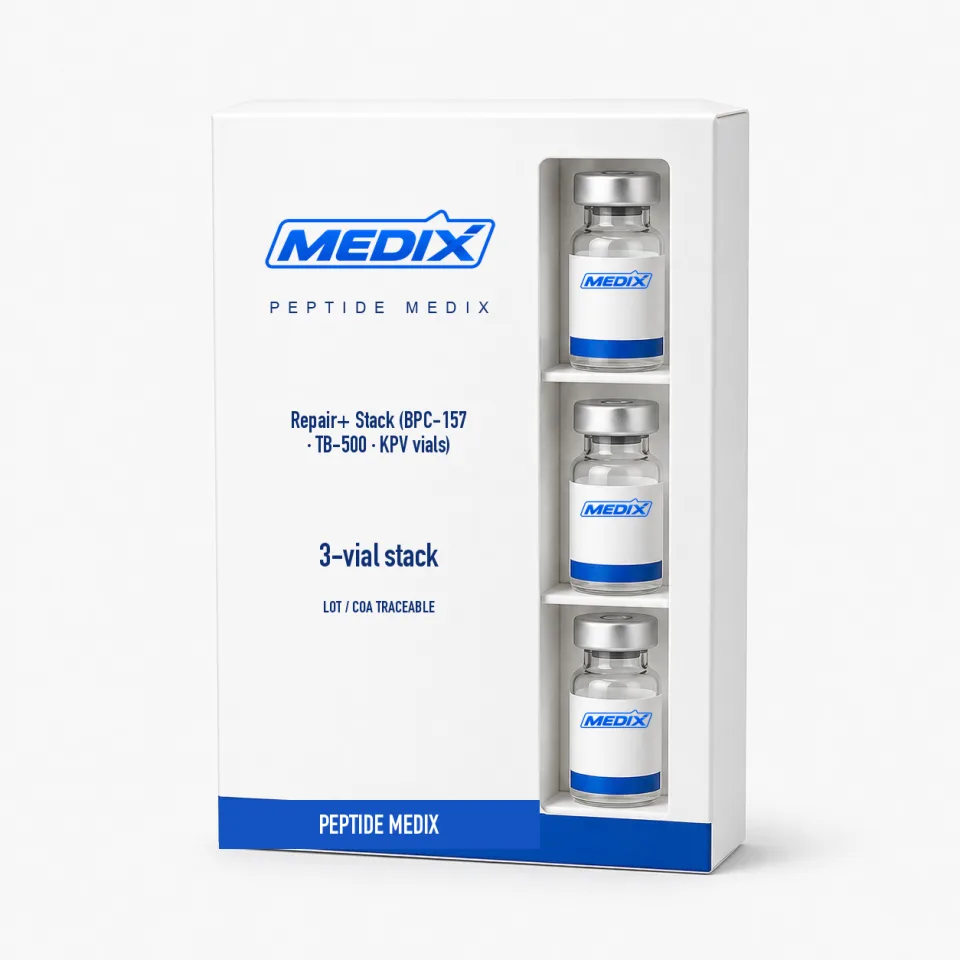
- Every vial assayed to ≥99% (HPLC) with its own lot COA
- Certificate of analysis tied to your lot number
- Tracked EU delivery, dispatched the next working day
Repair+ Stack (BPC-157 · TB-500 · KPV vials)
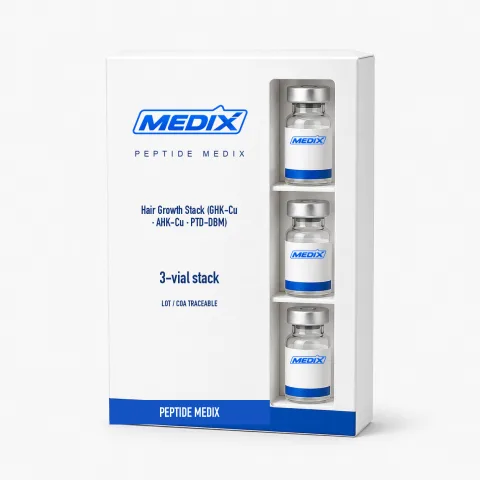
BPC-157, TB-500 and KPV supplied unmixed in three repair-research vials
In stock1 format available
€97
This listing is currently unavailable. Contact us and we will tell you when it is back or suggest an equivalent.
Ask about this listing or request its COA- FormLyophilized powder in each vial, individually capped
- Research areasTendon and gastrointestinal models, cell migration, NF-κB inflammatory signalling
For laboratory research use only. Sold exclusively for in-vitro laboratory research by qualified professionals. Not for human or veterinary use, and not a medicine, food, cosmetic or dietary supplement. Terms and Conditions
Overview
Key facts
Repair+ Stack provides BPC-157, TB-500 and KPV in three individually sealed lyophilised vials.
- Purity
- ≥99% by HPLC per vial; separate lot-matched COA for each
- Form
- Lyophilized powder in each vial, individually capped
- Storage
- −20 °C, protected from light and moisture
- Available size
- 3-vial stack
For research use only. Not for human consumption.
Repair+ Stack provides BPC-157, TB-500 and KPV in three individually sealed lyophilised vials. The compounds are the same as in our co-formulated 30 mg blend, but here they stay unmixed — the crucial difference for any study that needs to vary one of them against the others.
BPC-157 and TB-500 are the two repair-model peptides. BPC-157 is a synthetic sequence of 15 amino acids corresponding to part of a protein in human gastric juice, investigated in rodent models of tendon, ligament and gut injury; TB-500 reproduces the region of thymosin beta-4 that binds actin and features throughout research on cell migration. KPV comes from a different angle: it is the lysine–proline–valine tripeptide found at the end of alpha-MSH, and research on it concerns inflammatory signalling, not structural repair.
Since KPV is by far the lightest of the three — 342 g/mol versus 1,420 for BPC-157 — equal moles and equal mass lead to very different amounts, and separate vials let a protocol decide which to keep constant. Each vial has its own lot number, an HPLC assay at ≥99% purity and a certificate of analysis. For laboratory research only.
What sets this listing apart
Repair+ Stack combines BPC-157, TB-500 and KPV in one listing. Components that are also sold on their own are linked below, each with its own specification and COA.
Same compound, other listings
Specifications
Supply & purity
- Form
- Lyophilized powder in each vial, individually capped
- Purity
- ≥99% by HPLC per vial; separate lot-matched COA for each
Handling & storage
- Storage (lyophilized)
- −20 °C, protected from light and moisture
- Storage (reconstituted)
- 2–8 °C, protected from light
Additional detail
- Product type
- Multi-vial research kit — three separately sealed vials
- Kit contents
- One BPC-157 vial, one TB-500 vial, one KPV vial
- BPC-157
- CAS 137525-51-0 · C62H98N16O22 · 1419.55 g/mol
- TB-500
- CAS 885340-08-9 · C38H68N10O14 · 889.02 g/mol
- KPV
- CAS 67727-97-3 · C16H30N4O4 · 342.43 g/mol
- KPV sequence
- Lys-Pro-Val, the C-terminal tripeptide of alpha-MSH
- TB-500 sequence
- Ac-Leu-Lys-Lys-Thr-Glu-Thr-Gln (thymosin beta-4 actin-binding domain)
- Research areas
- Tendon and gastrointestinal models, cell migration, NF-κB inflammatory signalling
- Reconstitution
- Each vial prepared separately at protocol-defined concentration
Questions about Repair+ Stack (BPC-157 · TB-500 · KPV vials)
How is this different from the BPC-157 + TB-500 + KPV blend?
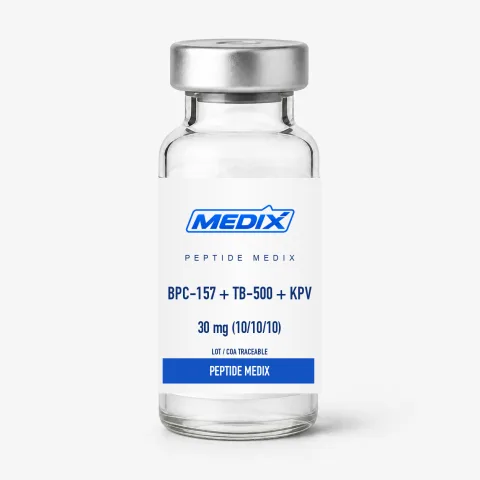
The blend combines all three in one vial at a fixed 10/10/10 mg split. This kit keeps them apart, so you decide concentration, ratio and timing. Pick the blend for convenience and the kit for experimental control.
Is each vial tested on its own?
Yes. Each vial is a separate production lot and is released with its own certificate showing HPLC identity and purity for that peptide. You'll receive three documents with the kit, and we can send the current ones before you order.
Is it normal for any of the solutions to have a colour?
No. The kit contains no copper complex, so all three peptides should dissolve into clear, colourless liquids. If a solution shows any tint, haze or particles, stop and put that vial to one side rather than carrying on.
Why pair KPV with two repair peptides?
It adds a separate body of research. BPC-157 and TB-500 are studied for tissue repair and cell migration, while KPV, derived from alpha-MSH, is investigated in inflammatory signalling and mucosal models — so one panel covers both repair and inflammation arms.
Can I open one vial and keep the others?
Yes. Unopened freeze-dried vials, kept sealed at −20 °C away from light and damp, remain stable for well over a year — so you can use the components one after another as each phase of your study needs them.
Related