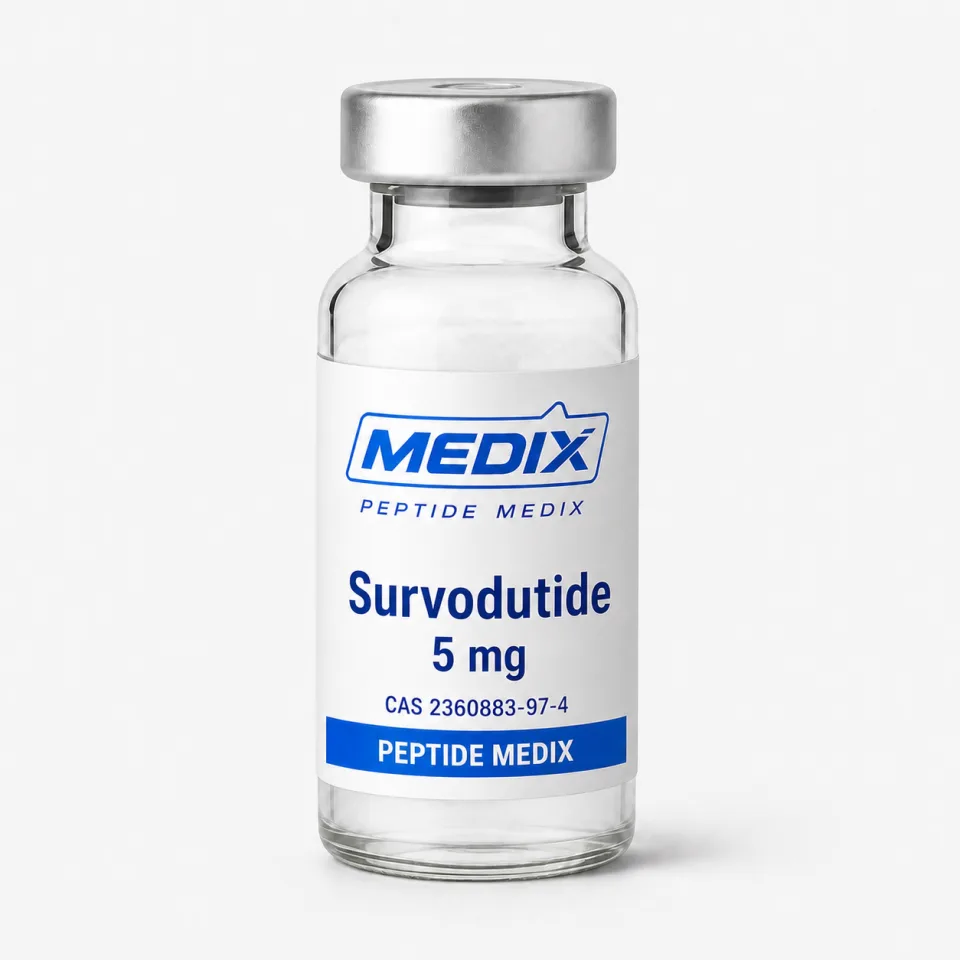
- HPLC purity ≥99%, with a COA for each lot on request
- Certificate of analysis tied to your lot number
- Tracked EU delivery, dispatched the next working day
Survodutide
Research peptide agonist of the glucagon and GLP-1 receptors, acylated for longevity
In stock3 formats availableCAS 2360883-97-4
€97Range €97 – €293
This listing is currently unavailable. Contact us and we will tell you when it is back or suggest an equivalent.
Ask about this listing or request its COA- FormLyophilized powder, sealed glass vial with flip-off seal
- Research areasHepatic lipid metabolism, energy expenditure, incretin-glucagon receptor crosstalk
For laboratory research use only. Sold exclusively for in-vitro laboratory research by qualified professionals. Not for human or veterinary use, and not a medicine, food, cosmetic or dietary supplement. Terms and Conditions
Overview
Key facts
When the question is how activity at the glucagon receptor modifies a GLP-1 response, survodutide is the compound researchers pick.
- CAS number
- 2360883-97-4
- Purity
- ≥99% by HPLC; lot-matched COA available
- Form
- Lyophilized powder, sealed glass vial with flip-off seal
- Storage
- −20 °C, sealed and protected from light and moisture
- Available sizes
- 5 mg · 10 mg · 20 mg
For research use only. Not for human consumption.
When the question is how activity at the glucagon receptor modifies a GLP-1 response, survodutide is the compound researchers pick. A typical programme first measures cAMP potency at each receptor on its own using transfected cells, then moves into liver cells, fat cells or whole animals, where outcomes driven by glucagon — liver fat, ketone output, indirect calorimetry — can be told apart from effects on how much the animals eat. It is also the benchmark against which triple agonists, which add GIP activity to these two receptors, are compared.
Rather than GLP-1, its backbone derives from the glucagon family; protease-resistant substitutions stabilise it, and a fatty side chain lets it bind albumin reversibly — the acylation trick used across this class, applied here to a different starting sequence. It is registered as CAS 2360883-97-4, and papers also refer to it by a development code that is worth adding to literature searches. Our specification omits a molecular formula because published structural accounts do not agree; the certificate for your lot records the identity data confirmed for your vial. We stock 5 mg, 10 mg and 20 mg fills; they dissolve in bacteriostatic water or a dilute alkaline or phosphate buffer. Keep the unopened cake frozen and solutions refrigerated.
Specifications
Identity
- CAS number
- 2360883-97-4
- Peptide class
- Acylated dual glucagon receptor / GLP-1 receptor agonist
Supply & purity
- Form
- Lyophilized powder, sealed glass vial with flip-off seal
- Purity
- ≥99% by HPLC; lot-matched COA available
- Available sizes
- 5 mg, 10 mg, 20 mg
- Solubility
- Bacteriostatic water; dilute alkaline or phosphate buffers also used
Handling & storage
- Storage (lyophilized)
- −20 °C, sealed and protected from light and moisture
- Storage (reconstituted)
- 2–8 °C, protected from light; use within the study window
Additional detail
- Structural notes
- Glucagon-superfamily backbone with protease-resistant substitutions and a fatty-acid side chain for albumin binding
- Research areas
- Hepatic lipid metabolism, energy expenditure, incretin-glucagon receptor crosstalk
Questions about Survodutide
What distinguishes survodutide from tirzepatide?
Tirzepatide activates the two incretin receptors, GIP and GLP-1. Survodutide instead pairs GLP-1 with the glucagon receptor, so research with it centres on how the liver handles fuels and on energy expenditure, not on interplay between incretin receptors.
Which purity data and documents are provided?
Every lot is HPLC-tested to ≥99%, with identity confirmed by mass spectrometry, and its certificate of analysis — matched to the vial number shipped — is available, so assay data stay traceable to the material used.
Why don't you list a molecular formula?
We only print values we are sure of. Sources describe this peptide's structure in different ways, so instead we direct you to the certificate for your lot, which shows the identity data we have confirmed for your particular vial.
What are the storage requirements?
Keep unopened freeze-dried vials frozen at −20 °C, protected from light and humidity. Once dissolved, store in the fridge at 2–8 °C, out of the light, and finish within the period documented for your study; split into aliquots so it isn't repeatedly frozen and thawed.
Related