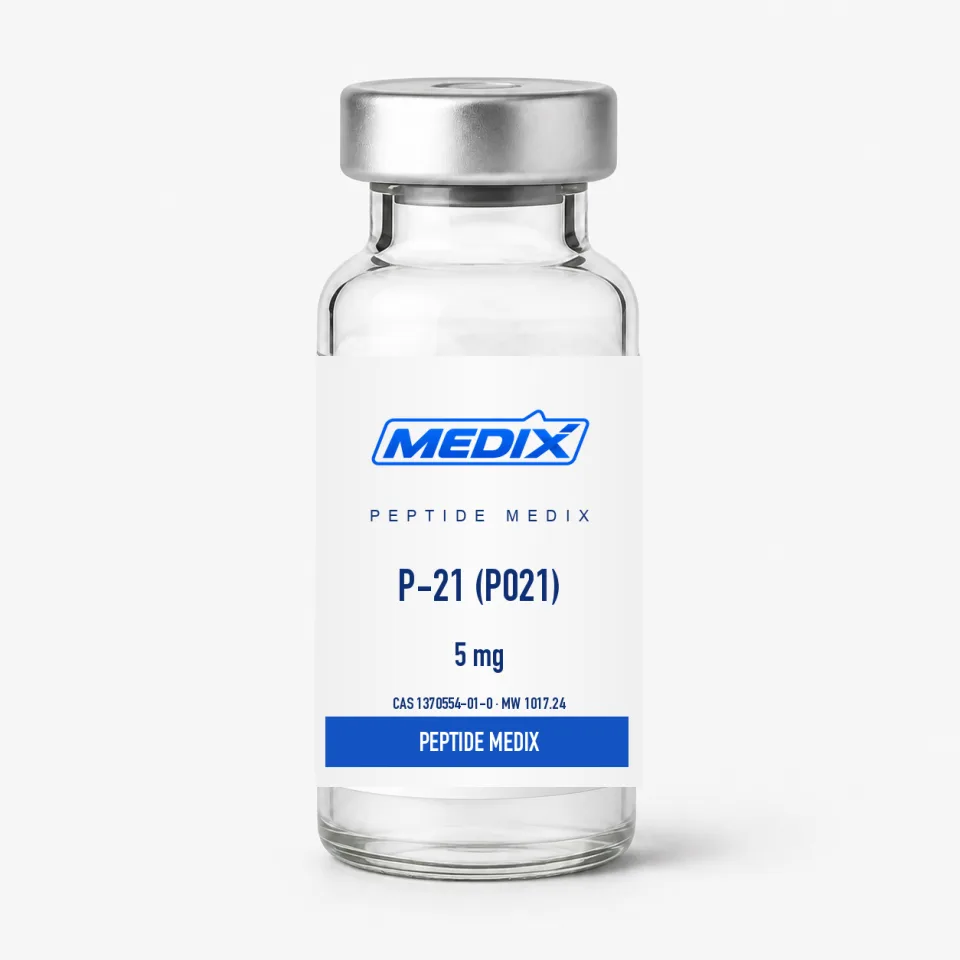
- HPLC purity ≥99%, with a COA for each lot on request
- Certificate of analysis tied to your lot number
- Tracked EU delivery, dispatched the next working day
P-21 (P021)
CNTF-derived peptide mimetic researched in neurogenesis and BDNF-signalling models
In stock1 format availableCAS 1370554-01-0
€123
This listing is currently unavailable. Contact us and we will tell you when it is back or suggest an equivalent.
Ask about this listing or request its COA- FormLyophilized powder in a sealed glass vial
- Research areasAdult hippocampal neurogenesis, BDNF and CREB signaling, tau pathology models
For laboratory research use only. Sold exclusively for in-vitro laboratory research by qualified professionals. Not for human or veterinary use, and not a medicine, food, cosmetic or dietary supplement. Terms and Conditions
Overview
Key facts
P-21 (sometimes written P021) is a small synthetic molecule derived from the part of ciliary neurotrophic factor (CNTF) responsible for its activity.
- CAS number
- 1370554-01-0
- Purity
- ≥99% by HPLC; lot-matched COA available
- Form
- Lyophilized powder in a sealed glass vial
- Storage
- −20 °C, protected from light and moisture
- Available size
- 5 mg
For research use only. Not for human consumption.
P-21 (sometimes written P021) is a small synthetic molecule derived from the part of ciliary neurotrophic factor (CNTF) responsible for its activity. Rather than reproducing the full protein of some 200 residues, its designers reduced that active stretch to four amino acids, put an acetyl cap on one end and an amide on the other, and attached an adamantane group. Each change serves a purpose — blocking exopeptidases and making the molecule more fat-soluble — so it behaves quite unlike an ordinary peptide fragment.
The feature that really sets P-21 apart from a simple tetrapeptide is its adamantane cage: a stiff, very fat-soluble hydrocarbon that sharply raises the partition coefficient yet is barely touched by metabolism — a building block medicinal chemists use for exactly that combination. Published studies come from neuroscience in rodents: formation of new neurons in the adult hippocampus (tracked with BrdU or doublecortin labelling), BDNF levels and CREB phosphorylation, the density of dendritic spines, and models of tau pathology in which the compound is given over long periods. That is why it comes as one 5 mg vial: working concentrations are low and doses are taken from a co-solvent stock. Different sources publish different structural identifiers for it, so the certificate for your lot is the authoritative account of what you receive.
What sets this listing apart
P-21 (P021) – vial, 5 mg. Lyophilized powder in a sealed glass vial. Other P-21 listings differ in format, fill or combination partners; the specification and COA always refer to the listing you order.
Same compound, other listings
Specifications
Identity
- CAS number
- 1370554-01-0
Supply & purity
- Form
- Lyophilized powder in a sealed glass vial
- Purity
- ≥99% by HPLC; lot-matched COA available
- Solubility
- Limited aqueous solubility; a co-solvent step is commonly used before dilution
Handling & storage
- Storage (lyophilized)
- −20 °C, protected from light and moisture
Additional detail
- Available size
- 5 mg
- Also known as
- P021, CNTF-derived peptide mimetic
- Core structure
- Ac-Asp-Gly-Gly-Leu-Ag-NH2, where Ag denotes an adamantylated glycine residue
- Parent protein
- Ciliary neurotrophic factor (CNTF)
- Compound class
- Adamantylated neurotrophic peptide mimetic
- Research areas
- Adult hippocampal neurogenesis, BDNF and CREB signaling, tau pathology models
- Synthesis
- Solid-phase peptide synthesis with preparative HPLC purification
- Storage (in solution)
- 2–8 °C short term; aliquot and freeze for longer storage
Questions about P-21 (P021)
Which protein is P-21 based on?
On ciliary neurotrophic factor (CNTF). P-21 imitates the active region of that protein, cut down to a short peptide and given an acetyl cap, an amide at the other end and an adamantane group — additions that protect it from enzymes and make it more fat-soluble.
Is a certificate of analysis available?
Yes. HPLC testing for purity and mass spectrometry for identity are done on every lot, and you can ask for the COA. With P-21 this matters more than usual, because suppliers and reference databases don't agree on its published structural identifiers.
How do labs dissolve P-21?
The adamantane in its structure makes it poorly soluble in water. Labs therefore make up a concentrated stock in a compatible organic solvent and dilute it into buffer immediately before use, check the final dilution for any precipitate, and keep the solvent level within what the assay can tolerate.
Which size can be ordered?
A single vial containing 5 mg of freeze-dried powder — enough for panels of cell-based assays and small studies in animals, since the compound is used at low concentrations taken from a co-solvent stock.
How does it compare with Dihexa?
Both are small, chemically modified molecules that grew out of peptide research and are studied for neurotrophic-type signalling, but they have different origins: P-21 from CNTF, Dihexa from angiotensin IV, reportedly acting via HGF/c-Met. That is why some labs test them side by side.
Related