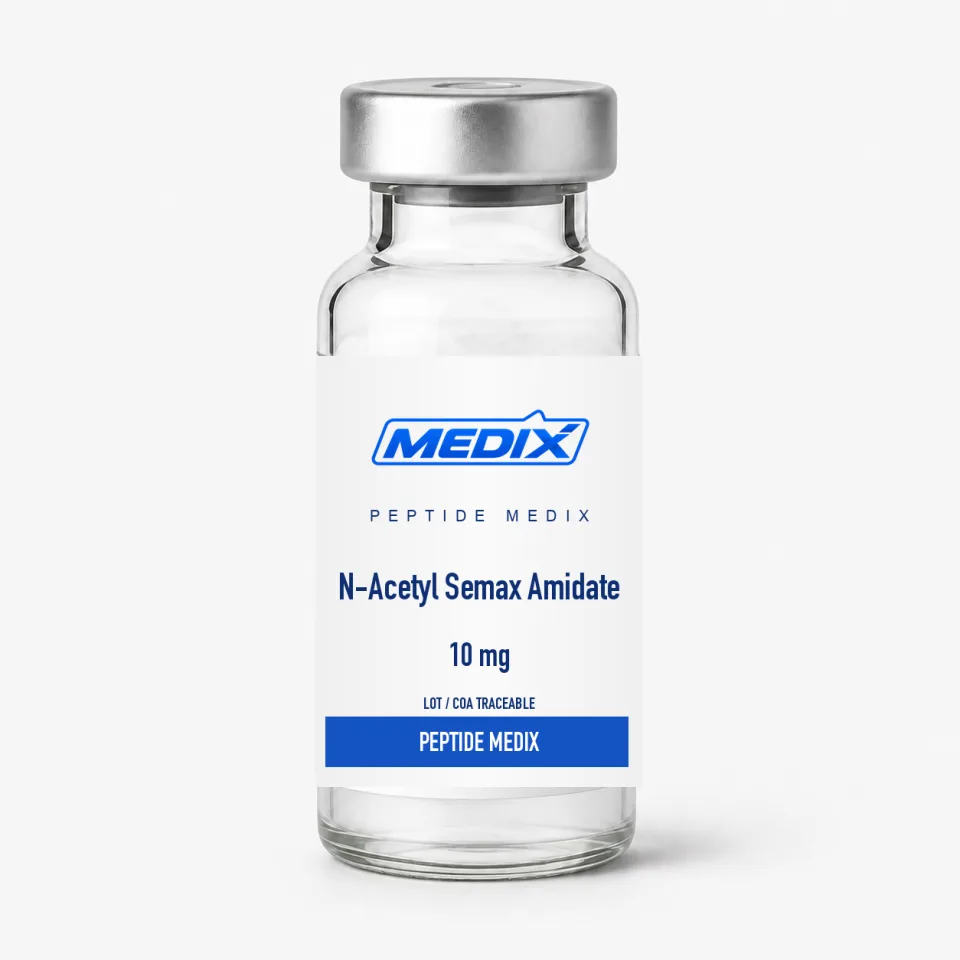
- HPLC purity ≥99%, with a COA for each lot on request
- Certificate of analysis tied to your lot number
- Tracked EU delivery, dispatched the next working day
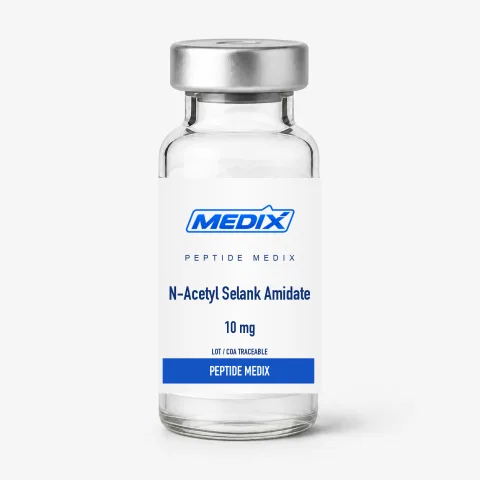
N-Acetyl Semax Amidate
End-capped Semax analogue for research on extended stability
In stock1 format available
€76
This listing is currently unavailable. Contact us and we will tell you when it is back or suggest an equivalent.
Ask about this listing or request its COA- FormLyophilized white powder in a sealed glass vial
- Research areasPeptide stability, neurotrophic factor expression, attention and memory models
For laboratory research use only. Sold exclusively for in-vitro laboratory research by qualified professionals. Not for human or veterinary use, and not a medicine, food, cosmetic or dietary supplement. Terms and Conditions
Overview
Key facts
N-Acetyl Semax Amidate — often shortened to NA-Semax-Amidate or NASA — is Semax protected at both ends.
- Amino acid sequence
- Ac-Met-Glu-His-Phe-Pro-Gly-Pro-NH2
- Purity
- ≥99% by HPLC; lot-matched COA available
- Form
- Lyophilized white powder in a sealed glass vial
- Storage
- −20 °C, protected from light and moisture
- Available size
- 10 mg
For research use only. Not for human consumption.
N-Acetyl Semax Amidate — often shortened to NA-Semax-Amidate or NASA — is Semax protected at both ends. Starting from the heptapeptide Met-Glu-His-Phe-Pro-Gly-Pro, an acetyl group is added to the free N-terminus and the C-terminal carboxyl is converted into a primary amide. These are textbook peptide-chemistry measures against exopeptidases, and each removes a charged end, which also changes the molecule's overall polarity.
The aim of the modifications is greater stability, not a new mode of action. Researchers using end-protected analogues usually compare breakdown kinetics, persistence in plasma and tissue, and mucosal permeability with the unmodified parent. Within the Semax family this is especially interesting because Semax itself already has a Pro-Gly-Pro tail added for the same purpose — making the acetylated, amidated form a second protective layer.
Supplied as a single 10 mg lyophilised vial for laboratory work: stability studies, analytical method development, in vitro assays and authorised animal research. Each batch is HPLC-purified, and its certificate of analysis is available. This is a research chemical, not a medicine or supplement.
Specifications
Identity
- Amino acid sequence
- Ac-Met-Glu-His-Phe-Pro-Gly-Pro-NH2
- Peptide class
- Terminally protected synthetic ACTH(4-10) analog
Supply & purity
- Form
- Lyophilized white powder in a sealed glass vial
- Purity
- ≥99% by HPLC; lot-matched COA available
- Solubility
- Soluble in bacteriostatic water and sterile water
Handling & storage
- Storage (lyophilized)
- −20 °C, protected from light and moisture
- Storage (reconstituted)
- 2–8 °C; aliquot to avoid freeze-thaw cycles
Additional detail
- Available size
- 10 mg
- Parent peptide
- Semax — ACTH(4-10) analog, CAS 80714-61-0
- Modifications
- N-terminal acetyl cap; C-terminal primary amide
- Research areas
- Peptide stability, neurotrophic factor expression, attention and memory models
- Synthesis
- Solid-phase peptide synthesis with preparative HPLC purification
Questions about N-Acetyl Semax Amidate
What separates it from standard Semax?
The backbone is the same; this version adds an N-terminal acetyl group and turns the C-terminal acid into an amide. Both changes stop exopeptidases and remove a charged end, so the analogue is studied chiefly for stability and permeability rather than for any different mechanism.
Do you supply a certificate of analysis?
Yes. Each lot is HPLC-tested for purity and confirmed by mass spectrometry for identity, with the lot certificate available on request. For modified analogues the measured mass is particularly helpful, as it confirms that acetylation and amidation are both present.
Which size can be ordered?
One 10 mg lyophilised vial — suitable for comparative stability panels and in vitro assay series that include unmodified Semax as a control.
What is the storage advice after reconstitution?
Keep the solution at 2–8 °C, away from light, and use it within your planned study period. Divide it into single-use portions instead of freezing and thawing one vial again and again — that damages peptides whether or not their ends are protected.
Which diluent should I choose?
Bacteriostatic water is the usual bench choice; use sterile water if the solution must be preservative-free. Run the solvent slowly down the vial wall and let the powder dissolve without agitation. Your experimental design determines the concentration.
Related