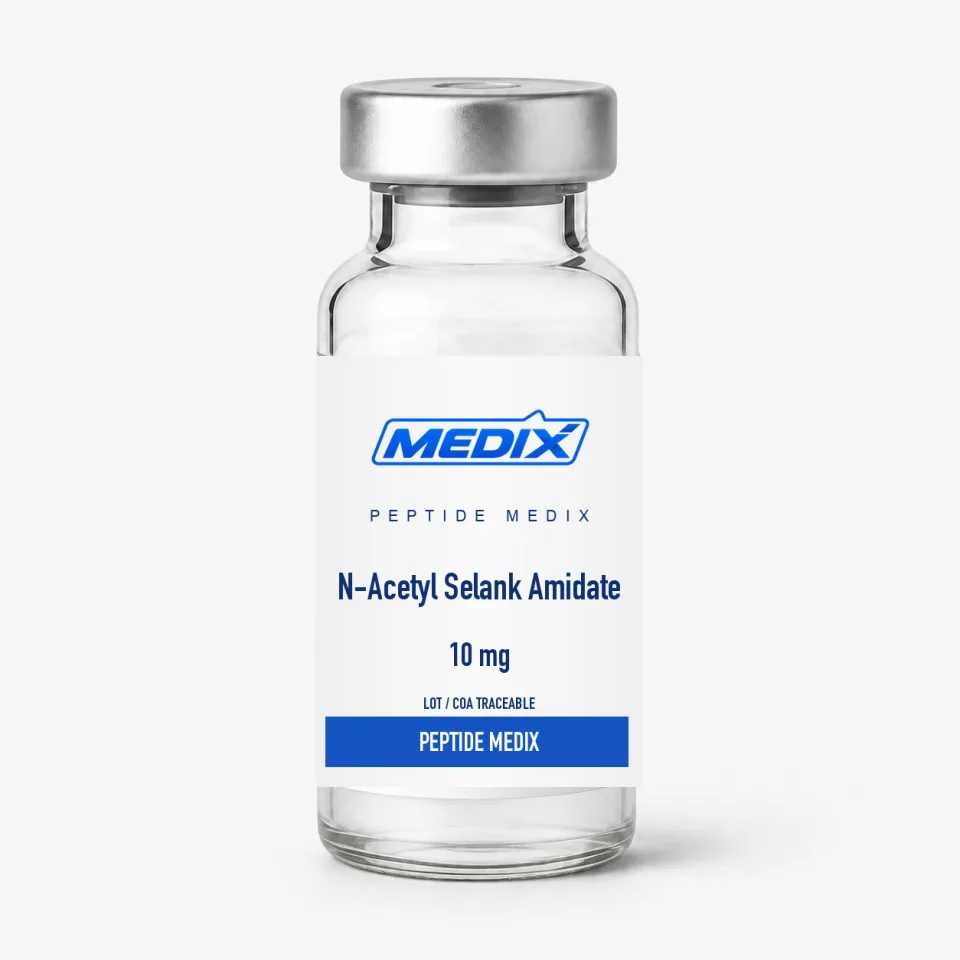
- HPLC purity ≥99%, with a COA for each lot on request
- Certificate of analysis tied to your lot number
- Tracked EU delivery, dispatched the next working day
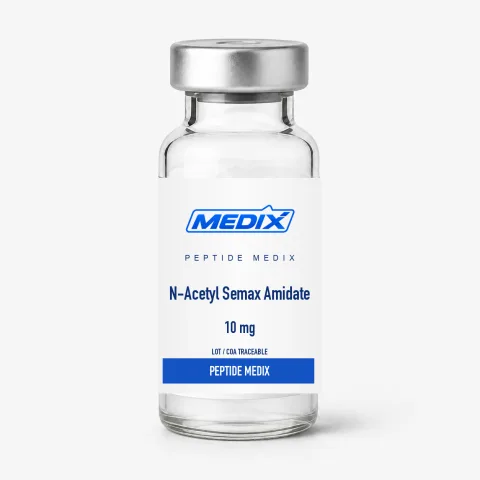
N-Acetyl Selank Amidate
End-capped Selank analogue for stability and behavioural research
In stock1 format available
€76
This listing is currently unavailable. Contact us and we will tell you when it is back or suggest an equivalent.
Ask about this listing or request its COA- FormLyophilized white powder in a sealed glass vial
- Research areasPeptide stability, anxiety-like behavior models, GABAergic markers, cytokine expression
For laboratory research use only. Sold exclusively for in-vitro laboratory research by qualified professionals. Not for human or veterinary use, and not a medicine, food, cosmetic or dietary supplement. Terms and Conditions
Overview
Key facts
N-Acetyl Selank Amidate is Selank — the tuftsin-derived heptapeptide Thr-Lys-Pro-Arg-Pro-Gly-Pro — with both ends chemically protected.
- Amino acid sequence
- Ac-Thr-Lys-Pro-Arg-Pro-Gly-Pro-NH2
- Purity
- ≥99% by HPLC; lot-matched COA available
- Form
- Lyophilized white powder in a sealed glass vial
- Storage
- −20 °C, protected from light and moisture
- Available size
- 10 mg
For research use only. Not for human consumption.
N-Acetyl Selank Amidate is Selank — the tuftsin-derived heptapeptide Thr-Lys-Pro-Arg-Pro-Gly-Pro — with both ends chemically protected. The N-terminus carries an acetyl cap and the C-terminal carboxyl has been turned into a primary amide, so the sequence reads Ac-Thr-Lys-Pro-Arg-Pro-Gly-Pro-NH2. The order of residues stays the same; these are simply the usual ways of guarding a peptide against the amino- and carboxypeptidases that attack free ends.
Peptide Medix EU offers it as a 10 mg lyophilised vial for in vitro assays, analytical method development and authorised animal studies. Every lot is purified by preparative HPLC and identity-checked by mass spectrometry; the certificate of analysis for the lot is available on request. Shipped from our EU warehouse. Not a medicine, supplement or consumer product.
Specifications
Identity
- Amino acid sequence
- Ac-Thr-Lys-Pro-Arg-Pro-Gly-Pro-NH2
- Peptide class
- Terminally protected synthetic tuftsin analog
Supply & purity
- Form
- Lyophilized white powder in a sealed glass vial
- Purity
- ≥99% by HPLC; lot-matched COA available
- Solubility
- Freely soluble in bacteriostatic water and sterile water
Handling & storage
- Storage (lyophilized)
- −20 °C, protected from light and moisture
- Storage (reconstituted)
- 2–8 °C; aliquot to avoid repeated freeze-thaw
Additional detail
- Available size
- 10 mg
- Parent peptide
- Selank — tuftsin analog, CAS 129954-34-3
- Modifications
- N-terminal acetyl cap; C-terminal primary amide
- Research areas
- Peptide stability, anxiety-like behavior models, GABAergic markers, cytokine expression
- Synthesis
- Solid-phase peptide synthesis with preparative HPLC purification
Questions about N-Acetyl Selank Amidate
How is it different from ordinary Selank?
Its sequence is unchanged; what it gains is an acetyl cap at the N-terminus and an amide at the C-terminus, which both stop exopeptidases and cancel the terminal charges. Researchers use it mostly to compare stability and permeability, not because it works by a different mechanism.
Has an independent lab verified the peptide?
Yes — reversed-phase HPLC for purity and mass spectrometry for identity on every lot, with the matching certificate available on request. The measured mass also proves that both end modifications are present in the finished product.
How much material do I receive?
A single 10 mg lyophilised vial — generally enough for a comparative assay series running the protected analogue and unmodified Selank next to each other under identical conditions.
For how long can the dissolved peptide be used?
Refrigerate it at 2–8 °C in the dark and finish it within the period your protocol sets. End-capping slows enzymatic breakdown but doesn't make a peptide stable in water forever, so cold storage and aliquoting remain important.
What solvent suits it?
Bench reconstitution normally uses bacteriostatic water; switch to sterile water when you need a preservative-free preparation. Add the solvent slowly and let the powder dissolve without shaking. Working concentrations are entirely a matter of your assay design.
Related