- HPLC purity ≥99% plus MS identity confirmation, COA for every lot
- Certificate of analysis tied to your lot number
- Tracked EU delivery, dispatched the next working day
Matrixyl (Palmitoyl Pentapeptide-4)
Palmitoyl pentapeptide-4 (Pal-KTTKS), a lipidated matrikine from collagen
In stock2 formats availableCAS 214047-00-4
€46Range €46 – €131
This listing is currently unavailable. Contact us and we will tell you when it is back or suggest an equivalent.
Ask about this listing or request its COA- FormWhite to off-white lyophilized powder in a sealed glass vial
- Mol. weight802.05 g/mol
- Research areasProcollagen I and III synthesis, fibronectin, ECM remodelling, skin permeation
For laboratory research use only. Sold exclusively for in-vitro laboratory research by qualified professionals. Not for human or veterinary use, and not a medicine, food, cosmetic or dietary supplement. Terms and Conditions
Overview
Key facts
Matrixyl is the trade name for palmitoyl pentapeptide-4 — a signalling fragment of the extracellular matrix (a matrikine) to which a fatty acid has been attached.
- CAS number
- 214047-00-4
- Molecular formula
- C39H75N7O10
- Molecular weight
- 802.05 g/mol
- Purity
- ≥99% by HPLC with mass-spectrometric identity check; COA per lot
- Form
- White to off-white lyophilized powder in a sealed glass vial
- Storage
- −20 °C, sealed, protected from light and moisture
- Available sizes
- 10 mg · 50 mg
For research use only. Not for human consumption.
Matrixyl is the trade name for palmitoyl pentapeptide-4 — a signalling fragment of the extracellular matrix (a matrikine) to which a fatty acid has been attached. The peptide is Lys-Thr-Thr-Lys-Ser (KTTKS), with a palmitic acid chain on its first lysine. KTTKS occurs in the propeptide at the C-terminal end of type I collagen and is freed as the matrix is broken down and rebuilt; the finding that such fragments send signals back to fibroblasts is why this peptide became so central to matrix research. The palmitoyl tail was added to make it more fat-soluble and to improve how it behaves in creams and other topical bases compared with the unmodified peptide.
Most lab work with Pal-KTTKS asks how fibroblasts respond — whether they make more procollagen types I and III, fibronectin or glycosaminoglycans — or looks at formulation questions such as how it distributes between phases, whether it forms micelles and how well it gets through skin. It is also the standard against which the wider group of fatty-acid-modified matrikines — palmitoyl tripeptide-1, palmitoyl tetrapeptide-7 and others — is usually tested.
Peptide Medix EU offers palmitoyl pentapeptide-4 freeze-dried, in vials of 10 mg or 50 mg. An independent laboratory confirms ≥99% purity by HPLC, each lot has its own certificate, and orders ship from our EU warehouse.
What sets this listing apart
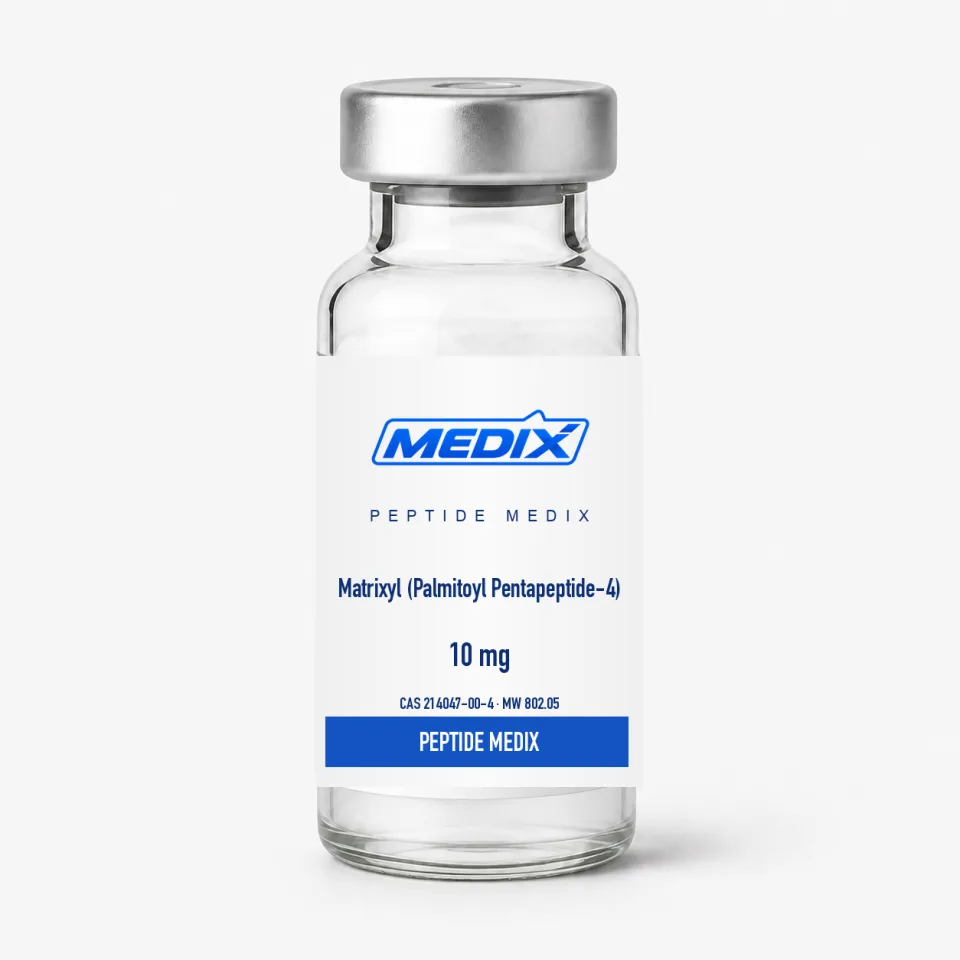
Matrixyl (Palmitoyl Pentapeptide-4) – vial, 10/50 mg. White to off-white lyophilized powder in a sealed glass vial. Other Matrixyl listings differ in format, fill or combination partners; the specification and COA always refer to the listing you order.
Same compound, other listings
Specifications
Identity
- CAS number
- 214047-00-4
- Molecular formula
- C39H75N7O10
- Molecular weight
- 802.05 g/mol
- Peptide class
- Lipidated matrikine / collagen-fragment signal peptide
Supply & purity
- Form
- White to off-white lyophilized powder in a sealed glass vial
- Purity
- ≥99% by HPLC with mass-spectrometric identity check; COA per lot
- Available sizes
- 10 mg, 50 mg
- Solubility
- Limited in plain water; usually prepared with a co-solvent such as propylene glycol, ethanol or DMSO before dilution
Handling & storage
- Storage (lyophilized)
- −20 °C, sealed, protected from light and moisture
Additional detail
- Peptide sequence
- Palmitoyl-Lys-Thr-Thr-Lys-Ser (Pal-KTTKS)
- INCI name
- Palmitoyl Pentapeptide-4 (formerly palmitoyl pentapeptide-3)
- Research areas
- Procollagen I and III synthesis, fibronectin, ECM remodelling, skin permeation
- Storage (in solution)
- 2–8 °C, short-term; check for cloudiness before use
Questions about Matrixyl (Palmitoyl Pentapeptide-4)
What is Matrixyl?
It is the brand name for palmitoyl pentapeptide-4: KTTKS carrying palmitic acid at its N-terminal end. KTTKS is a piece of the propeptide of type I collagen, and the version with the fatty acid is one of the most thoroughly researched matrikines in both matrix biology and cosmetic-ingredient science.
How is it different from unmodified KTTKS?
The amino-acid sequence is the same; the difference is the 16-carbon fatty tail. Adding it makes the molecule part water-loving, part fat-loving, so it moves into oily phases, clumps into micelles once it passes a certain concentration and behaves very differently in skin-penetration tests. Comparative studies nearly always report the two separately.
Is the lot tested by an independent lab, and can I view the COA?
Yes. Identity and purity of every production lot are checked by an independent laboratory using HPLC with mass-spectrometric confirmation, and you can request the lot's certificate before buying. It shows lot number, assay result and test date for your records.
How do I dissolve it for lab use?
It dissolves only poorly in plain water. The usual approach is to make a concentrated stock in propylene glycol, ethanol or DMSO and then stir it into the water phase. Note which co-solvent you used and how much ends up in the final mix, and watch diluted solutions for any haze, which means the peptide has come out of solution.
Which research endpoints is it used for?
Typically how much procollagen (types I and III), fibronectin and glycosaminoglycans cultured skin fibroblasts produce, plus formulation measures such as how well it passes through model membranes and how stable it stays in emulsions. All of these are lab measurements and are reported cautiously, specific to each model.
Is Matrixyl identical to palmitoyl pentapeptide-3?
Yes — that is simply an older INCI name for the same molecule, which was later renamed palmitoyl pentapeptide-4. Older papers and datasheets may still say pentapeptide-3, so check CAS 214047-00-4 when comparing literature values with the certificate for your lot.
Related