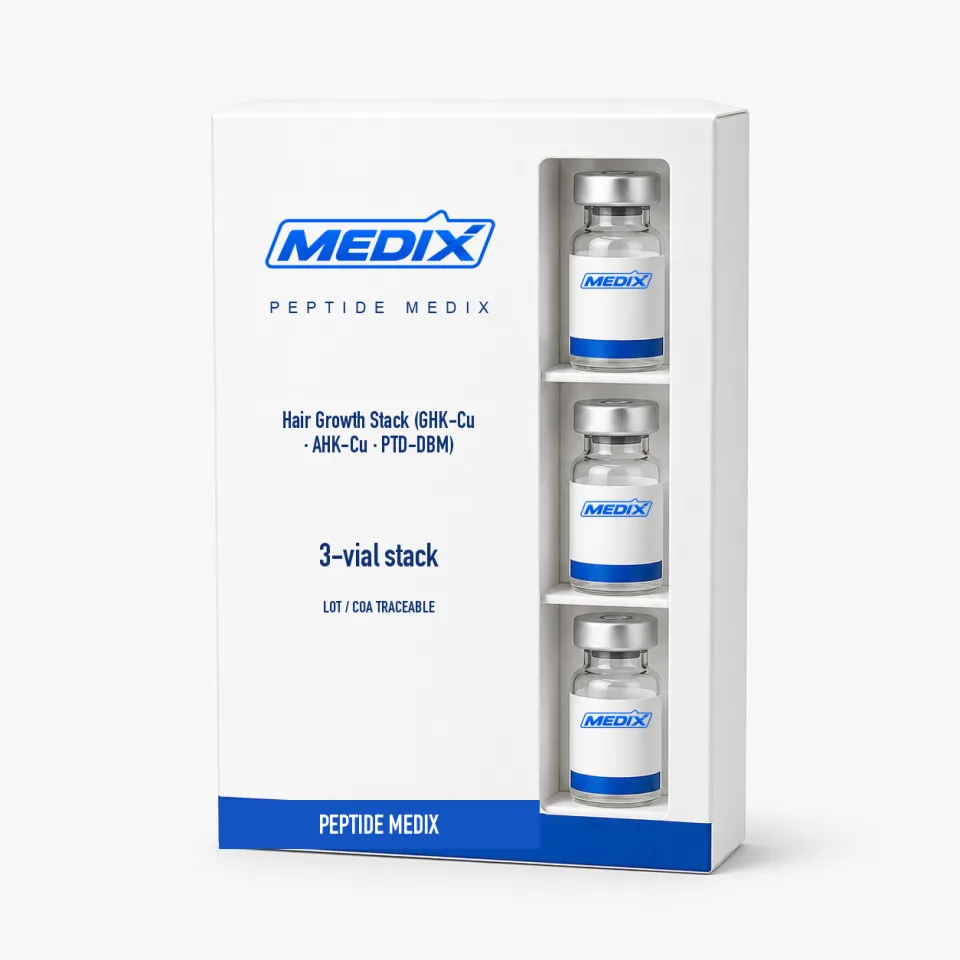
- Every vial assayed to ≥99% (HPLC), each with its own lot COA
- Certificate of analysis tied to your lot number
- Tracked EU delivery, dispatched the next working day
Hair Growth Stack (GHK-Cu · AHK-Cu · PTD-DBM)
GHK-Cu, AHK-Cu and PTD-DBM in three separately sealed vials for follicle research
In stock1 format available
€157
This listing is currently unavailable. Contact us and we will tell you when it is back or suggest an equivalent.
Ask about this listing or request its COA- FormLyophilized powder in each vial, individually stoppered and crimped
- Research areasDermal papilla cell cultures, hair follicle cycling, angiogenic signalling, matrix synthesis, topical formulation science
For laboratory research use only. Sold exclusively for in-vitro laboratory research by qualified professionals. Not for human or veterinary use, and not a medicine, food, cosmetic or dietary supplement. Terms and Conditions
Overview
Key facts
This stack collects the three peptides that turn up most frequently in hair-follicle and dermal papilla studies, supplied as individually sealed vials instead of a single pre-mixed blend.
- Purity
- ≥99% by HPLC per vial; a separate lot-matched COA for each
- Form
- Lyophilized powder in each vial, individually stoppered and crimped
- Storage
- −20 °C, sealed and protected from light and moisture
- Available size
- 3-vial stack
For research use only. Not for human consumption.
This stack collects the three peptides that turn up most frequently in hair-follicle and dermal papilla studies, supplied as individually sealed vials instead of a single pre-mixed blend. Two of them are copper-chelating tripeptides: GHK-Cu, the copper(II) complex of glycyl-histidyl-lysine characterised by Pickart, and AHK-Cu, its alanine variant, known in cosmetics as copper tripeptide-3. The third, PTD-DBM, is a cell-penetrating fusion peptide that blocks the binding of CXXC5 to Dishevelled in the Wnt/beta-catenin pathway.
Separate vials matter more for this set than for most. The copper peptides are strongly coloured, water-soluble and lose their copper in acidic conditions, while PTD-DBM is a much bigger molecule with its own solubility behaviour and a different research question behind it. Packing them apart lets a lab set each concentration on its own terms, run control groups with a single peptide, and keep two vials sealed in the freezer (−20 °C) while working with the third.
What sets this listing apart
Hair Growth Stack combines GHK-Cu (Copper Peptide), AHK-Cu (Copper Tripeptide-3) and PTD-DBM in one listing. Components that are also sold on their own are linked below, each with its own specification and COA.
Same compound, other listings
Specifications
Supply & purity
- Form
- Lyophilized powder in each vial, individually stoppered and crimped
- Purity
- ≥99% by HPLC per vial; a separate lot-matched COA for each
Handling & storage
- Storage (lyophilized)
- −20 °C, sealed and protected from light and moisture
- Storage (reconstituted)
- 2–8 °C, protected from light; aliquot to avoid freeze–thaw
Additional detail
- Product type
- Multi-vial research stack — three separately sealed vials
- Kit contents
- One GHK-Cu vial, one AHK-Cu vial, one PTD-DBM vial
- GHK-Cu
- CAS 89030-95-5 · C14H24N6O4·Cu · 403.93 g/mol · blue powder
- AHK-Cu
- CAS 1245800-58-7 · C15H26N6O4·Cu · ≈417.96 g/mol as the copper complex
- PTD-DBM
- Cell-permeable fusion peptide: protein transduction domain joined to the Dishevelled-binding motif of CXXC5
- Sequences
- GHK-Cu: Gly-His-Lys with coordinated Cu(II); AHK-Cu: Ala-His-Lys with coordinated Cu(II)
- Molecular targets
- Copper-dependent matrix signalling (GHK-Cu, AHK-Cu); CXXC5–Dishevelled interaction in Wnt/beta-catenin signalling (PTD-DBM)
- Research areas
- Dermal papilla cell cultures, hair follicle cycling, angiogenic signalling, matrix synthesis, topical formulation science
- Reconstitution
- Each vial prepared separately in bacteriostatic or sterile water; avoid acidic media with the copper peptides
Questions about Hair Growth Stack (GHK-Cu · AHK-Cu · PTD-DBM)
Why not blend the three peptides?
In separate vials you can choose each concentration freely, run controls with just one peptide and treat the copper complexes at the pH they need. Mixing them at the factory would fix the ratio for good and make it impossible to say which peptide caused an effect you see.
What separates GHK-Cu from AHK-Cu?
Almost nothing: AHK has alanine in first position where GHK has glycine, so both keep the histidine and lysine that bind copper(II). Published data suggest overlapping activity; AHK-Cu has been studied more narrowly in dermal papilla and follicle assays, GHK-Cu across a wider range of dermal research.
Why does a hair stack include PTD-DBM?
PTD-DBM joins a protein transduction domain, which carries it into cells, to the part of CXXC5 that binds Dishevelled. By competing for that binding, it lifts a brake on Wnt/beta-catenin signalling — a pathway at the heart of the hair-follicle growth cycle — which is why mouse studies on growing new follicles feature it.
Does every vial have its own COA?
Yes. Each vial comes from a separate production lot, and each is released with a certificate stating HPLC identity and purity against the ≥99% specification, so you get three documents rather than one report for a blend. The current certificates can be sent before you order.
Why keep the copper peptides away from acidic solutions?
GHK-Cu and AHK-Cu are blue because copper(II) is held by the ring of their histidine and by their free amino end. Strong acid adds protons to these groups and lets the copper go, changing what is really in your assay. If the colour fades, treat that as the warning sign.
Related