- Each component assayed to ≥99% (HPLC); per-lot COA on request
- Certificate of analysis tied to your lot number
- Tracked EU delivery, dispatched the next working day
TB-500 + GHK-Cu
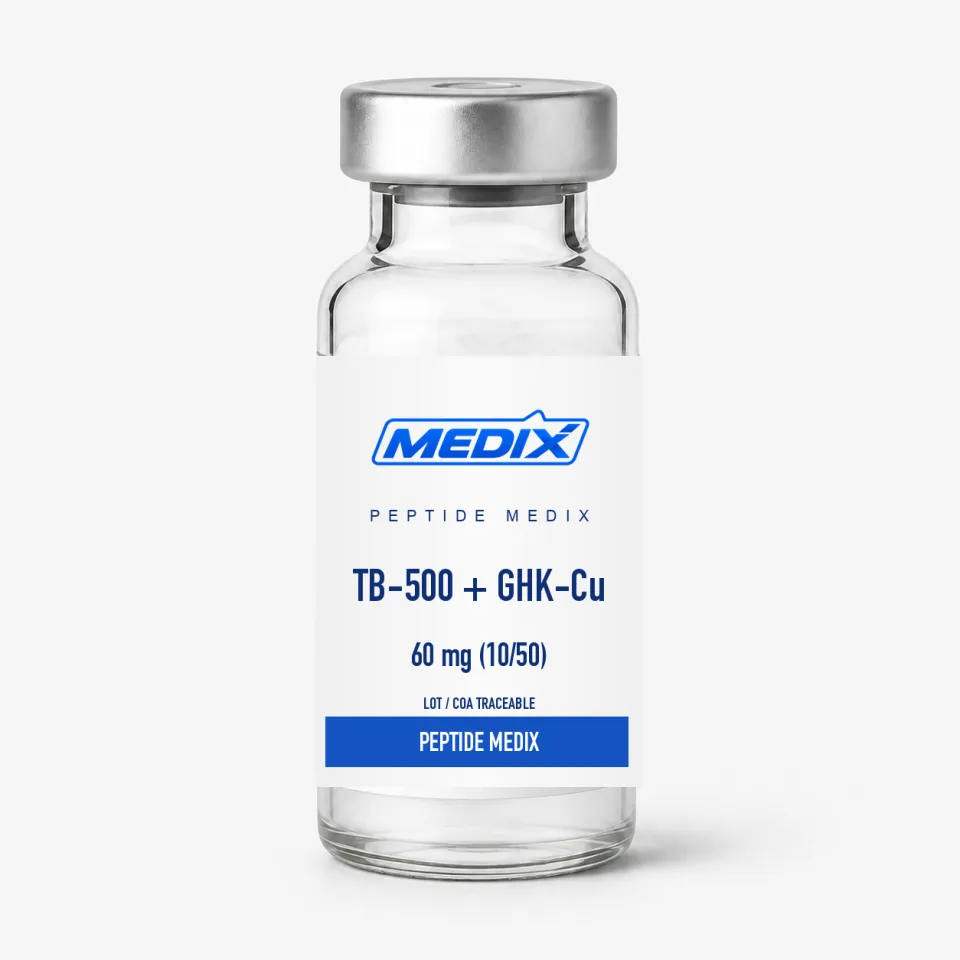
10 mg TB-500 and 50 mg GHK-Cu co-lyophilised in one research vial
In stock1 format available
€127
This listing is currently unavailable. Contact us and we will tell you when it is back or suggest an equivalent.
Ask about this listing or request its COA- FormCo-lyophilized blue powder blend, sealed glass vial with crimped stopper
- Research areasCell migration, wound closure, angiogenesis, collagen and glycosaminoglycan synthesis, dermal and follicle models
For laboratory research use only. Sold exclusively for in-vitro laboratory research by qualified professionals. Not for human or veterinary use, and not a medicine, food, cosmetic or dietary supplement. Terms and Conditions
Overview
Key facts
The two peptides in this vial tackle tissue remodelling from opposite ends.
- Purity
- ≥99% by HPLC per component; lot-matched COA available
- Form
- Co-lyophilized blue powder blend, sealed glass vial with crimped stopper
- Storage
- −20 °C, sealed and protected from light and moisture
- Available size
- 60 mg · (10/50)
For research use only. Not for human consumption.
The two peptides in this vial tackle tissue remodelling from opposite ends. TB-500 is the acetylated heptapeptide matching residues 17–23 of thymosin beta-4 — the actin-binding domain of a 43-amino-acid protein that sequesters G-actin — and is studied mainly for cell migration and wound closure. GHK-Cu, the copper(II) complex of the tripeptide glycyl-L-histidyl-L-lysine first isolated from human plasma in the 1970s, is studied for extracellular-matrix synthesis, collagen and glycosaminoglycan production and copper-dependent enzyme chemistry.
The fill totals 60 mg: 10 mg TB-500 and 50 mg GHK-Cu. The uneven split reflects how each is used, not a statement about relative potency — GHK-Cu is conventionally handled in much larger amounts than short synthetic fragments in matrix and skin models. Both peptides are synthesised and purified to ≥99% by reversed-phase HPLC before they are combined, so the lot's certificate of analysis reports each one separately instead of describing the mixture as a single substance.
What sets this listing apart
TB-500 + GHK-Cu combines TB-500 and GHK-Cu (Copper Peptide) in one listing (60 mg). Components that are also sold on their own are linked below, each with its own specification and COA.
Same compound, other listings
Specifications
Identity
- Peptide class
- Actin-binding thymosin fragment combined with a copper-binding matrix tripeptide
Supply & purity
- Form
- Co-lyophilized blue powder blend, sealed glass vial with crimped stopper
- Purity
- ≥99% by HPLC per component; lot-matched COA available
- Available sizes
- 60 mg total — 10 mg TB-500 / 50 mg GHK-Cu
- Solubility
- Bacteriostatic or sterile water; avoid chelating buffers that strip copper
Handling & storage
- Storage (lyophilized)
- −20 °C, sealed and protected from light and moisture
- Storage (reconstituted)
- 2–8 °C, protected from light, used within the study window
Additional detail
- Components
- TB-500 (thymosin beta-4 fragment 17–23) and GHK-Cu (copper tripeptide-1)
- Blend ratio
- 1:5 TB-500 to GHK-Cu by mass
- TB-500 CAS number
- 885340-08-9
- TB-500 formula and mass
- C38H68N10O14, 889.02 g/mol
- TB-500 sequence
- Ac-Leu-Lys-Lys-Thr-Glu-Thr-Gln
- GHK-Cu CAS number
- 89030-95-5
- GHK-Cu formula and mass
- C14H24N6O4·Cu, 403.93 g/mol
- GHK-Cu sequence
- Gly-His-Lys, complexed with copper(II)
- Colour
- Blue in powder and in solution — an indicator of copper coordination
- Research areas
- Cell migration, wound closure, angiogenesis, collagen and glycosaminoglycan synthesis, dermal and follicle models
Questions about TB-500 + GHK-Cu
What amount of each peptide does the vial contain?
10 mg TB-500 and 50 mg GHK-Cu in a 60 mg fill — a 1:5 mass ratio. The exact loading appears on the label and on the lot certificate, which lists the two peptides individually rather than treating the blend as one substance.
What makes the powder blue?
GHK-Cu is a copper(II) complex, and the bound copper colours both the lyophilised cake and the dissolved solution a distinct blue. That makes a handy in-process check: a steady blue means the complex is intact, while fading or a green tinge suggests the copper binding has been disrupted.
Which diluent should I use?
Bacteriostatic water for vials drawn from repeatedly, sterile water for single-use solutions. Steer clear of EDTA buffers, strong reducing agents and chelator-rich media, which can pull copper from the GHK-Cu and change what you are actually testing.
Is a certificate of analysis provided?
Yes. Each vial links to a lot COA covering both peptides — HPLC purity of ≥99% for each plus identity by mass spectrometry. Please quote the lot number printed on the vial when asking for it.
Why use them together rather than in separate experiments?
They act at different stages of remodelling — cytoskeletal migration on one side, matrix biosynthesis on the other — so researchers often want both present at a fixed ratio. A co-lyophilised vial saves a second reconstitution, an extra stopper puncture and another source of pipetting variation between arms.
Can it be used on humans or as a cosmetic?
No. Both peptides are supplied as research chemicals in a lab vial. The blend is not a medicine, cosmetic or supplement and is not authorised for any use in any circumstances.
Related