- HPLC purity ≥99%, with a COA for each lot on request
- Certificate of analysis tied to your lot number
- Tracked EU delivery, dispatched the next working day
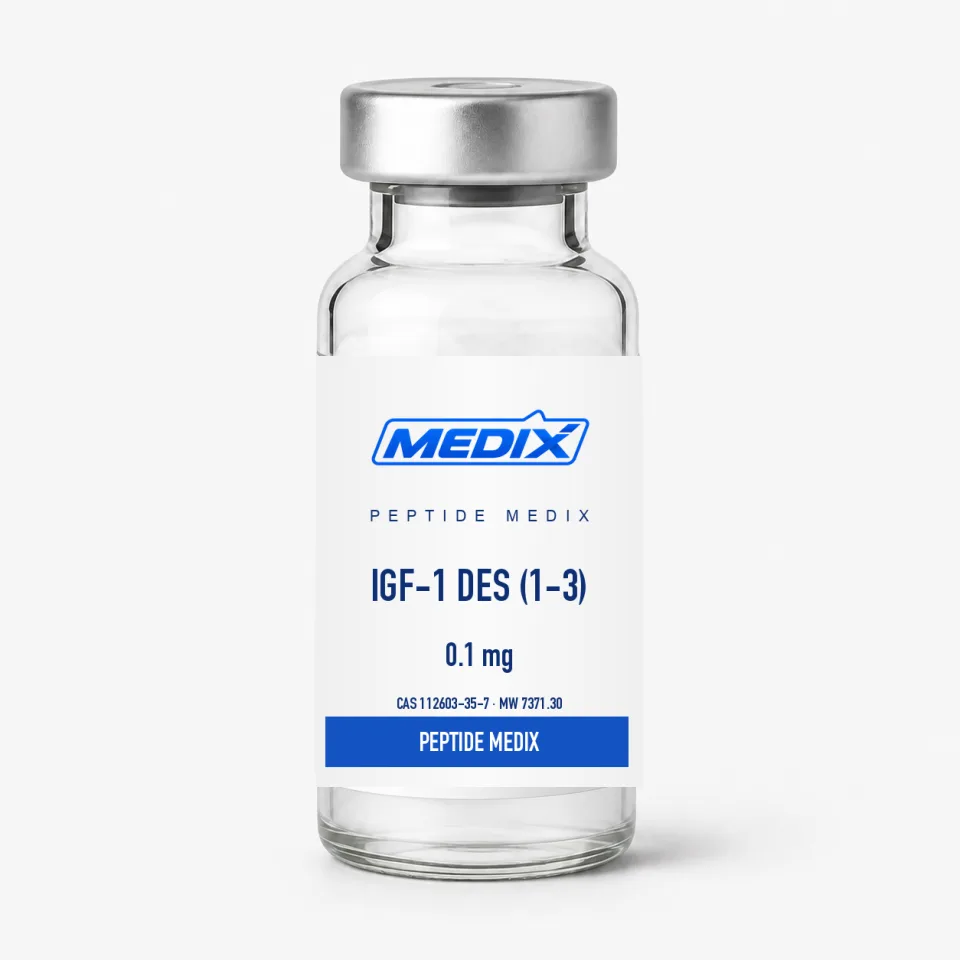
IGF-1 DES (1-3)
Truncated 67-residue IGF-1 analogue, DES(1-3), with weak IGFBP binding
In stock2 formats availableCAS 112603-35-7
€34Range €34 – €93
This listing is currently unavailable. Contact us and we will tell you when it is back or suggest an equivalent.
Ask about this listing or request its COA- FormLyophilized powder, sealed glass vial
- Mol. weight7371.30 g/mol
- Research areasIGF-1R signalling, myoblast differentiation, binding-protein-independent assays
For laboratory research use only. Sold exclusively for in-vitro laboratory research by qualified professionals. Not for human or veterinary use, and not a medicine, food, cosmetic or dietary supplement. Terms and Conditions
Overview
Key facts
IGF-1 DES(1-3) is a shortened form of insulin-like growth factor 1 lacking the first three N-terminal amino acids — glycine, proline and glutamate — which leaves a 67-residue chain of about 7371 g/mol.
- CAS number
- 112603-35-7
- Molecular weight
- 7371.30 g/mol
- Purity
- ≥99% by HPLC; lot-matched COA available
- Form
- Lyophilized powder, sealed glass vial
- Storage
- −20 °C or below, sealed and protected from light and moisture
- Available sizes
- 0.1 mg · 1 mg
For research use only. Not for human consumption.
IGF-1 DES(1-3) is a shortened form of insulin-like growth factor 1 lacking the first three N-terminal amino acids — glycine, proline and glutamate — which leaves a 67-residue chain of about 7371 g/mol. Unlike most engineered analogues, it does not originate purely in the lab: it was first found as a natural variant in bovine colostrum and human brain tissue, where a specific protease trims native IGF-1.
Losing Glu3 removes a key contact for the IGF binding proteins, and the analogue is reported to bind IGFBPs far more weakly than intact IGF-1 while keeping full activity at the IGF-1 receptor. In systems rich in binding proteins — serum-containing culture media, for example — this translates into much higher apparent potency, which is why DES(1-3) became a standard tool for studying IGF-1 receptor signalling free of binding-protein interference.
Specifications
Identity
- CAS number
- 112603-35-7
- Molecular weight
- 7371.30 g/mol
- Chain length
- 67 amino acids (native IGF-1 minus the N-terminal Gly-Pro-Glu)
Supply & purity
- Form
- Lyophilized powder, sealed glass vial
- Purity
- ≥99% by HPLC; lot-matched COA available
- Available sizes
- 0.1 mg, 1 mg
Handling & storage
- Storage (lyophilized)
- −20 °C or below, sealed and protected from light and moisture
Additional detail
- Also known as
- DES(1-3) IGF-1, IGF-1 DES, des-Gly-Pro-Glu IGF-1
- Key modification
- Deletion of residues 1–3, removing the Glu3 IGFBP contact
- Protein class
- Truncated insulin-like growth factor analogue
- Primary target
- IGF-1 receptor (IGF-1R), a receptor tyrosine kinase
- Origin note
- Also occurs naturally; first isolated from bovine colostrum and brain tissue
- Research areas
- IGF-1R signalling, myoblast differentiation, binding-protein-independent assays
Questions about IGF-1 DES (1-3)
What is IGF-1 DES(1-3)?
An analogue of insulin-like growth factor 1 with 67 amino acids, missing the first three N-terminal residues (Gly-Pro-Glu). The deletion sharply reduces binding to IGF binding proteins yet preserves IGF-1 receptor activity, making it a valuable in vitro tool.
Why does DES(1-3) seem more potent in culture?
The advantage depends on context rather than on the molecule itself. Binding proteins in serum or secreted by cells capture most native IGF-1, whereas DES(1-3) escapes them, so a larger share of the added amount reaches the receptor.
How is it different from IGF-1 LR3?
Both evade IGF binding proteins, by different means. LR3 has arginine at position 3 plus a 13-residue N-terminal extension; DES(1-3) simply lacks the first three residues. LR3 is the bigger molecule and is usually reported to stay active for longer.
Is it found in nature?
Yes. DES(1-3) IGF-1 was originally isolated from bovine colostrum and human brain, apparently formed when intact IGF-1 is cleaved by proteases. That natural origin sets it apart from the purely engineered analogues in this class.
Is purity checked by an independent lab?
Yes. An independent laboratory uses HPLC to confirm identity and ≥99% purity for every lot, and the Certificate of Analysis for your lot can be requested. Check that it matches the lot number on your vial.
Related