- HPLC purity ≥99%, with a COA for each lot on request
- Certificate of analysis tied to your lot number
- Tracked EU delivery, dispatched the next working day
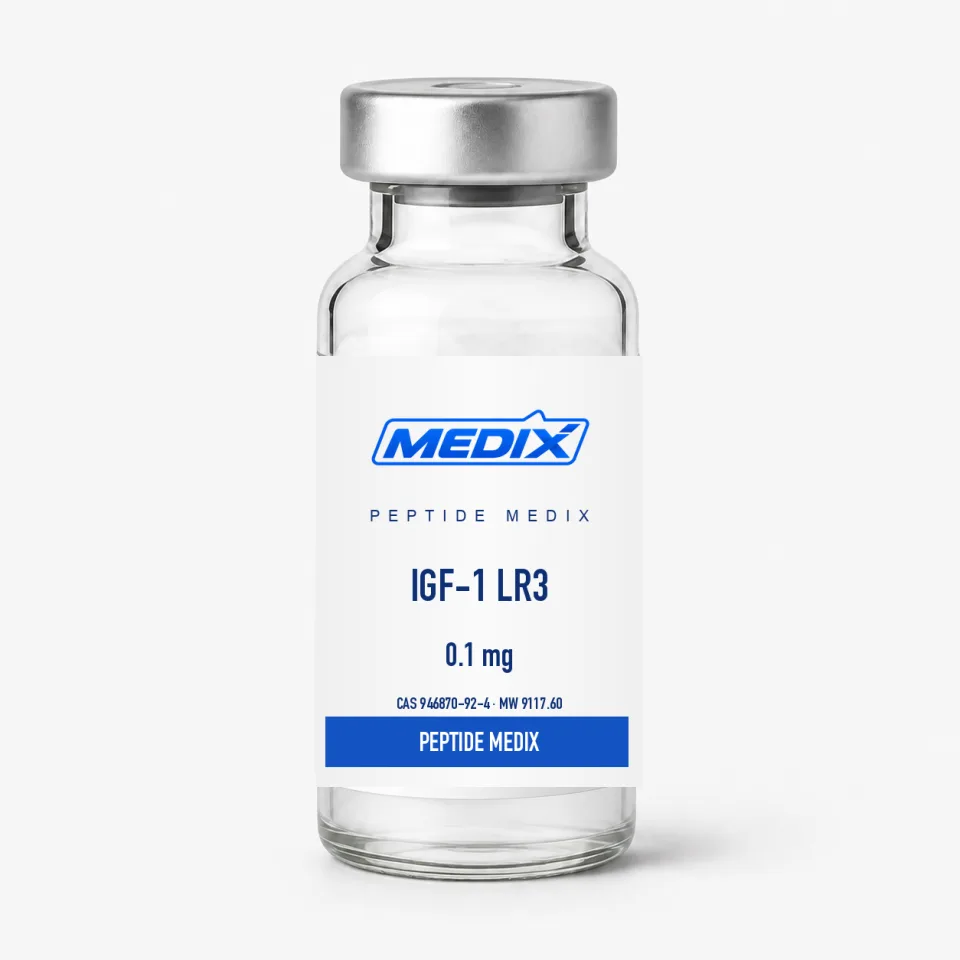
IGF-1 LR3
Long R3 IGF-1 — 83-residue recombinant analogue with weak IGFBP binding
In stock2 formats availableCAS 946870-92-4
€34Range €34 – €85
This listing is currently unavailable. Contact us and we will tell you when it is back or suggest an equivalent.
Ask about this listing or request its COA- FormLyophilized powder, sealed glass vial
- Mol. weight9117.60 g/mol
- Research areasIGF-1R signalling, myoblast and cell proliferation assays, serum-free culture
For laboratory research use only. Sold exclusively for in-vitro laboratory research by qualified professionals. Not for human or veterinary use, and not a medicine, food, cosmetic or dietary supplement. Terms and Conditions
Overview
Key facts
IGF-1 LR3 — short for Long R3 insulin-like growth factor 1 — is a recombinant analogue of human IGF-1 with 83 amino acids, defined by two engineered changes: position 3 carries arginine where the natural protein has glutamate, and an extra stretch of 13 residues is added to the…
- CAS number
- 946870-92-4
- Molecular formula
- C400H625N111O115S9
- Molecular weight
- 9117.60 g/mol
- Purity
- ≥99% by HPLC; lot-matched COA available
- Form
- Lyophilized powder, sealed glass vial
- Storage
- −20 °C or below, sealed and protected from light and moisture
- Available sizes
- 0.1 mg · 1 mg
For research use only. Not for human consumption.
IGF-1 LR3 — short for Long R3 insulin-like growth factor 1 — is a recombinant analogue of human IGF-1 with 83 amino acids, defined by two engineered changes: position 3 carries arginine where the natural protein has glutamate, and an extra stretch of 13 residues is added to the N-terminus. Together these raise the molecular weight to about 9118 g/mol and, more importantly, greatly weaken binding to the IGF binding proteins, which in the blood normally hold on to more than 95% of IGF-1.
Vials contain 0.1 mg or 1 mg — small by our standards, because cell culture uses it at nanomolar levels and one milligram covers an enormous number of plates. With a molecular weight of 9117.60 g/mol, 1 mg equals about 110 nanomoles; dissolved in 1 mL that makes a stock of around 110 micromolar, which is then diluted several thousand times. At these working levels, noticeable amounts stick to plastic tubes and pipette tips, so dilute stocks are usually made up with a carrier protein — commonly 0.1% bovine serum albumin. Published use is mainly in culture with little or no serum, in proliferation assays with myoblasts and other cells, and in studies of IGF-1 receptor signalling where binding proteins from serum would otherwise distort the results.
Specifications
Identity
- CAS number
- 946870-92-4
- Molecular formula
- C400H625N111O115S9
- Molecular weight
- 9117.60 g/mol
- Chain length
- 83 amino acids (70-residue IGF-1 core plus 13-residue N-terminal extension)
Supply & purity
- Form
- Lyophilized powder, sealed glass vial
- Purity
- ≥99% by HPLC; lot-matched COA available
- Available sizes
- 0.1 mg, 1 mg
Handling & storage
- Storage (lyophilized)
- −20 °C or below, sealed and protected from light and moisture
Additional detail
- Also known as
- Long R3 IGF-1, LR3 IGF-1
- Key modifications
- Arg substituted for Glu at position 3; N-terminal 13-residue extension
- Protein class
- Recombinant insulin-like growth factor analogue
- Primary target
- IGF-1 receptor (IGF-1R), a receptor tyrosine kinase
- Research areas
- IGF-1R signalling, myoblast and cell proliferation assays, serum-free culture
Questions about IGF-1 LR3
What is IGF-1 LR3?
A recombinant version of IGF-1 (insulin-like growth factor 1) with 83 amino acids, carrying arginine at position 3 and an extra 13-residue stretch at the N-terminus. Both changes reduce binding to IGF binding proteins, making it a dependable way to activate the IGF-1 receptor in cell culture.
LR3 or DES(1-3) — how do they differ?
Each escapes IGF binding proteins, but by a different route: DES(1-3) lacks the first three N-terminal residues, while LR3 has arginine in position 3 plus an extension. LR3 is the larger molecule and is typically described as remaining stable for longer.
Do you provide a Certificate of Analysis?
Yes. An independent lab HPLC-tests each lot for identity and ≥99% purity, and the matching certificate can be requested. Compare its lot number with your vial before adding the material to your lab records.
Why add a carrier protein?
At the low concentrations used in cell culture, proteins stick to plastic tubes and tips, quietly reducing the dose that reaches your cells. A carrier such as 0.1% BSA in dilute working stocks coats those surfaces and keeps the concentration where you intended it.
Related