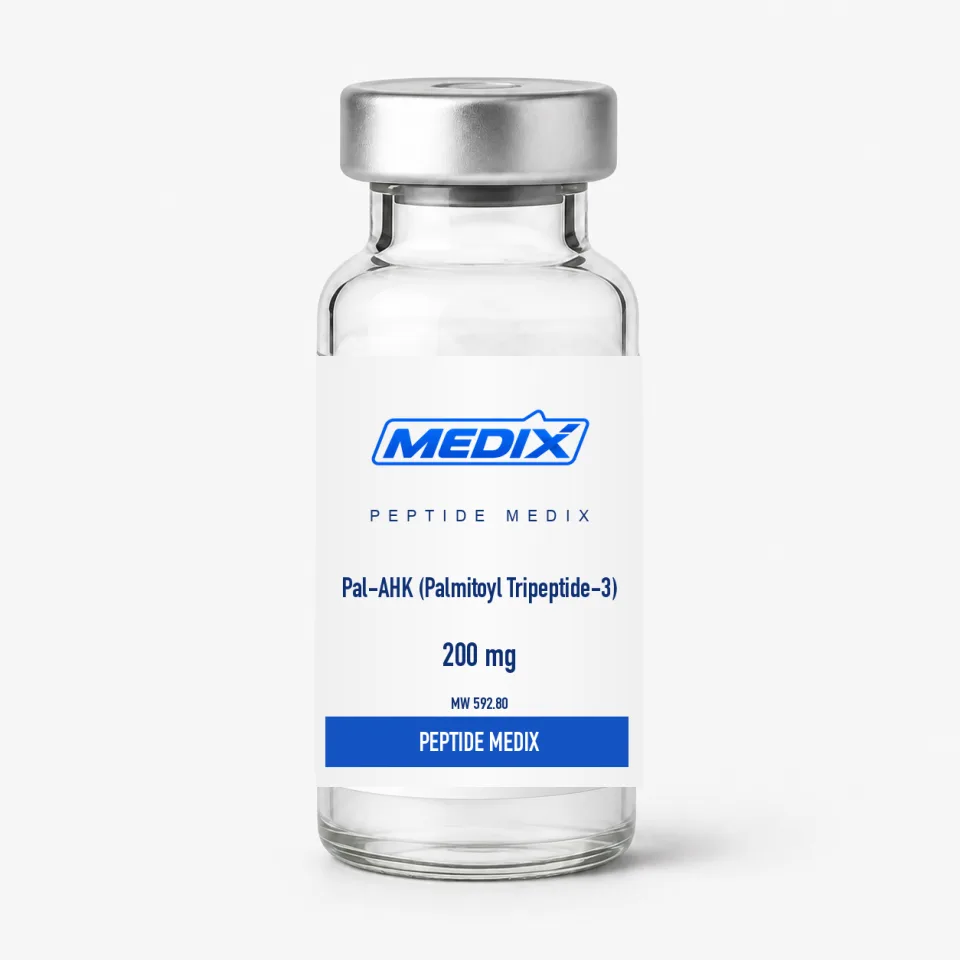
- HPLC purity ≥99%, with a COA for each lot on request
- Certificate of analysis tied to your lot number
- Tracked EU delivery, dispatched the next working day
Pal-AHK (Palmitoyl Tripeptide-3)
Palmitoylated Ala-His-Lys tripeptide for hair-follicle and formulation studies
In stock1 format available
€178
This listing is currently unavailable. Contact us and we will tell you when it is back or suggest an equivalent.
Ask about this listing or request its COA- FormLyophilized amphiphilic peptide powder, sealed glass vial
- Mol. weight592.80 g/mol
- Research areasDermal-papilla cell models, follicle biology, extracellular-matrix signaling and topical peptide partitioning
For laboratory research use only. Sold exclusively for in-vitro laboratory research by qualified professionals. Not for human or veterinary use, and not a medicine, food, cosmetic or dietary supplement. Terms and Conditions
Overview
Key facts
Pal-AHK — listed in most catalogues as Palmitoyl Tripeptide-3 — is Ala-His-Lys acylated with palmitic acid at its N-terminus.
- Molecular formula
- C31H56N6O5
- Molecular weight
- 592.80 g/mol
- Amino acid sequence
- Palmitoyl-Ala-His-Lys-OH (Pal-AHK)
- Purity
- ≥99% by HPLC; lot-matched COA available
- Form
- Lyophilized amphiphilic peptide powder, sealed glass vial
- Storage
- −20 °C lyophilized, protected from light and moisture
- Available size
- 200 mg
For research use only. Not for human consumption.
Pal-AHK — listed in most catalogues as Palmitoyl Tripeptide-3 — is Ala-His-Lys acylated with palmitic acid at its N-terminus. The 16-carbon fatty chain turns a small, water-soluble tripeptide into an amphiphile that moves more easily into lipid phases and onto interfaces. Palmitic acid is a saturated C16 acid attached via a stable amide bond, so the lipid is an integral part of the molecule, not something that detaches.
Its AHK core is a close relative of the copper peptide AHK-Cu. In the unmodified tripeptide, copper is held by the terminal amine together with the histidine imidazole — and acylating that amine takes away one of those anchor points. Pal-AHK carries no bound copper and is investigated mainly as a lipidated signal peptide in dermal papilla, follicle and topical-delivery models. Data specific to Pal-AHK are far sparser than for AHK-Cu or GHK-Cu, so do not borrow mechanisms or results from those compounds without direct controls.
Each 200 mg vial holds lyophilised Pal-Ala-His-Lys (C31H56N6O5, 592.80 g/mol). As an amphiphile rather than a freely water-soluble peptide, how it dissolves matters as much as how much you weigh. HPLC-tested, with a certificate of analysis for each lot, and supplied purely for laboratory formulation and cell-model research — not as a cosmetic, medicine or personal-use product.
Specifications
Identity
- Molecular formula
- C31H56N6O5
- Molecular weight
- 592.80 g/mol
- Peptide class
- N-terminally lipidated signal tripeptide
Supply & purity
- Form
- Lyophilized amphiphilic peptide powder, sealed glass vial
- Purity
- ≥99% by HPLC; lot-matched COA available
- Solubility
- Poorly water-soluble; commonly evaluated with a validated co-solvent or surfactant vehicle
Additional detail
- Available size
- 200 mg
- Sequence
- Palmitoyl-Ala-His-Lys-OH (Pal-AHK)
- Also known as
- Pal-AHK, Palmitoyl AHK, Palmitoyl Tripeptide-3
- Copper status
- No coordinated copper added; not AHK-Cu
- Research areas
- Dermal-papilla cell models, follicle biology, extracellular-matrix signaling and topical peptide partitioning
- Storage
- −20 °C lyophilized, protected from light and moisture
Questions about Pal-AHK (Palmitoyl Tripeptide-3)
Are Pal-AHK and AHK-Cu interchangeable?
No. Pal-AHK is Ala-His-Lys carrying an N-terminal palmitoyl chain and no copper; AHK-Cu is the copper(II) complex of the non-lipidated tripeptide. Mass, solubility, colour and coordination chemistry all differ.
Why is it listed among hair peptides?
Specialist catalogues and the sparse research discussion place it mainly next to AHK-Cu in dermal papilla and follicle-model studies. The category reflects that research setting — it is not a claim that the raw peptide affects hair.
Is there a standard CAS number for Pal-AHK?
We could not confirm a universally reliable CAS entry for this exact Pal-Ala-His-Lys-OH form, so we deliberately identify it by sequence, formula and molecular weight instead of quoting a doubtful registry number.
Related