- HPLC-assayed purity of ≥99%
- Certificate of analysis tied to your lot number
- Tracked EU delivery, dispatched the next working day
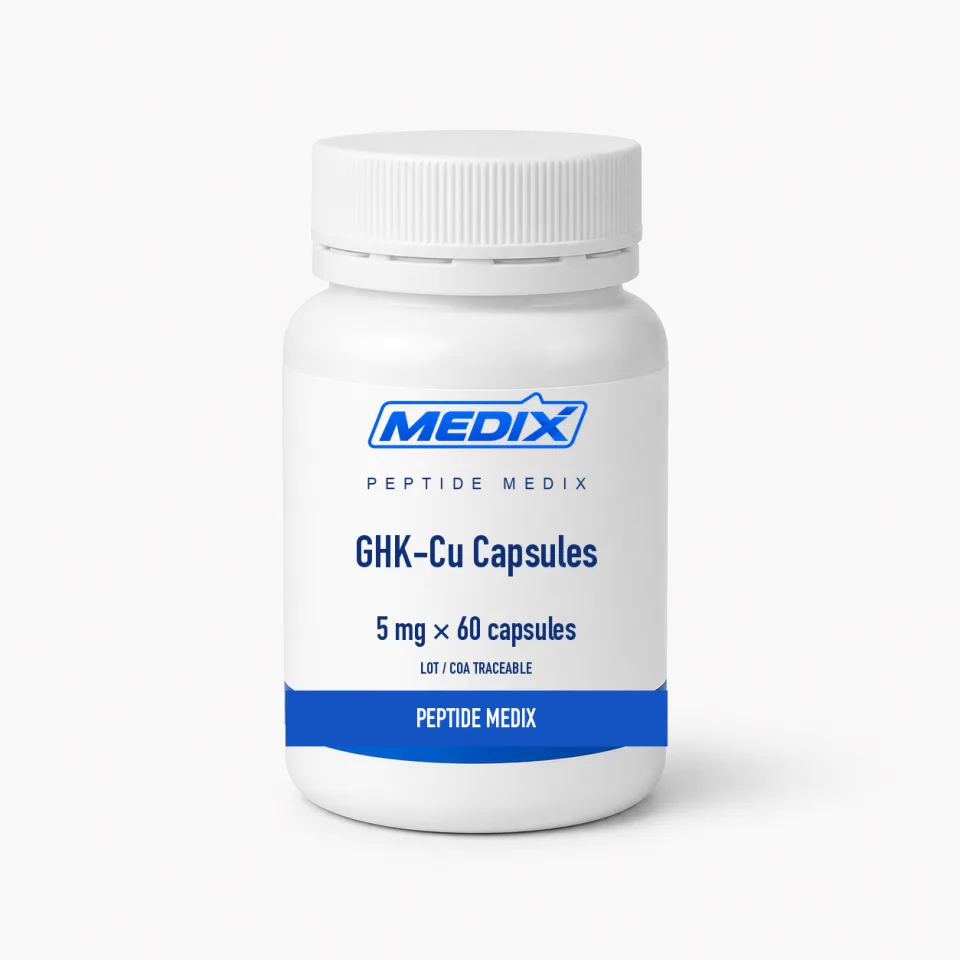
GHK-Cu Capsules
Copper tripeptide in oral capsules — 5 mg GHK-Cu each, 60 per bottle
In stock1 format available
€55
This listing is currently unavailable. Contact us and we will tell you when it is back or suggest an equivalent.
Ask about this listing or request its COA- FormOral capsule in a sealed bottle with tamper-evident closure
- Research areasOral peptide bioavailability, copper transport and homeostasis, matrix remodelling, skin and hair-follicle models
For laboratory research use only. Sold exclusively for in-vitro laboratory research by qualified professionals. Not for human or veterinary use, and not a medicine, food, cosmetic or dietary supplement. Terms and Conditions
Overview
Key facts
These capsules deliver GHK-Cu — glycyl-L-histidyl-L-lysine bound to copper(II) — as a fixed oral unit of 5 mg, sixty capsules to a bottle.
- CAS number
- 89030-95-5
- Molecular formula
- C14H24N6O4·Cu
- Molecular weight
- 403.93 g/mol (copper(II) complex)
- Purity
- ≥99% by HPLC before encapsulation; lot-matched COA available
- Form
- Oral capsule in a sealed bottle with tamper-evident closure
- Storage
- Cool, dry and dark in the closed bottle; refrigeration extends shelf stability
- Available size
- 5 mg · 60 capsules
For research use only. Not for human consumption.
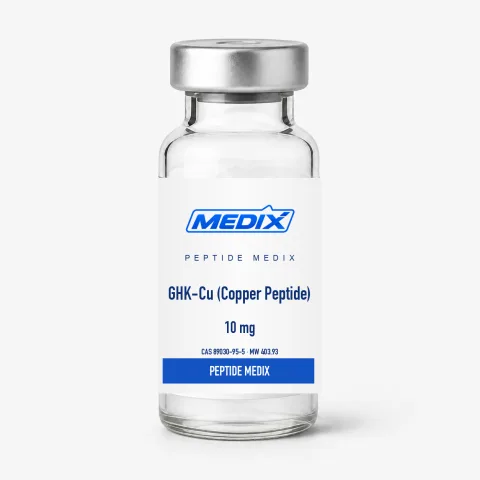
These capsules deliver GHK-Cu — glycyl-L-histidyl-L-lysine bound to copper(II) — as a fixed oral unit of 5 mg, sixty capsules to a bottle. It is the same blue material used in our vials and serums: the histidine ring, terminal amine and a backbone nitrogen form a pocket that holds Cu(II) firmly yet still lets it be exchanged with the cell's copper carriers.
Moving to an oral format alters the research question, not the molecule. A vial can be reconstituted at any concentration and serves cell culture, matrix studies or parenteral dosing in animal models. A capsule is a set amount that travels through the gut, where a small peptide–metal complex meets peptidases, stomach acid and dietary ligands and transport proteins competing for its copper. Whether it passes through intact, splits into free peptide and copper, or is absorbed as fragments remains an open question under active study.
What sets this listing apart
GHK-Cu Capsules – capsules, 5 mg. Oral capsule in a sealed bottle with tamper-evident closure. Other GHK-Cu listings differ in format, fill or combination partners; the specification and COA always refer to the listing you order.
Same compound, other listings
Specifications
Supply & purity
- Form
- Oral capsule in a sealed bottle with tamper-evident closure
Additional detail
- Peptide per capsule
- 5 mg GHK-Cu
- Available count
- 60 capsules
- Active component
- GHK-Cu, copper(II) complex of glycyl-L-histidyl-L-lysine
- INCI name of active
- Copper Tripeptide-1
- Amino acid sequence (active)
- Gly-His-Lys, coordinated to Cu(II)
- CAS number (active)
- 89030-95-5
- Molecular formula (active)
- C14H24N6O4·Cu
- Molecular weight (active)
- 403.93 g/mol (copper(II) complex)
- Peptide purity
- ≥99% by HPLC before encapsulation; lot-matched COA available
- Colour
- Blue powder fill — the colour indicates intact copper coordination
- Research areas
- Oral peptide bioavailability, copper transport and homeostasis, matrix remodelling, skin and hair-follicle models
- Storage
- Cool, dry and dark in the closed bottle; refrigeration extends shelf stability
Questions about GHK-Cu Capsules
How do the capsules differ from the GHK-Cu vial?
Same peptide, different use. The vial is lyophilised powder that you dissolve at any concentration for cell culture or injection studies; each capsule is a fixed 5 mg oral unit aimed at research on gut transit and oral bioavailability.
Does the copper make it through digestion?
That is exactly what remains unknown. Stomach acid, brush-border peptidases and competing copper-binding proteins can all break up the complex. Good studies therefore measure peptide and copper separately rather than assuming the intact complex enters the bloodstream.
Why is the capsule content blue?
Because of the bound copper(II) ion, typical of the intact complex. The colour is a rough qualitative guide — fading suggests dissociation or degradation — but quantitative proof still needs chromatography and elemental analysis.
What purity documents are provided?
The peptide used in production is released at ≥99% by reversed-phase HPLC, and the lot's certificate of analysis is available. Keep it on file to link the encapsulated material to its source peptide lot.
Should copper be considered as a separate variable?
Yes. The body regulates copper closely, and overall copper exposure is a factor in itself. Studies in this field typically add copper-only and peptide-only control arms so any effect can be credited to the complex and not simply to the metal.
Related